
Global Highlights for This Week: AI Trade Faces Key Test as Earnings, Central Bank Decisions, and Mideast Tensions Drive Markets

As the US corporate earnings season enters its peak, global financial markets are bracing for another pivotal trading week.
Tech giants including Alphabet, Intel, and Tesla are scheduled to report their results, subjecting the investment thesis behind US artificial intelligence stocks to a fresh round of scrutiny.
Meanwhile, the European Central Bank (ECB) is set to announce its latest interest rate decision.
Analysts note that against the backdrop of re-escalating Middle East tensions, resurgent international oil prices, and the approaching Federal Reserve policy meeting, three core narratives—corporate earnings, central bank policy, and geopolitics—will collectively dictate the direction of global asset prices this week.
AI Trade Faces a Key Test
Over the past two years, the AI boom has been the primary engine driving US equities higher. The most highly anticipated market catalyst this week is undoubtedly Alphabet's latest quarterly results, scheduled for release after Wednesday's closing bell.
As the world's third-largest publicly traded company and one of the "hyperscalers" investing most heavily in US AI infrastructure, Alphabet serves not only as a barometer for the internet advertising industry but also as a bellwether for AI capital expenditure.
Tech giants such as Microsoft, Google, Meta, and Amazon continue to pour hundreds of billions of dollars into building data centers and procuring AI chips.
This sustained spending has continually benefited companies across the AI supply chain—including Nvidia, Broadcom, TSMC, and Micron—and has been a powerful force propelling US stock indices to successive record highs.
Consequently, rather than the earnings figures themselves, the market will be laser-focused on any updated guidance from Alphabet's management regarding future AI capital expenditure.
Kevin Mahn, Chief Investment Officer at Hennion & Walsh Asset Management, noted that if Alphabet signals any cuts to its AI investment budget, it could trigger a domino effect across the entire AI supply chain, delivering a severe blow to the AI trade.
However, Wall Street consensus currently suggests that a sharp, near-term reduction in AI spending by Alphabet remains unlikely. With OpenAI, Anthropic, and Meta continuously intensifying the competition, Google still needs to maintain elevated levels of capital expenditure to defend its competitive edge in the AI landscape.
In addition to Google, Intel and Texas Instruments will also post their results this week. Compared to previous quarters, the significance of chipmakers' earnings report cards has increased markedly this time around.
Just recently, AI-related stocks underwent their sharpest correction of the year. The Philadelphia Semiconductor Index has tumbled more than 20% from its record high in late June, technically entering a bear market.
This multi-day pullback has also dragged down the S&P 500 and the Nasdaq Composite, snapping their previous streaks of record highs.
Earlier, Samsung Electronics and TSMC posted better-than-expected earnings, yet the market reaction was muted. This indicates that investors have priced exceptionally high expectations into the semiconductor sector, and merely "beating expectations" is no longer sufficient to drive stock prices higher.
Given the substantial weighting the chip sector currently holds in major equity indices, its trajectory has become a critical variable for the broader US stock market.
Furthermore, a heavy concentration of leveraged ETF capital in the semiconductor sector has amplified stock price swings, visibly exacerbating short-term volatility in the AI trade.
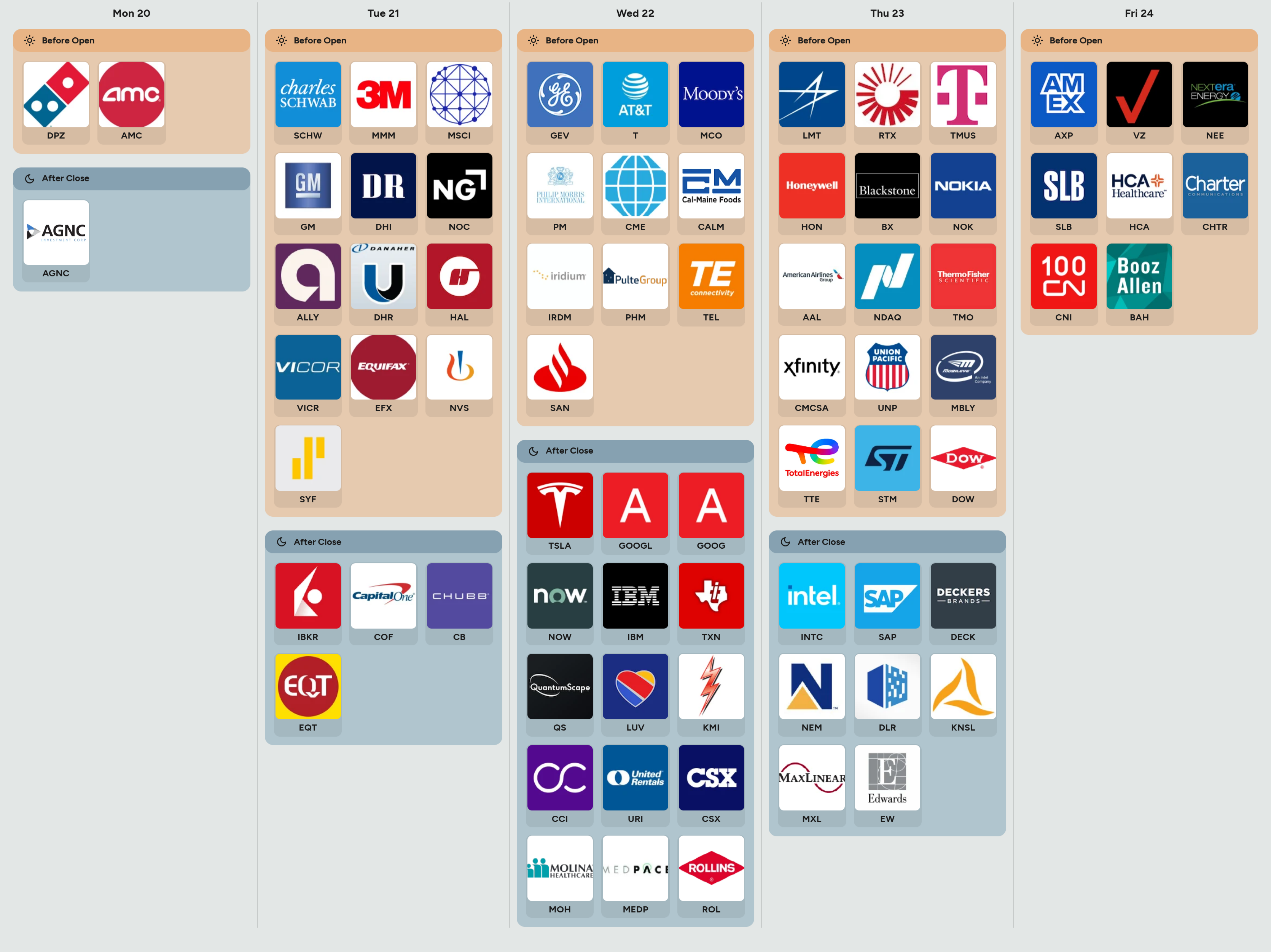
Beyond the technology sector, market data shows that over 80 S&P 500 components are scheduled to report their quarterly earnings this week.
Tesla, a member of the "Magnificent Seven," will also release its latest financial statement. Additionally, leaders in finance and defense, including American Express, Philip Morris, and RTX (Raytheon Technologies), will deliver their scorecards.
LSEG data shows that analysts currently project aggregate Q2 earnings for S&P 500 companies to grow by approximately 26% year-on-year, on track for one of the fastest growth rates in recent years.
Michael Arone, Chief Investment Strategist at State Street, remarked that while the market is constantly buffeted by headlines regarding geopolitics and tariff policies, the underlying support for the stock market's sustained rise remains corporate earnings fundamentals, with listed companies showing robust earnings resilience overall.
ECB Widely Expected to Hold Rates Steady
On the macro front, global economic data releases are relatively light this week. The most closely watched indicators include US ADP private payrolls, PMI, new home sales, and weekly initial jobless claims.
With the recent re-escalation of the Middle East conflict pushing international oil prices higher, the market hopes to gauge through the US PMI data whether rising energy costs have begun to weigh on business activity, and whether the US economy maintains strong growth momentum.
Previously released US CPI and PPI data for June both came in below market expectations, temporarily easing fears of a inflation resurgence and prompting investors to scale back bets on further Federal Reserve rate hikes.
Interest rate futures currently show that traders expect the Fed to hold rates steady at its policy meeting later this month, while the next 25-basis-point rate hike is seen as more likely to occur in December, rather than in September as previously feared by the market.
In Europe, the ECB will announce its latest interest rate decision on Thursday, marking another major focus for global markets. The consensus expectation is that following a 25-basis-point rate hike in June, the central bank will choose to hit the pause button at this meeting.
Recent eurozone inflation data fell short of market forecasts, and significant uncertainty remains regarding the situation in the Middle East.
Consequently, most institutions believe the ECB is more likely to wait for additional economic data before deciding whether to hike rates again in September.
Middle East Tensions Remain the Ultimate Wildcard
Nevertheless, a rebound in energy prices remains one of the ECB's primary concerns.
Should the situation in the Middle East continue to deteriorate and international oil prices approach their previous highs, energy costs could push European inflation back up, increasing pressure on the ECB to tighten policy further down the road.
Recent escalations in tensions between the US and Iran have sparked a rebound in international oil prices. Investors worry that a wider conflict could drive up global energy costs once again, reigniting inflationary pressures.
For now, the broader consensus in the market is that the current round of conflict will not be prolonged, which has kept risk assets relatively stable. However, if oil prices see a rapid advance moving forward, it could not only dent corporate earnings expectations but also force major central banks—including the Fed and the ECB—to maintain tight monetary policy for longer.
Key Macro Events
Monday (July 20): China 1-Year Loan Prime Rate (LPR); Germany June PPI (MoM); Canada June CPI (MoM); US June Conference Board Leading Economic Index (LEI) (MoM); Tokyo Stock Exchange closed for holiday.
Tuesday (July 21): UK June Unemployment Rate; Germany July ZEW Economic Sentiment; Eurozone July ZEW Economic Sentiment; US ADP Private Payrolls Change (Week ending July 4).
Wednesday (July 22): US API Crude Oil Stock Changes (Week ending July 17); UK June CPI (MoM); US EIA Crude Oil Stock Changes (Week ending July 17); Samsung Galaxy Unpacked Event.
Thursday (July 23): China June SWIFT RMB Global Payments Share; Australia June Unemployment Rate (Seasonally Adjusted); US Initial Jobless Claims (Week ending July 18); US EIA Natural Gas Stock Changes (Week ending July 17); European Central Bank (ECB) Interest Rate Decision; ECB President Christine Lagarde holds monetary policy press conference.
Friday (July 24): Japan June Core CPI (YoY); Eurozone July Flash Manufacturing PMI; UK July Flash Manufacturing PMI; US July S&P Global Flash Manufacturing PMI; US June New Home Sales (Annualized); Central Bank of the Russian Federation (CBR) Interest Rate Decision.