
Market Questions the "Musk Premium"

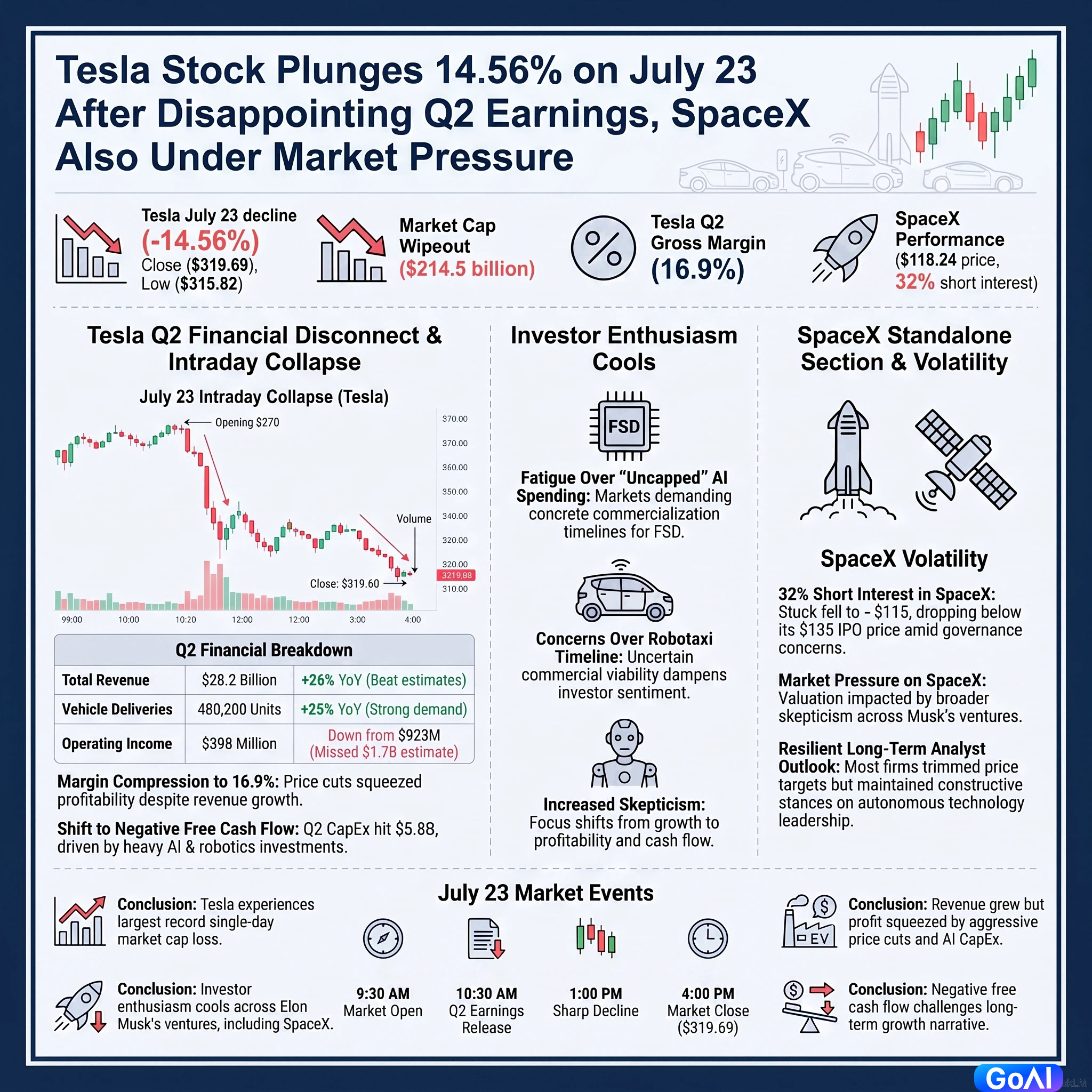
On July 23, Tesla closed down 14.56% at $319.69 per share after touching an intraday low of $315.82.
The single-day loss erased roughly $214.5 billion in market capitalization—its largest drop on record—making it one of the worst performers in the S&P 500 for the session.
Tesla Stock Plunges
Market data shows Tesla’s second-quarter earnings presented a conflicting picture of top-line revenue growth against bottom-line margin pressure.
Tesla's Q2 revenue reached approximately $28.2 billion, up 26% year-over-year and beating market estimates, while vehicle deliveries rose 25% to around 480,200 units (Associated Press).
The top-line figures indicate that demand has not stalled across the board, as EV adoption continues to climb in select overseas markets, with European demand supported by energy pricing and green transition policies.
However, volume growth failed to deliver parallel profit expansion. Second-quarter net income stood at roughly $1.11 billion, translating to an EPS of $0.32 to $0.33, missing Wall Street consensus estimates of $0.53 to $0.55.
Barron's highlighted that Tesla’s quarterly operating income dropped to $398 million, well below analyst projections of $1.7 billion and down from $923 million in the year-ago period.
The profit miss reflects continued margin compression across Tesla's core automotive business. Total gross margin narrowed to roughly 16.9% in Q2, falling short of expectations as price cuts, product mix shifts, promotional incentives, and lower regulatory credit revenue squeezed profitability.
Barron's noted that average realized prices per vehicle fell nearly $2,000 quarter-over-quarter. For a company whose valuation has long priced in high growth and premium margins, this shift suggests its core EV business is gravitating toward the valuation metrics of a mature automaker.
Compounding investor anxiety were shifts in capital expenditure and free cash flow.
Tesla’s Q2 CapEx reached approximately $5.8 billion—primarily allocated toward autonomous driving, AI, robotics, and supporting infrastructure—pushing free cash flow into negative territory for the first time in two years (The Wall Street Journal).
Investor Enthusiasm Cools
In recent years, Elon Musk has repeatedly emphasized the strategic importance of robotaxis, Full Self-Driving (FSD), humanoid robots, autonomous concept vehicles, and proprietary chips—positioning Tesla as a forward-looking technology platform rather than a traditional automaker.
However, Wall Street’s patience appears to be wearing thin following this latest earnings print. Business Insider noted that the simultaneous sell-off in Tesla and Alphabet reflects mounting investor caution toward "uncapped AI capital expenditure."
As companies burn through free cash flow to fund future AI endeavors, markets are demanding concrete commercialization timelines over broad narrative promises.
Broad market headwinds added to the pressure on July 23, with the Dow Jones Industrial Average dropping about 507 points. Rising oil prices driven by geopolitical risk reignited inflation concerns, impacting Fed rate expectations and leaving high-valuation tech stocks particularly sensitive to earnings misses and cash flow strains.
Even so, Tesla's core metrics contain notable strengths: revenue growth remains solid, delivery volumes are holding near record levels, and energy storage and software subscriptions continue to scale. AP reported that global FSD subscribers are approaching 1.5 million, with limited robotaxi pilot deployments underway in several U.S. cities.
Barron's added that several analysts remain constructive on Tesla’s long-term lead in autonomous systems and robotics. While many Wall Street firms trimmed price targets following the report, few issued outright downgrades—indicating that markets are not dismissing Tesla's vision, but rather demanding clearer financial execution on its balance sheet.
Meanwhile, SpaceX—another company led by Musk—rose 2.6% to close at $118.24 on July 23, aided in part by market attention surrounding a scheduled Starship flight test. Nevertheless, the stock has faced sustained pressure in recent sessions.
SpaceX has experienced notable volatility post-listing, falling from above $225 to around $115—dropping below its $135 IPO price. Short interest has climbed sharply to roughly 32% of the tradable float, highlighting widening market polarization.
As of July 23, SpaceX's market capitalization hovered near $1.53 trillion, pulling back from the peak valuations seen during its initial post-IPO rally.
U.S. media outlets observe that investor enthusiasm surrounding Musk’s business empire is undergoing a reality check.
While SpaceX's initial listing sparked enthusiasm for commercial space, Starlink, and orbital AI infrastructure, market focus has pivoted toward operational execution: whether Starship can achieve commercial viability on schedule, if Starlink's growth can support current valuations, whether high CapEx will weigh on cash flow, and if corporate governance and cross-company transactions across Musk's ventures present added risk.