
AI CapEx Concerns Won't Disappear? JPMorgan Maps Out Market Outlook: Tech Takes a Back Seat as Cyclicals Lead

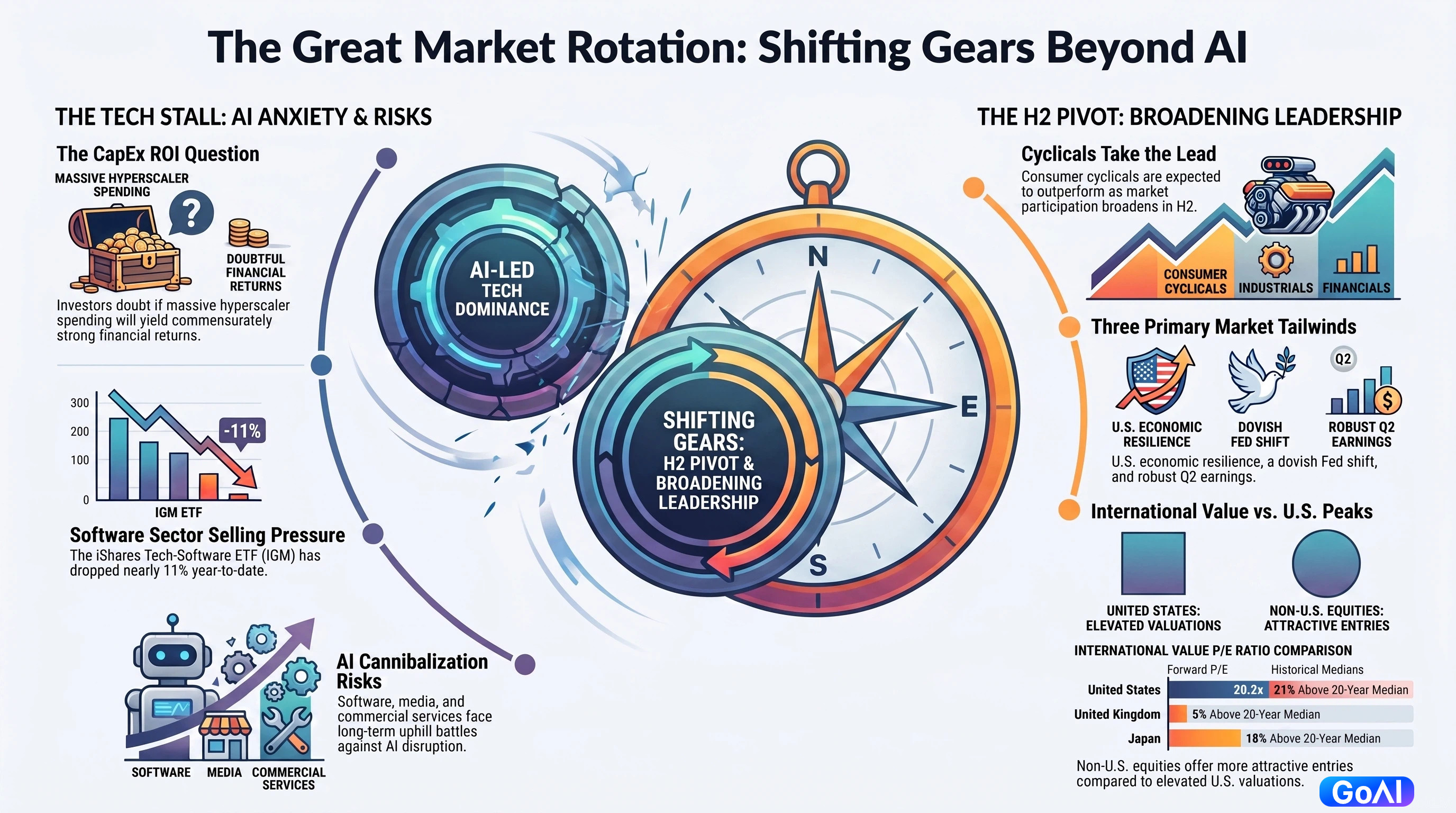
For months, massive capital expenditures have served as a central pillar of the AI-driven market rally, with tech giants committing hundreds of billions of dollars to the sector this year. However, the sheer size of these investments is triggering growing market anxiety.
JPMorgan cautions that investor anxiety surrounding hyperscaler data center outlays and persistent aversion to software equities are likely to endure, meaning tech is unlikely to serve as the primary engine for equity markets in the second half of the year.
In a report released Monday, a team of JPMorgan strategists led by Mislav Matejka noted that tech and AI-related equities are unlikely to repeat their dominant run from the second half of 2025.
A key factor driving this view is the expectation that the "Magnificent Seven"—Alphabet, Amazon, Apple, Meta, Microsoft, Nvidia, and Tesla—will remain burdened by investor skepticism regarding whether soaring capital expenditures will yield commensurately strong financial returns.
The bank's strategists also urged caution, predicting that investors will remain wary of sectors deemed vulnerable to "AI cannibalization," specifically software, commercial services, and media.
"In our view, companies in these space will face a persistent long-term uphill battle, regardless of whether they demonstrate near-term operational resilience against AI disruption," the strategists noted. "That said, given the severe valuation derating already priced in, tactical relief rallies could materialize."
Rotation in Market Leadership
Since January, software equities have faced severe selling pressure on concerns that AI could fundamental disrupt established software business models.
The iShares Expanded Tech-Software Sector ETF (IGM) has dropped nearly 11% year-to-date, while the Roundhill Magnificent Seven ETF (MAGS) has traded essentially flat over the same period.
For now, JPMorgan strategists prefer semiconductor names over hyperscalers and AI-vulnerable sectors, particularly as AI-related infrastructure outlays ramp up. However, they expect cyclical stocks to lead the market higher in the second half, with consumer cyclicals poised for outperformance.
JPMorgan reiterated that market leadership will continue to broaden, highlighting several key tailwinds for equity markets in H2:
-
U.S. Economic Resilience: The domestic economy is expected to remain resilient amid the war with Iran.
-
Federal Reserve Dovish Shift: Strategists expect the Fed to remain "as accommodative as possible." While rate-cut expectations were dialed back following the conflict's outbreak, the Fed could pivot toward a more dovish stance if inflation decelerates clearly over the coming months.
-
Strong Q2 Earnings & International Valuations: Robust second-quarter earnings, combined with attractive international valuations relative to the elevated U.S. market, offer compelling tailwinds. U.S. equities currently trade at a forward P/E ratio of 20.2x—21% above their 20-year median—compared to 5% above historical medians for UK equities and 18% for Japanese equities.
"If our view holds—that market participation broadens in H2, the Iran conflict avoids sharp escalation, and AI monetization doubts persist—non-U.S. equities stand a strong chance of outperforming U.S. markets for a second consecutive year," the strategists stated.
Finally, JPMorgan noted that institutional positioning in crowded trades, such as market-favorite semiconductor equities, has largely de-risked, which should help stabilize prices moving forward.
"Encouragingly, despite a substantial pullback in the momentum factor—with South Korea's KOSPI dropping nearly 40% and the Philadelphia Semiconductor Index sliding 30% over the past 4 to 6 weeks before Friday's surge—global stock indices (MXWO, SPX, SXXP) remain within 1% of their all-time highs," they wrote.