
Wall Street SpaceX Maiden Earnings Preview: Future Guidance Takes Center Stage Over Current Metrics

SpaceX's maiden post-IPO quarterly earnings report is shaping up to be one of the most highly anticipated Wall Street events this summer. However, whether the print will be enough to lure investors back into the battered stock remains an open question.
According to an official company announcement, SpaceX is scheduled to release its second-quarter financial and operational results after the market close on Tuesday, followed by a live audio webcast to discuss the performance.
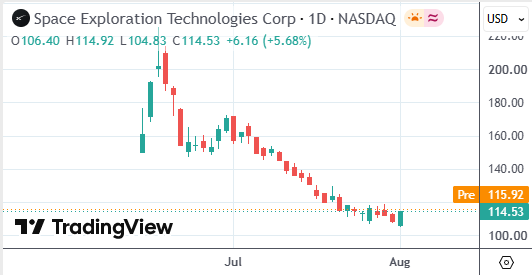
SpaceX debuted in June at an IPO price of $135 per share and has since experienced violent trading swings—initially surging to a peak of $225 before embarking on a sustained downtrend. The stock closed Monday at $114.53, down 15% from its offering price, leaving its market capitalization just above $1.5 trillion.
Q2 Earnings: A Valuation Reset Window
Analysts view the upcoming earnings release as a critical window for investors to reassess SpaceX’s fundamental value. However, because the company remains unprofitable and its business outlook hinges heavily on execution down the road, the print may raise more questions than it answers.
"The entire SpaceX narrative is written in the future; so much has yet to be accomplished—or has simply never been attempted by any company before—that there is very little to offer investors solid comfort right now," said Drew Cupps, head of the 5Perspectives Growth Team and portfolio manager at Polen Capital.
"There is a lack of near-term fundamental support, and you can't look back at the past year's performance to justify today's valuation."
What market participants and analysts will focus on instead is management's latest updates regarding artificial intelligence (AI), Starlink, and core launch operations.
"While SpaceX does not yet possess the clear profitability profile of established tech giants, it commands a portfolio of highly forward-looking, highly capable assets—some of which face no direct competitive alternatives," Cupps added.
Heavy Pressure Weighing on Shares
Compounding headwinds for the stock is a massive wave of upcoming lockup expirations. On August 6, up to 911.5 million shares will unlock, representing over $100 billion in market value based on current share prices.
That supply wave is only the beginning: billions of additional shares could become eligible for public trading before the end of the year. This dramatic influx of secondary market supply threatens to exert persistent overhead pressure on the stock.
Wall Street consensus currently calls for a second-quarter loss of $0.24 per share on revenue of approximately $6.8 billion. Given the company's historically limited disclosures, analysts acknowledge low confidence in their underlying model forecasts.
"I have almost no confidence in these consensus estimates," stated Jim Lebenthal, Chief Market Strategist at Cerity Partners. "To put it bluntly, I feel many analysts are essentially throwing darts at the wall."
SpaceX's primary vulnerability remains its elevated valuation multiples. Trading at approximately 448 times forward 12-month earnings expectations, the stock commands the highest forward P/E ratio in the Nasdaq 100 Index. On a price-to-sales basis, it trades at roughly 26 times forward revenue, ranking among the top ten highest in the index.
The lofty valuation has drawn mounting short-seller interest. Data from S3 Partners shows that short interest as a percentage of float has surged from roughly 18% to 34% over the past month—a level that now surpasses Tesla's short exposure.
Wall Street Maintains Long-Term Optimism
Despite near-term headwinds, Wall Street analysts maintain an overwhelmingly bullish long-term stance. Of the 39 analysts tracked by media consensus, 30 maintain a "Buy" rating, with few trimming their ultra-bullish forecasts post-IPO.
Raymond James analyst Brian Gesuale reiterated his 12-month price target of $800, arguing that SpaceX’s top-line growth trajectory remains on the cusp of exponential scaling.
Morgan Stanley analyst Adam Jonas recently reaffirmed a $300 price target, noting that trading near the $100 mark effectively prices SpaceX’s entire AI infrastructure business at zero—offering a highly compelling entry point.
Meanwhile, Bernstein analyst Douglas Harned advised institutional investors to look past single-quarter variance and focus on management's conviction in long-term expansion.
"We believe the quarterly numbers themselves are secondary; what truly matters is the degree of confidence management projects regarding the company's growth trajectory," Harned’s team wrote in a note. "Investors should look past short-term stock volatility. In our view, the company's path toward a multi-trillion-dollar valuation is a matter of 'when,' not 'if,' anchored by its orbital data center roadmap."