
Is the U.S. Bull Market Near a Reversal? BofA Points to Midterm Elections as Key Turning Point, Advises Gold as Hedge

Bank of America has issued its latest warning that the U.S. stock market bull run could encounter its next major hurdle in the final months of the year.
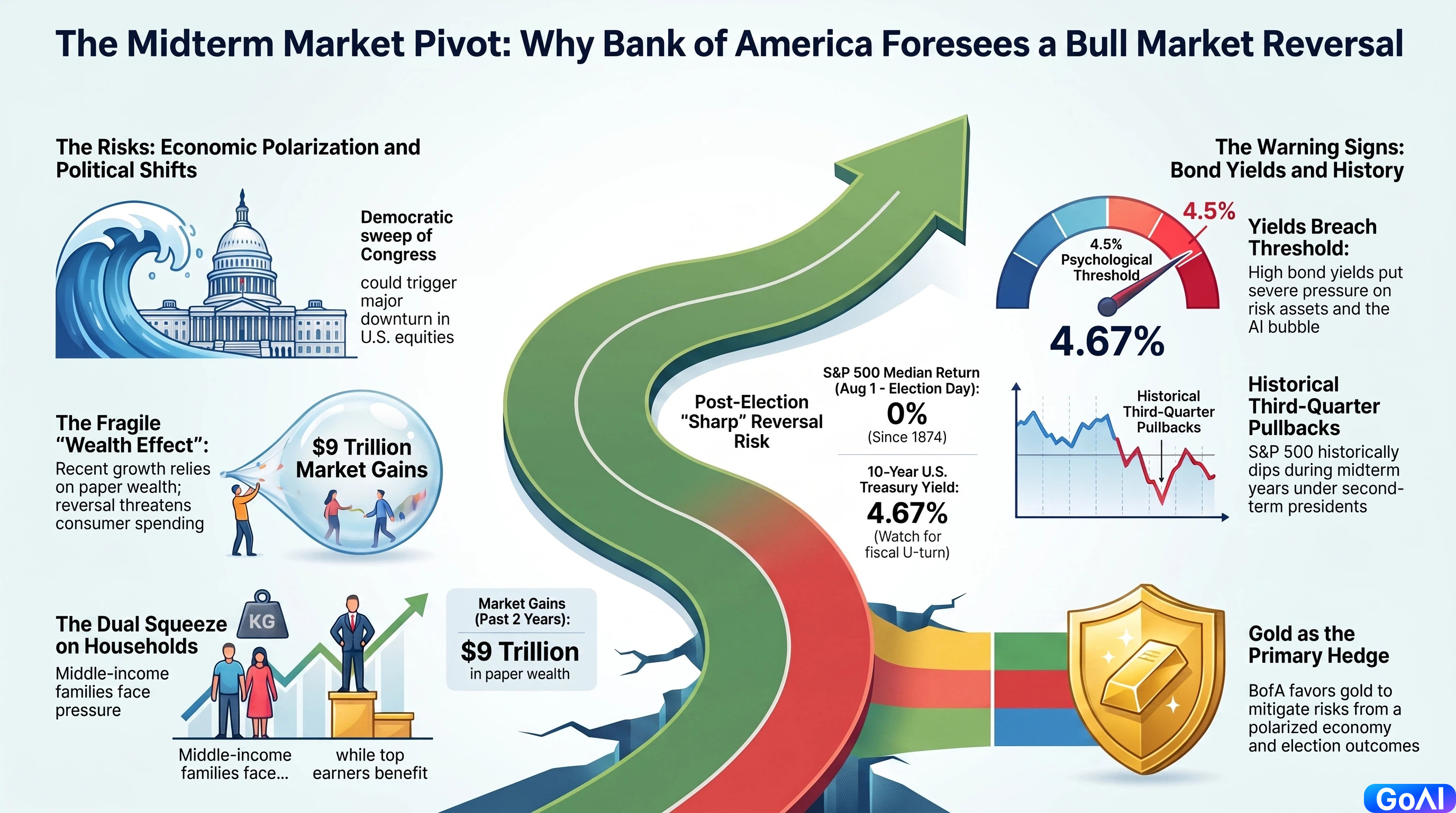
In a recent research note, a team of BofA strategists led by Michael Hartnett highlighted a risk of a "sharp" reversal in U.S. equities following the November midterm elections—a scenario that could materialize if Democrats sweep Congress.
The analysts urged investors to steer clear of risk assets in the near term and rotate toward defensive allocations instead.
Hartnett added that Bank of America favors gold as an investment to hedge against risks stemming from a "polarized economy" and the outcome of the midterm elections.
Public dissatisfaction with economic conditions under the Trump administration has been mounting recently, driven primarily by a deepening economic polarization—namely, the widening income gap between high earners and middle- to low-income households.
While top earners have benefited from rising stock portfolios and real estate values, many middle- and lower-income Americans are enduring a dual squeeze from elevated inflation and a cooling labor market.
BofA strategists noted that recent economic growth has been anchored by the wealth effect of rising stock prices, with investors pocketing $9 trillion in market gains over the past two years. A market reversal would pose a threat to broader growth, as shrinking paper wealth could prompt consumers to cut back on spending.
Furthermore, the bank raised the concern that bond yields could push higher amid persistent investor anxieties over inflation and the nation's fiscal outlook. In a bearish scenario, yields could reach levels high enough to put severe pressure on risk assets, potentially triggering a collapse in the artificial intelligence (AI) bubble.
"Bonds terminate booms and bubbles," the strategists wrote. "A bubble ends when a 'high yield, low dollar' combination forces a fiscal policy U-turn, shifting asset allocation from equities into bonds."
They added that rising yields represent a "canary in the coal mine" that they are closely monitoring.
Yields have already begun moving higher on inflation concerns, though the market has tolerated the rise so far. The 10-year U.S. Treasury yield currently hovers around 4.67%, breaching the psychological threshold of 4.5% that investors watch closely.
Bank of America is not alone. Other Wall Street forecasters have also signaled that market volatility could spike as the midterm elections draw near.
Analysts at Oppenheimer noted in a previous report that during midterm election years under a second-term president, the S&P 500 historically tends to experience a pullback in the third quarter.
Similarly, Goldman Sachs strategists pointed out in an earlier note that in every midterm election year since 1974, the median return for the S&P 500 from August 1 to Election Day in November has been 0%.