
What’s the signal? UBS warns of "AI havoc" as tech volatility hits highest level since dot-com bubble

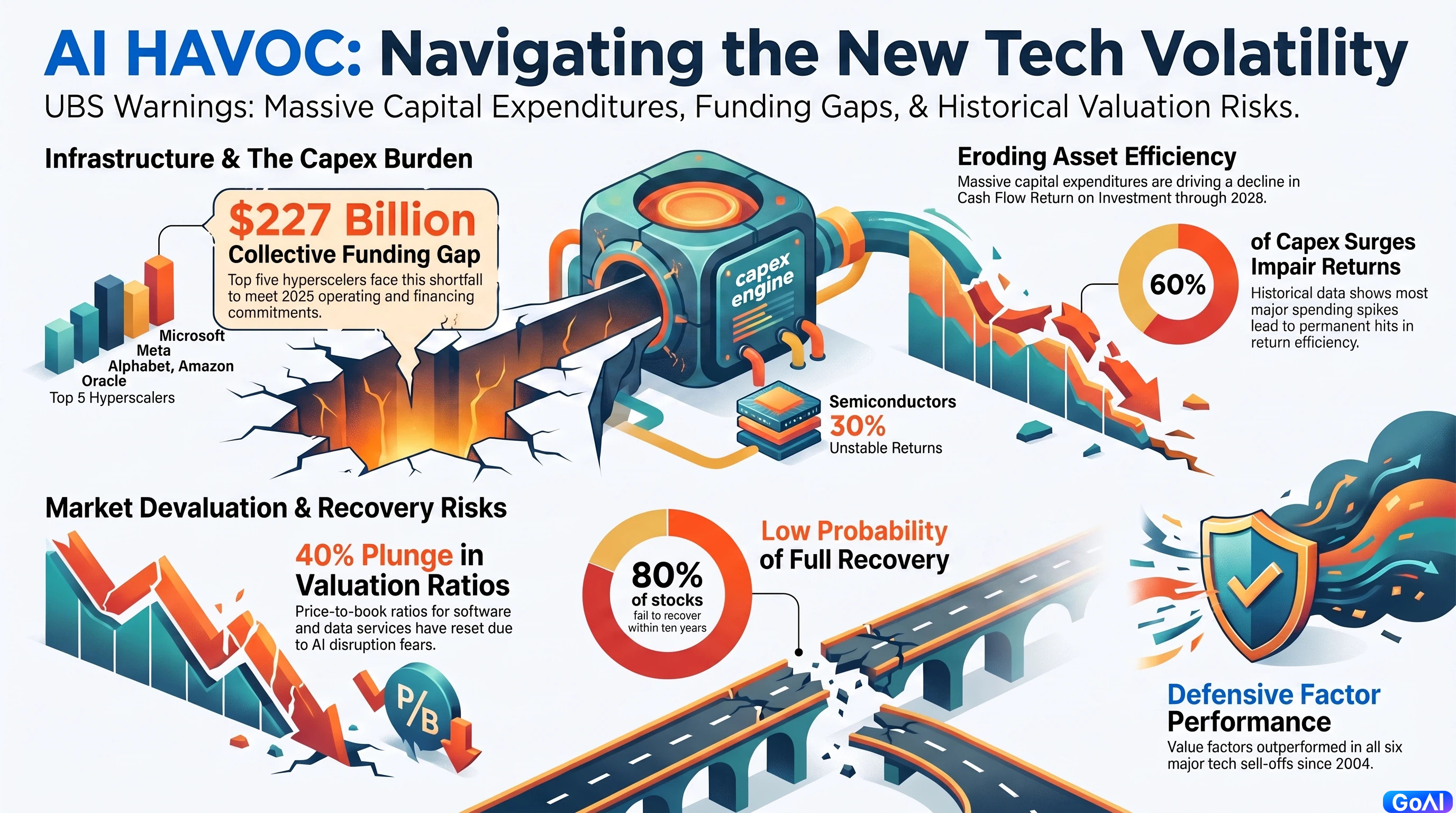
Global tech sector volatility has surged to its highest level since the dot-com bubble burst as investors reassess the long-term cash flow sustainability of AI-driven hyperscalers and semiconductor companies, according to a new report from UBS’s HOLT research unit.
The bank’s analysis highlights that spending on AI infrastructure is imposing a growing burden.
While profit margins remain stable, massive capital expenditures by major hyperscalers are eroding asset efficiency and driving a decline in Cash Flow Return on Investment (CFROI) through 2028.
UBS estimates that the top five hyperscalers—Microsoft, Meta, Alphabet, Amazon, and Oracle—will face a collective funding gap of $227 billion next year to meet their operating and financing commitments.
Historical data shows that out of roughly 650 major capex surges since 1998, 60% led to a permanent impairment in CFROI, with the hit being most pronounced for companies that entered with already-high initial returns.
On the other hand, UBS notes that the semiconductor industry faces a distinct set of risks. The sector’s return on investment has nearly tripled to around 30%—a feat achieved by less than 1% of companies since 1990.
UBS points out that current valuations assume these elevated returns will persist for five years, an assumption that flies in the face of typical competitive dynamics.
The report also cites Chinese AI developers like DeepSeek and Moonshot AI to demonstrate that the industry's so-called "moats" may not be insurmountable, given China's tendency to prioritize market share over profitability.
In addition, valuation multiples for software, enterprise data, and services stocks have reset due to fears of AI-driven disruption, with aggregate price-to-book (P/B) ratios plunging nearly 40% over the past 18 months.
UBS found that historically, 80% of stocks that experienced a devaluation of similar magnitude failed to recover to their prior valuations within a decade.
Finally, looking beyond technology, UBS notes that value and low-volatility factors have historically been the strongest performers during tech-led sell-offs, with value outperforming in all six major sell-offs since 2004 and low-volatility delivering outperformance in four.
However, the bank warns that both approaches face limitations in the current market environment.
The traditional link between value stocks and the economic cycle has weakened, while low-volatility equities tend to underperform outside of sell-off periods unless backed by solid fundamentals.