
"Second Space Age" Accelerates: Goldman Sachs Forecasts $1.8T Space Economy by 2035

From late last year through this summer—particularly surrounding SpaceX's formal IPO—the space economy has emerged as one of global markets' most compelling thematic trades, spanning orbital data centers, SpaceX's first-mover dominance, and Asia-focused aerospace portfolios.
Industry specialists argue that a proven, mass-deployable launch vehicle like Starship will drastically lower launch costs per kilogram, expand the envelope of commercially viable applications, and establish the foundational physical infrastructure required for the broader space economy.
Marking humanity’s entry into the space age following the Soviet Union's launch of the first artificial satellite on October 4, 1957, Goldman Sachs recently published a research report titled The Second Space Age.
The firm projects space is set to become "a new pillar of the industrial economy," catalyzed by declining launch costs, massive private capital inflows, and broad access to public equity financing.
Goldman Sachs analysts project the space economy will reach $1.8 trillion by 2035, at which point private investment is expected to overtake sovereign funding as the sector’s primary growth engine.
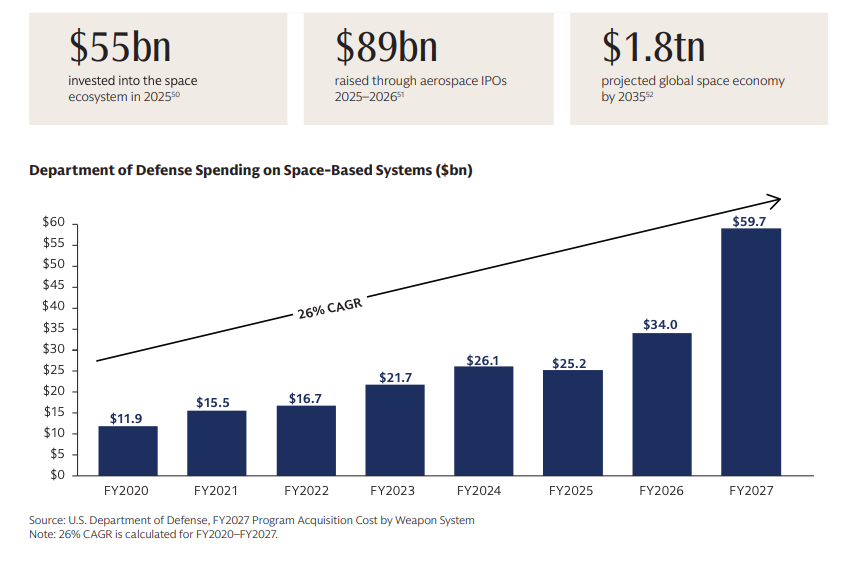
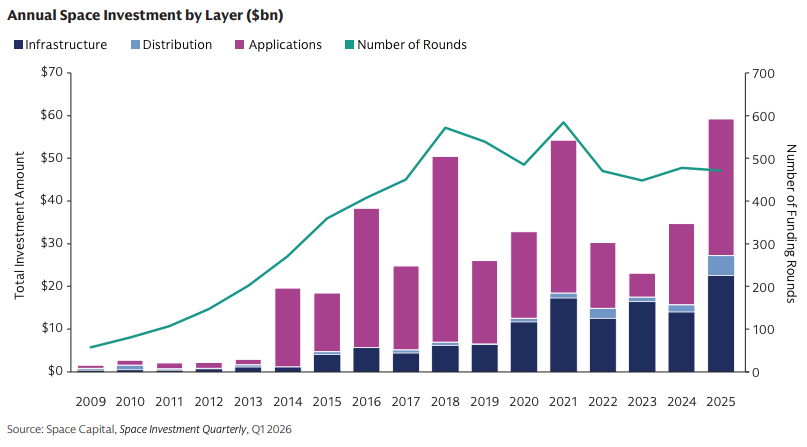
Private capital deployment surpassed $55 billion last year, followed by an unprecedented $36 billion in the first quarter of 2026 alone.
The structural transformation originated in launch economics—historically the sector's most restrictive bottleneck.
In 1981, delivering a 1-kilogram payload into low-Earth orbit (LEO) via the Space Shuttle cost roughly $65,400. SpaceX's Falcon Heavy disrupted that paradigm, driving costs down to approximately $1,500 per kilogram.
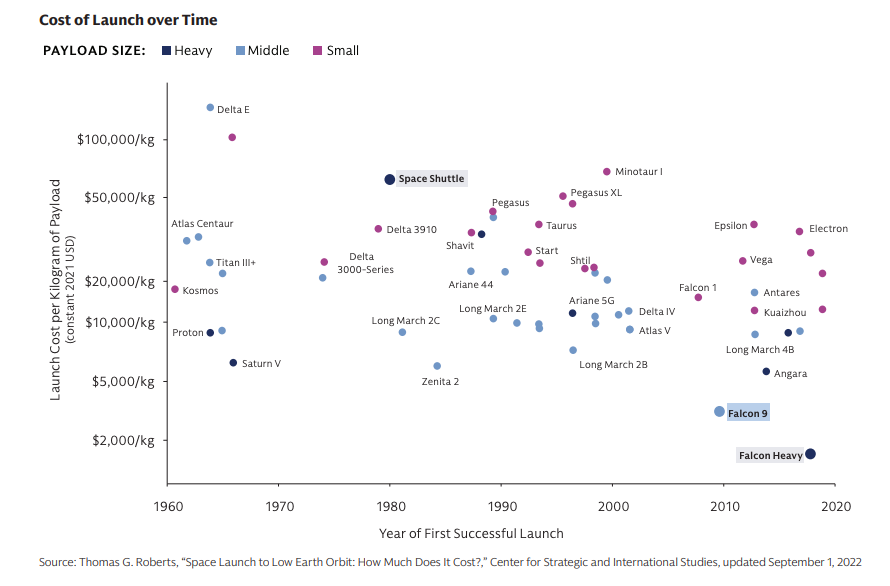
"This dramatic cost reduction stems from the advent of partially reusable rocket boosters—an innovation that transformed the massive fixed cost of rocket manufacturing into an asset reusable across multiple flights," Goldman Sachs analysts noted.
"As more operators move to replicate and refine this approach, launch costs are likely to fall further, broadening access to orbit."
The analysts added: "LEO infrastructure represents one of the clearest commercial beachheads in the modern space economy, actively expanding, complementing, and directly competing with terrestrial networks."
SpaceX stands out as the primary beneficiary. Goldman Sachs estimates that Starlink—supported by a mega-constellation approaching 10,000 satellites—generated over $11 billion in revenue in 2025 as its subscriber base surpassed 10 million.
While Amazon aims to challenge SpaceX's market footprint, its competing constellation remains years behind.
New Frontiers Drive Novel Industries
Goldman Sachs highlights that falling launch costs will transform satellite services, driving commercial maturity across persistent asset tracking, real-time Earth observation, direct-to-cell connectivity, and high-throughput satellite broadband capable of displacing legacy terrestrial links.
With launch costs falling and orbital platforms maturing, significant capability upgrades are imminent:
Positioning, Navigation, and Timing (PNT): Enhancements are set to enable continuous, high-precision tracking across logistics, maritime shipping, and industrial supply chains.
Persistent Earth Observation: Sub-meter resolution with one-minute revisit rates will provide continuous monitoring, complemented by advanced synthetic-aperture radar (SAR) operating through adverse weather conditions.
Direct-to-Cell: Technology is transitioning from emergency messaging and remote telemetry into mainstream cellular connectivity.
Satellite Broadband: LEO constellations are positioned to displace substantial portions of terrestrial fiber and traditional backhaul infrastructure routing traffic to core networks.
The pace of aerospace innovation is expanding beyond baseline communications infrastructure.
The next evolutionary phase is expected to be defined by In-Space Servicing, Assembly, and Manufacturing (ISAM)—a foundational enabler for advanced orbital architectures.
ISAM enables the assembly of orbital structures exceeding launch fairing constraints while allowing satellites to launch with lighter propellant loads via in-orbit refueling.
This also paves the way for microgravity-enabled manufacturing, including orbital biomanufacturing.
Over the long term, space-based resource extraction, space-based solar power (SBSP), and scaled lunar activity could achieve commercial viability.
As these capabilities scale, they provide the operational rationale for a permanent lunar presence, anchoring a broader lunar economy spanning transportation, communications, energy generation, construction, and space tourism.
Orbital compute has emerged as a particularly dynamic focus. While space-based processing has historically supported edge compute payloads, exponential growth in AI inference demands alongside terrestrial datacenter bottlenecks—specifically power constraints, multi-year grid interconnection queues, and regulatory permitting delays—is driving hyperscalers to evaluate space-based architectures.
Sun-synchronous orbits offer access to near-unlimited solar power with fewer zoning constraints. Significant technical hurdles remain:
- Thermal Management: Despite low ambient temperatures, the vacuum environment makes dissipating high-density heat from GPUs difficult, requiring advanced radiative cooling designs.
- Bandwidth & Latency: Feeder uplink and downlink capacities constrain total throughput.
- Servicing & Reliability: The inability to service or replace silicon in orbit poses reliability risks.
- Radiation Hardening: Commercial-off-the-shelf accelerators require structural hardening against solar particle events and cosmic radiation.
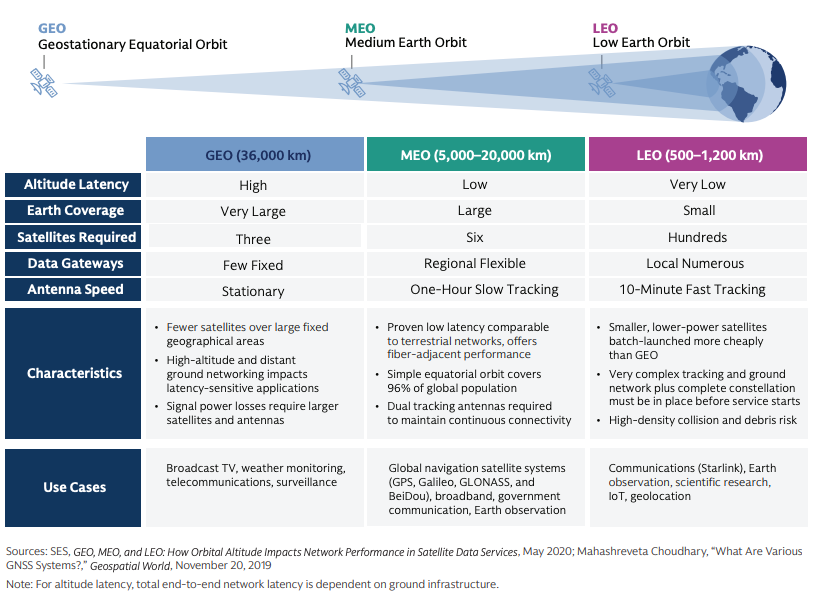
Commercialization also introduces regulatory and operational challenges. The proliferation of LEO mega-constellations has exacerbated orbital congestion. Unlike geostationary (GEO) satellites that cover vast areas from a single orbital slot, LEO constellations require thousands of satellites at lower altitudes to provide continuous coverage.
Sovereign nations and commercial operators are accelerating filings for orbital slots and spectrum allocations, which the International Telecommunication Union (ITU) assigns on a first-come, first-served basis.
While early movers like SpaceX retain significant structural advantages, competition for orbital slots and spectrum priority will intensify.
Orbital congestion reflects a broader institutional governance gap. Goldman Sachs notes that many emerging space activities operate within legal ambiguities.
Clarifying international regulatory frameworks across orbital property rights, spectrum, and traffic management will be a vital prerequisite for unlocking the long-duration capital required for full-scale commercialization.