
Bain Exposes Reality Behind AI Infrastructure Frenzy: A More Than $4 Trillion Revenue Shortfall

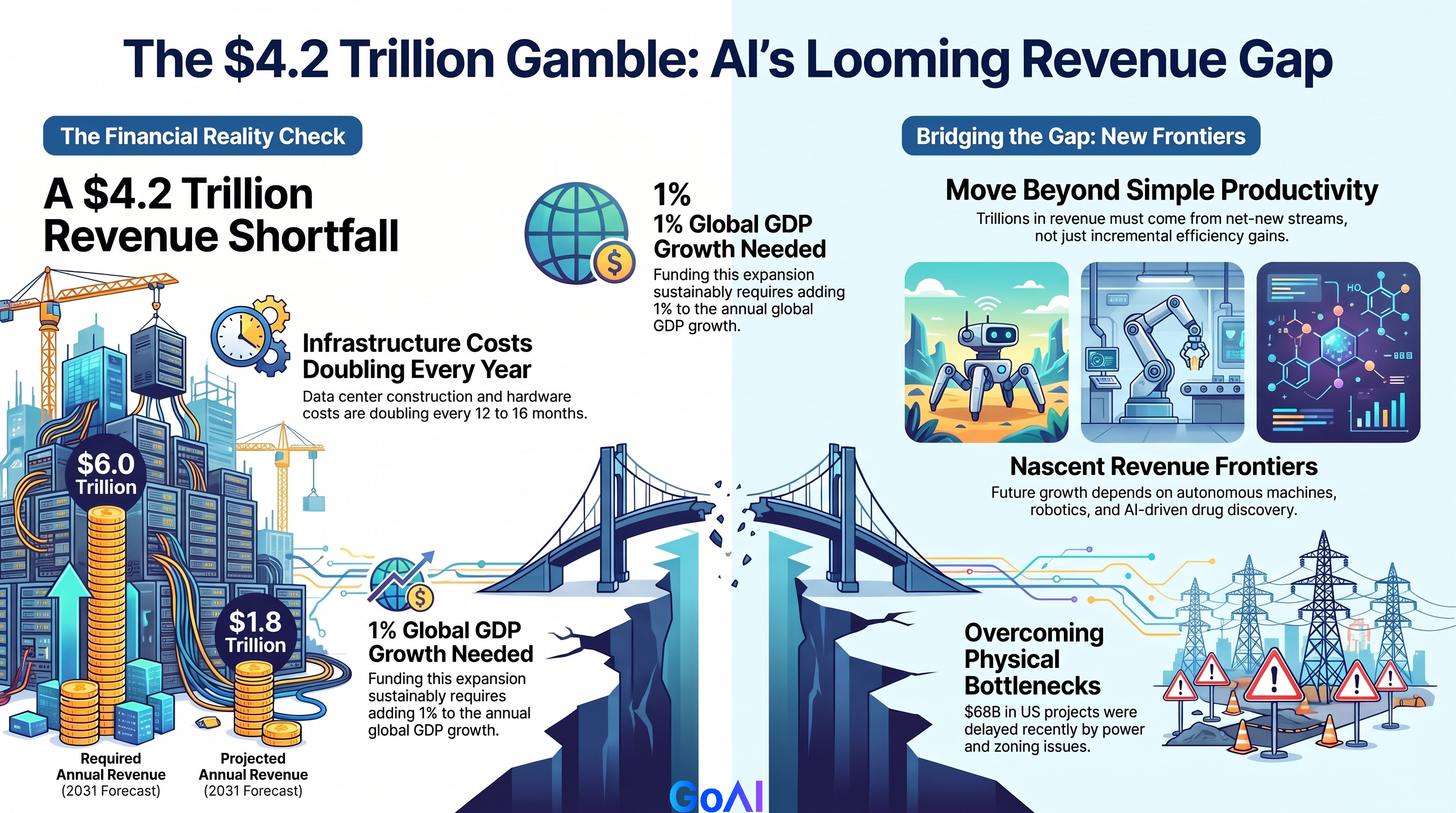
The global artificial intelligence industry will need to generate $6 trillion in annual revenue by 2031 to justify the trillions of dollars pouring into data center construction worldwide, according to a new report from top strategic consultancy Bain & Company.
In its annual Global Technology Report released Tuesday, the firm noted that existing consumer and enterprise AI applications are projected to generate at most $1.8 trillion in revenue, leaving a massive $4.2 trillion shortfall that must be filled by new demand.
The report indicated that this funding gap will likely need to come from nascent frontiers such as autonomous machines, robotics, and emerging domains including AI-driven drug discovery, mental healthcare, and energy generation.
"What the industry needs is a wave of innovation that will dwarf what mobile and cloud unlocked," wrote David Crawford, the report's lead author and Chairman of Bain's Global Technology, Media, and Telecommunications practice.
"AI infrastructure is being built well ahead of the demand curve, and funding it sustainably will require adding approximately 1% to the annual global GDP growth rate."
Bain's findings underscore the mounting hurdles threatening the sustainability of AI's current deployment pace.
Hyperscalers and tech titans led by Microsoft, Google, Amazon, Meta Platforms, and Oracle are pouring trillions of dollars into data center footprint expansion to satisfy exponential compute demand.
The scale and construction costs of these facilities are doubling roughly every 12 to 16 months, fueled in part by surging prices for high-end accelerators, networking hardware, and specialized components supplied by vendors like Nvidia and SK Hynix.
The report lands as the market debate sharpens over unrealized commercial returns among AI service providers.
Skeptics warn that an increasingly circular web of mutual dependency between hardware makers and model developers is inflating elevated expectations, which in turn demand ever-larger capital commitments.
Bain emphasized that while executive discussions remain predominantly focused on workforce productivity, the broader economics of AI infrastructure will require trillions of dollars in net-new revenue streams rather than mere incremental efficiency gains.
The consultancy projects cumulative data center capital expenditures will reach $5 trillion to $6.5 trillion by 2030, bringing at least 150 gigawatts of additional compute capacity online and intensifying structural strain on sovereign power grids.
By 2031, annual spending across the full AI infrastructure stack—spanning data centers, raw compute capacity, accelerators, and advanced memory upgrades—could reach as high as $1.5 trillion per year.
Meanwhile, data center developers are already running into acute bottlenecks, including severe shortages of high-voltage transformers, cooling water, and baseload electricity, alongside fierce local zoning opposition that blocked or delayed $68 billion worth of U.S. projects in the June quarter alone.