
Key Flaw in the AI Growth Thesis: Analysts Question Who Will Foot the Trillion-Dollar Bill

Anthropic's IPO prospectus has delivered another stark reminder to the Street regarding the staggering capital intensity of artificial intelligence.
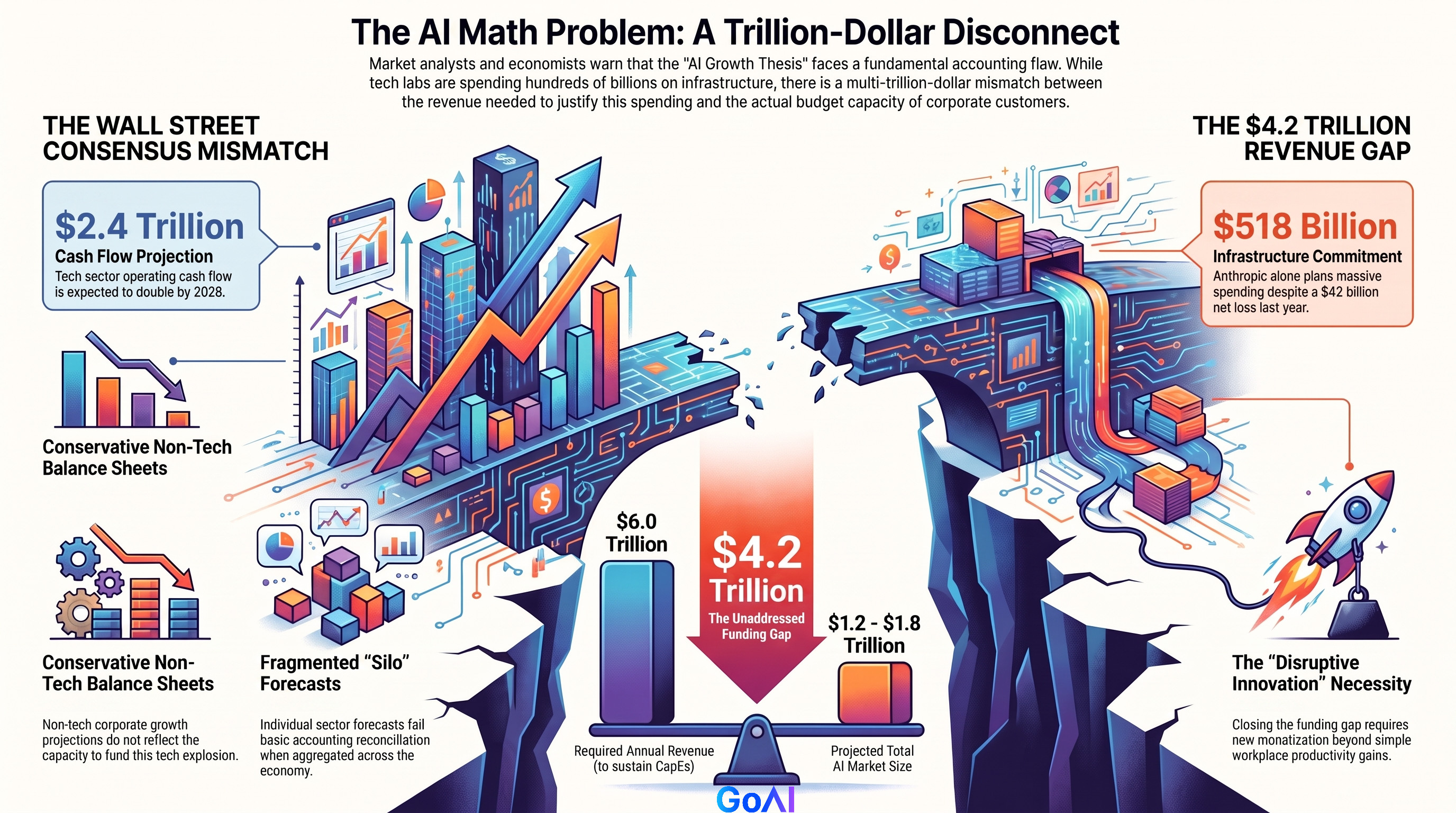
The frontier AI lab is reportedly slated to commit $518 billion over the coming years toward cloud compute, raw capacity, and infrastructure development, set against a net loss of nearly $42 billion over the past fiscal year.
Market observers note that the ultimate success of public debuts for Anthropic and OpenAI hinges on the constructive assumption that corporate customer revenues will eventually outstrip this gargantuan spending. However, the underlying financial math appears fundamentally at odds with itself.
Torsten Sløk, Chief Economist at Apollo Global Management, highlighted this disconnect in a recent research note, pointing out that enterprise customers must generate substantially higher earnings to justify and fund the software licenses and compute fees charged by leading labs. Yet, current Street-wide financial models forecast nothing of the sort.
"Equity analysts operate in sector silos, producing fragmented forecasts that fail basic accounting reconciliation when aggregated," Sløk wrote in his latest note.
Elaborating on the mismatch, Sløk noted: "Wall Street consensus expects technology sector operating cash flow to more than double by 2028, reaching roughly $2.4 trillion—an expansion of more than $1.2 trillion.
Concurrently, analysts project operating cash flow across the remaining non-tech constituents of the S&P 500—the very corporate base expected to fund this tech adoption—to expand at a significantly more subdued pace."
"In other words," Sløk continued, "the tech sector is aggressively positioned for an exponential explosion in downstream demand for enterprise AI and cloud architecture, whereas the corporate balance sheets responsible for paying these invoices reflect a far more conservative outlook. Both models cannot be right simultaneously."
"At the end of the day, either enterprise clients will generate free cash flow far beyond current sell-side expectations, or forward projections for Big Tech cash flows are drastically detached from reality. This leaves one central question: Who is actually going to sign all these checks for enterprise AI?" he added.
Sløk's critique coincides with a sobering assessment from Bain & Company, which also projected an unprecedented revenue gap relative to the capital required to fund the AI buildout.
A team led by David Crawford, Chairman of Bain's Global Technology, Media, and Telecommunications practice, argued: "Assuming capital expenditures stabilize at roughly 25% of top-line revenue—an ambitious yet defensible benchmark derived from hyperscale cloud economics—the global AI addressable market would need to reach nearly $6 trillion annually to sustain this scale of capital deployment."
The structural hurdle, per Bain’s findings, is that the combined consumer and enterprise AI market is only projected to reach between $1.2 trillion and $1.8 trillion, leaving an unaddressed funding gap of up to $4.2 trillion.
Bain concluded that closing this divide will require radical "disruptive innovation" that extends well beyond incremental workplace productivity gains.
To validate their astronomical capital outlays, hyperscalers and labs are effectively wagering that AI can unlock trillions of dollars in brand-new monetization from commercial frontiers that do not yet exist.