
How Not to Miss the Next MRNA Surge
What Moderna's 177% day taught me about using GoAI to track biotech before the breakthrough.
On August 19, 2026, Moderna announced positive Phase 3 results for its individualized cancer therapy, intismeran, used together with Merck's Keytruda in patients with high-risk melanoma.
The stock closed at $174.38, up from $62.96 the day before—a gain of nearly 177% in a single session.
I am a Moderna shareholder. I knew the cancer-vaccine program mattered, and I viewed my position as a small, venture-style bet on the company's mRNA platform. Yet when the news arrived, I realized I had not been following the story closely enough.
Owning a biotech stock is not the same as tracking it.
I knew the thesis, but not the timeline
Like many investors, I first paid serious attention to Moderna during the COVID-19 pandemic. Then vaccine demand declined, revenue fell, and the stock dropped dramatically from its 2021 high. Earlier this year, I started looking at the company again—not because of another COVID product, but because its mRNA platform might work in cancer.
The early melanoma data looked encouraging. Merck was sharing the development effort, and a Phase 3 result was expected later in 2026. I understood the broad opportunity, but I was not checking trial records, enrollment updates, interim analyses, or changes in management's guidance.
The Phase 3 announcement made that gap impossible to ignore. Moderna and Merck said the INTerpath-001 trial met its primary endpoint of recurrence-free survival and a key secondary endpoint of distant metastasis-free survival. The result mattered not only for one medicine, but also as late-stage validation of an mRNA-based individualized cancer therapy.
The market reacted instantly. I reacted later.
The question I asked GoAI
After the surge, I described the full situation to GoAI and asked:
If I don't want to miss the next MRNA, what should I do?
GoAI suggested looking beyond a single drug and asking whether a company has a reusable technology platform. It also highlighted signals that ordinary investors can understand without a medical degree:
- Strong Phase 2 efficacy data before a pivotal trial
- Validation from an experienced pharmaceutical partner
- Trial enrollment and completion dates
- Planned interim analyses
- Topline results and regulatory decision dates
The most valuable part came from my follow-up. Instead of asking GoAI to name another stock that might jump 177%, I asked it to build a clinical-development timeline for Moderna and keep it updated for me.
That changed the conversation from stock picking to research infrastructure.
From a one-time answer to an ongoing research system
Together, we set up two simple tools inside GoAI.
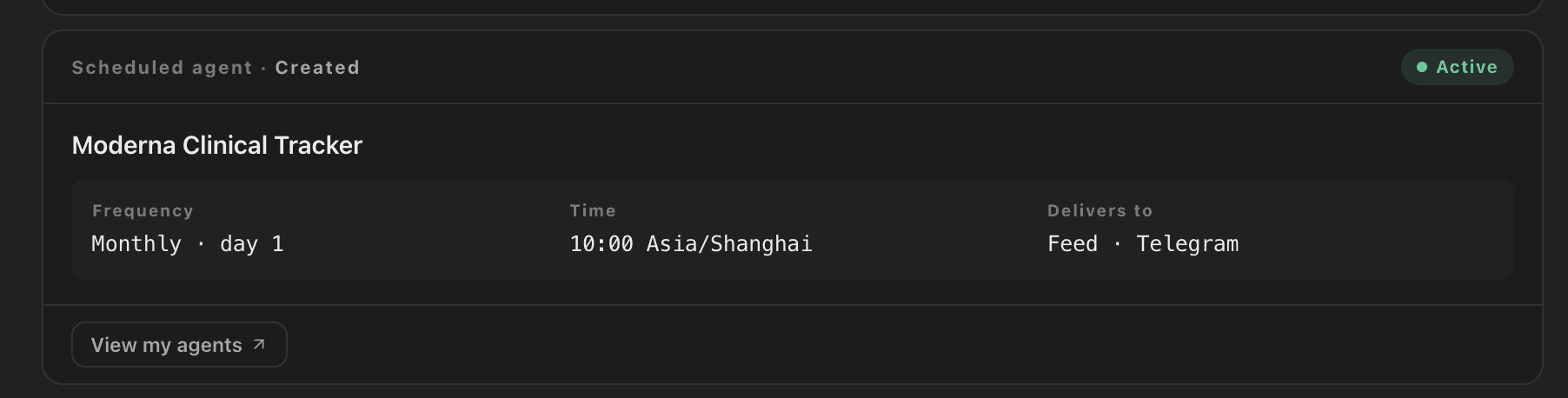
1. A recurring Moderna Clinical Tracker
The monthly tracker follows selected parts of Moderna's pipeline, including its Phase 3 norovirus vaccine program and additional cancer-vaccine studies. It looks for trial enrollment or completion, timeline changes, interim analyses, topline results, new safety or efficacy data, regulatory decisions, and important catalysts expected within the next 30 to 60 days.
The update is delivered through my GoAI feed and Telegram. GoAI does the repetitive monitoring; I decide what the new information means for my investment thesis.
2. A condition-triggered volatility alert
I also created a one-shot alert for a 10% move in either direction from MRNA's activation price.
The alert is not a trading strategy. It is an attention trigger. When a biotech stock moves that much, a clinical result, safety issue, regulatory decision, financing event, or sharp change in expectations may be behind it. The next step is always research.
That distinction matters. The session after Moderna's 177% surge, the stock closed 23.55% lower. In biotech, good science, valuation, positioning, and short-term price action can all pull in different directions. An alert should bring me back to the facts—not push me into an impulsive trade.

What changed in the way I use AI
Before this experience, I mainly thought of an AI investment assistant as something I could ask when I needed an answer. Now I see a more valuable use case: giving AI responsibility for research tasks that are important but easy to neglect.
A clinical program may go quiet for months. The important clue may appear in a trial-registry update, a quarterly presentation, a conference abstract, or a press release published before the market opens. Remembering to check all of them consistently is the real challenge.
A persistent AI workflow can keep the original thesis in context, monitor the same milestones over time, summarize what changed, flag approaching catalysts, and notify me when unusual price action suggests that something happened.
This does not remove clinical or investment risk. It reduces a different risk: being interested in a company without actually following it.
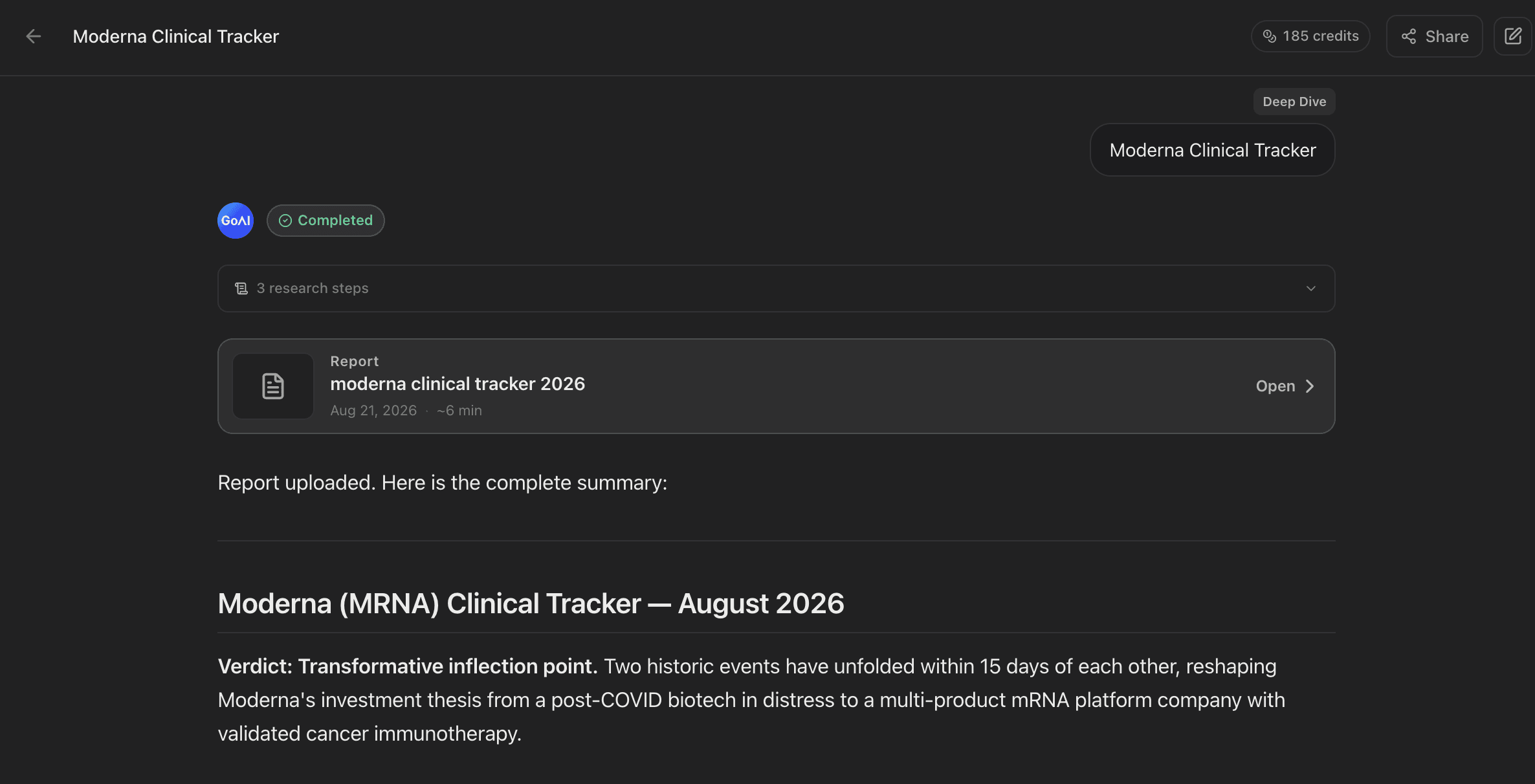
I ran the tracker once immediately after creating it. GoAI completed three research steps and returned a six-minute report with a concise verdict and the evidence behind it.
A prompt you can reuse
This is the simple template I now use for other biotech companies:
The real lesson from Moderna's historic day
The lesson from Moderna's surge is not to search for a biotech lottery ticket. It is that curiosity without a tracking system is fragile. I noticed the company, understood the technological promise, and held the stock. What I lacked was a process that could stay attentive when I could not.
GoAI turned that reflection into something practical: a clinical tracker, a catalyst window, and an alert that brings me back when the market says I should pay attention.
No tool can guarantee that I will catch the next MRNA before the market does. But the next time I invest in an innovative drug company, I will not just own the thesis. I will have a system for following it.
Turn your next question into a workflow
Build trackers, alerts, and deep-dive research around what matters to you.
Start Exploring with GoAIMore articles
Endowment Effect: What Is It and How to Overcome It?
Imagine holding onto a beloved old shirt that's seen better days—its frayed edges and faded colors hardly justify your emotional attachment. Yet, you cling to it because it's yours. This quirky human tendency, known as…
Anchoring in Investing: How to Recognize and Overcome This Common Pitfall
Imagine you're at a yard sale, eyeing a vintage guitar. The seller mentions it was once worth $1,000, but now they're asking $300. Are you tempted? At this moment, you might fall into the trap of anchoring bias. That…