
Coinbase = Coin + Base

When I was a kid, I read the Japanese manga Dragon Ball. Goten and Trunks were both average in strength, but after they merged, their strength increased dramatically. 1+1>2, and they almost defeated Majin Buu.

The same thing is happening with Coinbase. Coinbase's code in the secondary market is $Coinbase Global(COIN)$ "coin". This name is very good. Its revenue comes from many sources, but the main revenue comes from transaction fees, that is, the commissions generated by spot trading on the exchange. This part accounts for two-thirds of the total income. If we look at the growth, this part is also the fastest growing business.
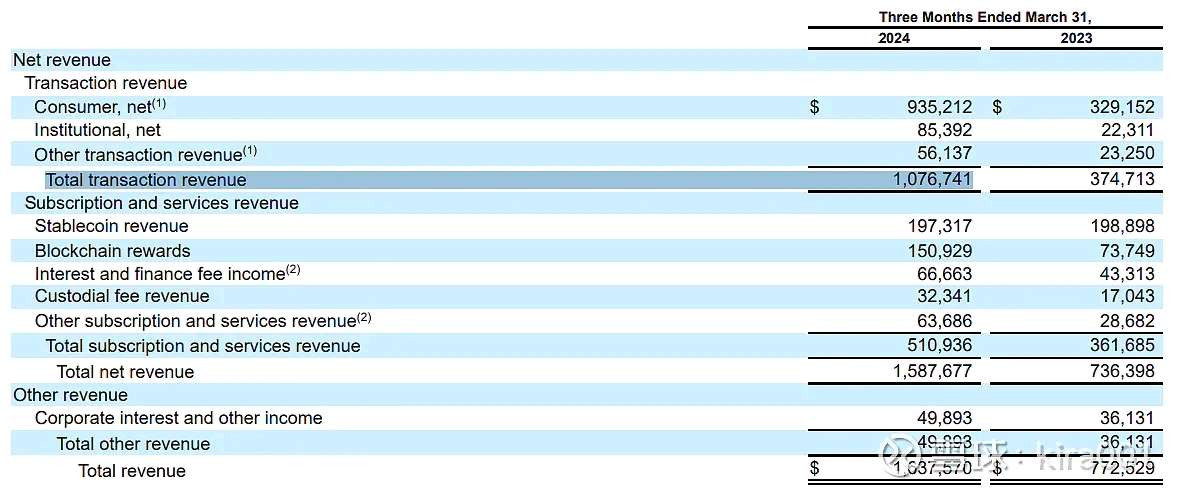
Consumer and institutional are very easy to understand. They are the transaction fees of retail investors and whale institutions. Retail investors have low transaction volumes (accounting for 18%), but the income generated is higher. 87% of transaction revenue is contributed by retail investors (poor retail investors like most of us, who have to pay more commissions while being cut off 🤧), so for COIN, retail investors are their real breadwinners.

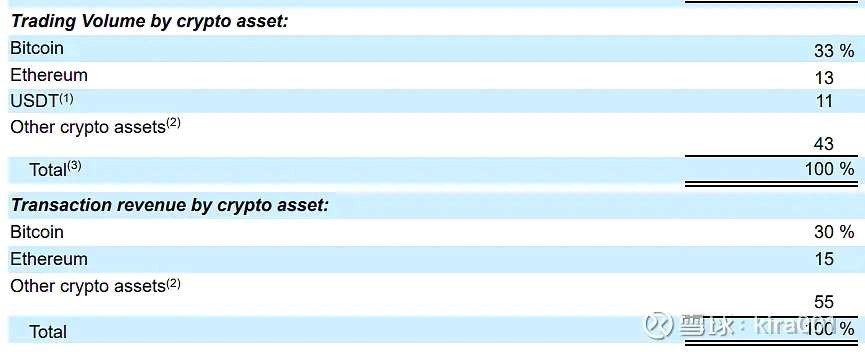
From the perspective of trading currencies, we can find that the majority of revenue is contributed by Bitcoin and ETH, but what is interesting is that Bitcoin accounts for 33% of the trading volume, but only contributes 30% of the revenue. On the contrary, the trading volume of other cryptocurrencies accounts for 43% but contributes more revenue (about 55%). This can be understood as the market value of other currencies is small, but the number of transactions is frequent, so they can bring higher revenue. On the contrary, Bitcoin is generally HODL, and it is difficult to generate commissions without trading. So back to the CME's involvement in Bitcoin spot trading business, I personally think it is a long-term positive for coin. Through CME, Web3 can be further promoted, attracting more retail investors (retail investors are the main contributors to revenue) to join the game, and then continue to trade other cryptos in Bitcoin or US dollars in coin. (After all, every retail investor has the dream of getting rich overnight, so they are more willing to trade undervalued cryptos on the market)
The current valuation of coin mainly comes from the trading part. How much this bull market can rise depends on the future of the entire crypto volume, but today I want to talk about the second growth engine of coin, which is likely to further push up the valuation of coin in the future.
Looking back at the revenue in the financial report, we can find that there is an other transaction revenue under transaction revenue, which is also growing very rapidly. It is the fastest growing business besides the retail and institutional transaction fees mentioned above. So, what is this part?
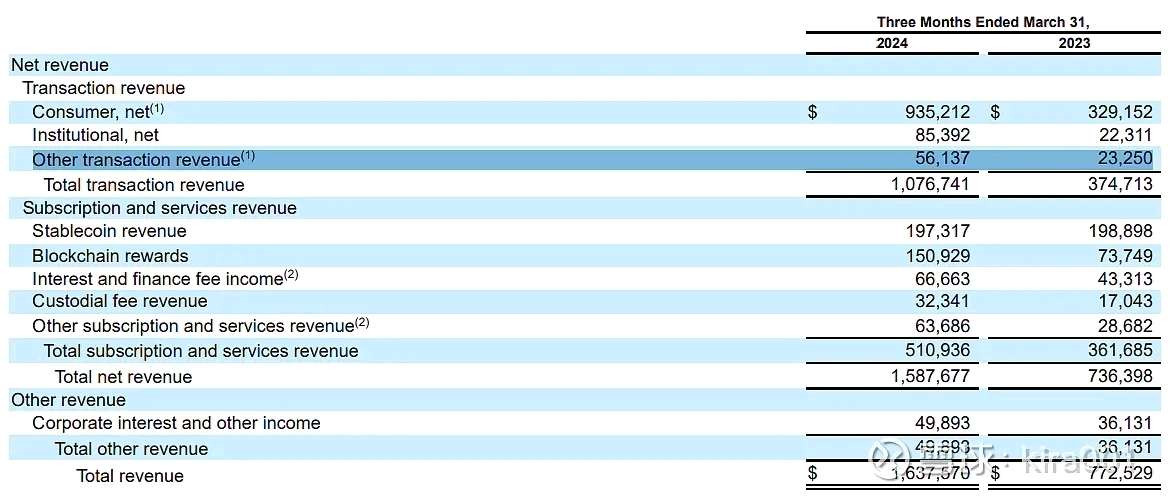
The financial report explains that this part is the revenue of coin's "base" network. Base is simply based on the layer 2 network of Ethereum.

In the web3 world, Ethereum is the largest public chain, followed by Solana. There are many layer 2 networks on Ethereum, and base is one of them. So who is the real king among these layer 2?
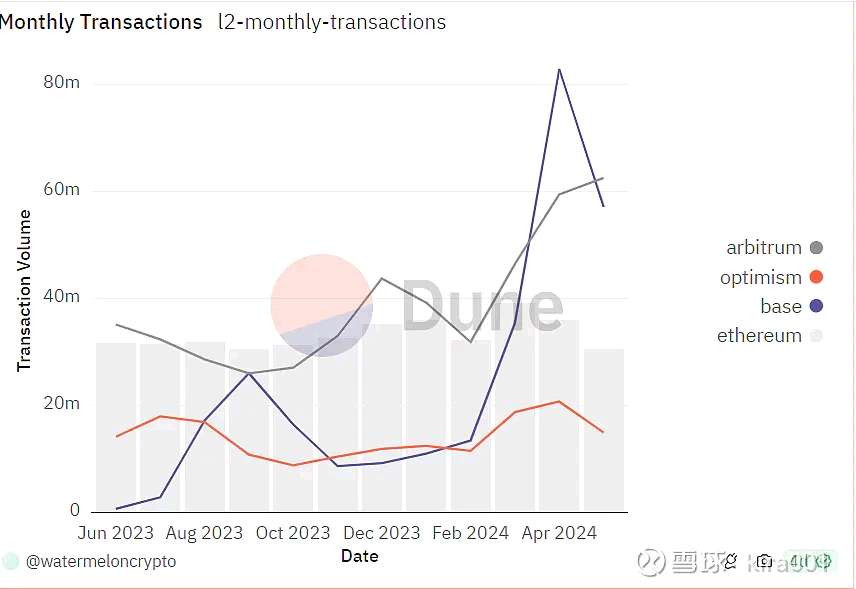
Trasanction is a good indicator. It can be seen that the monthly transaction volume of base has been closely following the layer 2 leader ARB, and for a short period of time it even surpassed arb (ARB's fully diluted market value is about 10 billion)
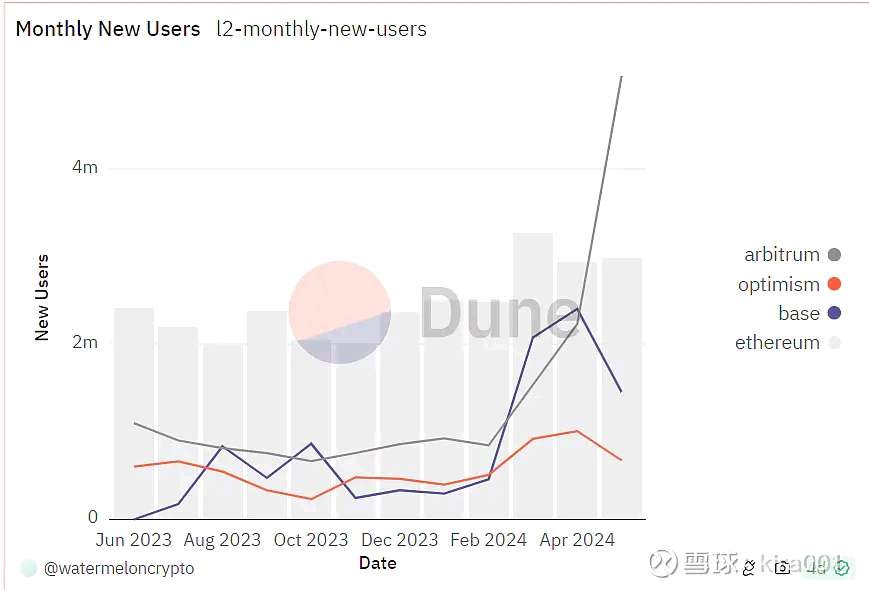
It also ranks second in terms of new users every month, and second in terms of active users. You should know that base is the only layer 2 that does not issue airdrop. When other public chains issued coins in the early days, they invested a lot of marketing costs to attract users, attracting many new users to brush data to get free coins (commonly known as airdrops in the industry), while base users have actually grown.
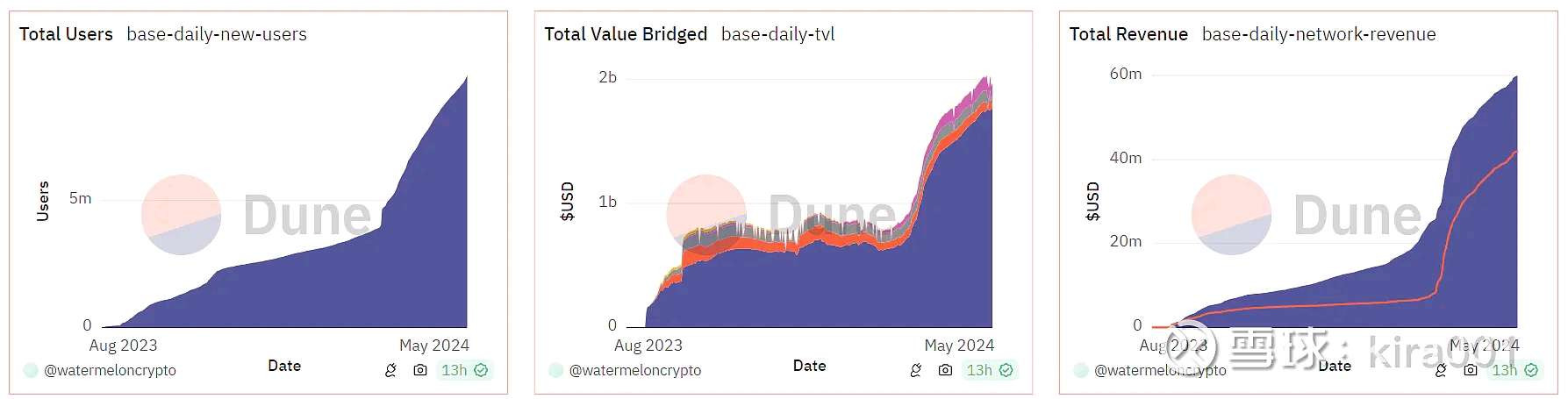
Looking back at the situation of BASE itself, it can be found that base is still experiencing a period of rapid growth. Since it went online in Q3 last year, it has maintained rapid growth in terms of user numbers, bridge value and revenue.
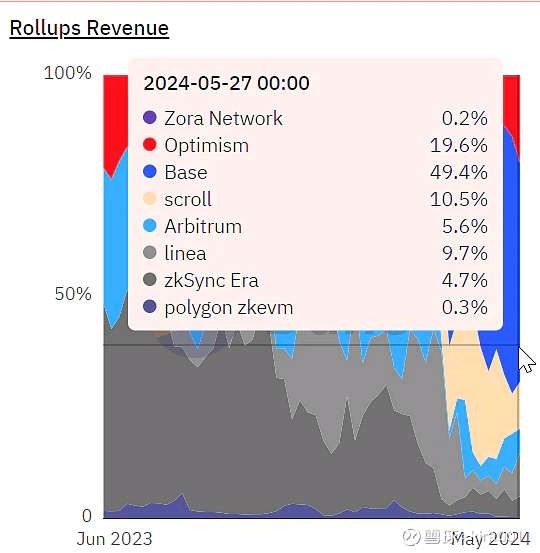
What's more interesting is the two parts of revenue and profit. It can be found that although base is the second, nearly half of the revenue is taken by it! Other players don’t seem to make much money.
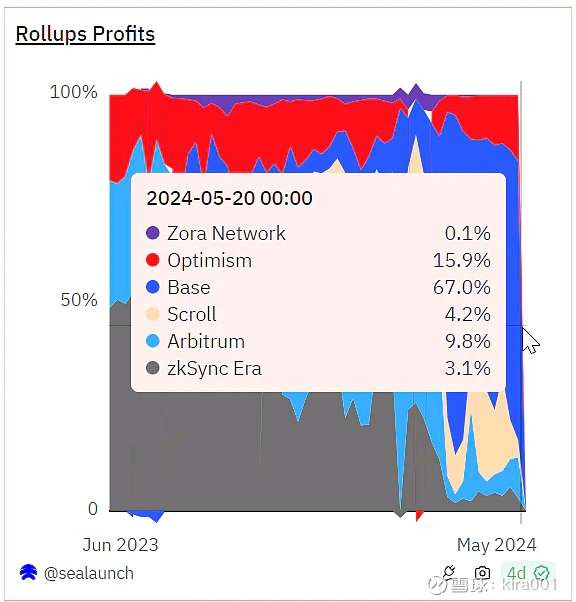
So what about the profit side? This part is even higher, accounting for 67%! Does this mean that they don’t want other players to survive? Calculate that Base’s profit margin is about 70+%, which is very high!
It’s hard to say how much revenue this part can generate in the future, but I think it is very likely to create another coin! And because of regulatory reasons, Base is unlikely to be split out and issue coins again, so this part of the revenue will continue to be reflected in the coin’s financial report, contributing valuable PE.