How to invest in individual stocks

In the community, I mainly talk about indexes and rarely talk about individual stocks, because individual stocks have many disadvantages compared to indexes, but I know that few people can resist the temptation of individual stocks (including myself). Today, I will briefly talk about my personal logic of holding individual stocks and give two examples.
I usually hold individual stocks from three perspectives
Corporate life
People usually pay the most attention to the ability of enterprises to make money, but few pay attention to the life of enterprises. It can be said that the biggest disadvantage of individual stocks compared to indexes is life. In a sense, the index has an infinite life. For example, the demise of individual stocks will be dynamically eliminated by the index, and new blood will be added, which has almost no impact on the overall index, but individual stocks are different. Since 1985, the average life of US stocks has been 14.5 years, and the median is only 8.9 years. Most companies are either acquired or delisted.
This is the biggest tail risk of holding individual stocks.
Correlation
The reason why we hold individual stocks is that some individual stocks can create very low correlation with the index due to their unique business model, providing a low-correlation diversified hedge for the entire portfolio. If the correlation between individual stocks and the index is very high, then the best way is to use the index instead of individual stocks.
Excess returns
This is easy to understand. The purpose of holding individual stocks and taking more risks is to have better risk compensation. It is a commonplace that all excess returns can be explained by innovation and monopoly. Innovation is unstable. For example, if you only hold innovative companies, except for a few companies that go against the sky, you are unlikely to outperform the Nasdaq because people cannot predict the future. But monopolies are relatively more stable, so when I want to achieve excess returns through individual stocks, I prefer to hold monopoly companies.
Let's use specific examples to illustrate.
Example 1: TPL
https://www.google.com/finance/quote/TPL:NYSE
Corporate life: TPL is a company founded in 1888, or in a sense, TPL is not a company at all. All TPL has is 880,000 acres of land, but there happens to be oil underground on this land. In other words, as long as this company is still a landowner in law, its life is unlimited. TPL does almost nothing, just rents land to oil producers and collects commissions based on the proportion of oil production. Recently, it has added some water treatment business. This is a company that even a fool can do well.
Correlation: TPL's income is mainly linked to oil production, that is, energy prices, and energy prices benefit from inflation, which means that inflation is good for TPL. Inflation usually has a negative impact on the index, resulting in a long-term low correlation between TPL and the S&P 500. The current annual correlation between the two is only 0.27. In contrast, the annual correlation between the S&P and the Nasdaq is 0.92.
Excess returns: TPL is the most extreme monopoly among monopolies, a physical monopoly. The earth is big, but there are not many places on the earth with oil, and there are even fewer places where oil is easy to mine. TPL happens to be in the Permian Basin, the world's best shale oil plate. This kind of physical monopoly cannot be replicated. Monopoly leads to massive excess returns for TPL.
Example 2: CBOE https://www.google.com/finance/quote/CBOE:BATS
Corporate life: The full name of CBOE is the Chicago Board Options Exchange. As the name suggests, it is an exchange, but it mainly trades options. To put it more humorously, it is a casino. What are the benefits of opening a casino? As long as there are people playing, the casino will not go bankrupt. Of course, the competition between casinos will also be the survival of the fittest.
Correlation: CBOE's flagship product is a series of volatility indices of VIX. When do people usually pay attention to volatility? When there are major changes in the market, the trading volume of VIX-related products will surge, and CBOE will benefit from the trading volume, so when the market is extreme, it is good for CBOE. Unlike TPL, this correlation tends to be short-term correlation. For example, this week, all assets were shaken by arbitrage, and CBOE rose 1.28% against the trend. The monthly correlation between CBOE and S&P 500 is only 0.29, providing a unique low-correlation hedge.
Excess returns: CBOE almost monopolizes option volatility products. This is like WeChat. The more people use it, the harder it is to replace. Almost all hedge funds will embed various products of CBOE, and this hedging idea is also beginning to penetrate retail investors. For example, the VIXM and SVXY pairing hedges volatility. The underlying products are all CBOE products.
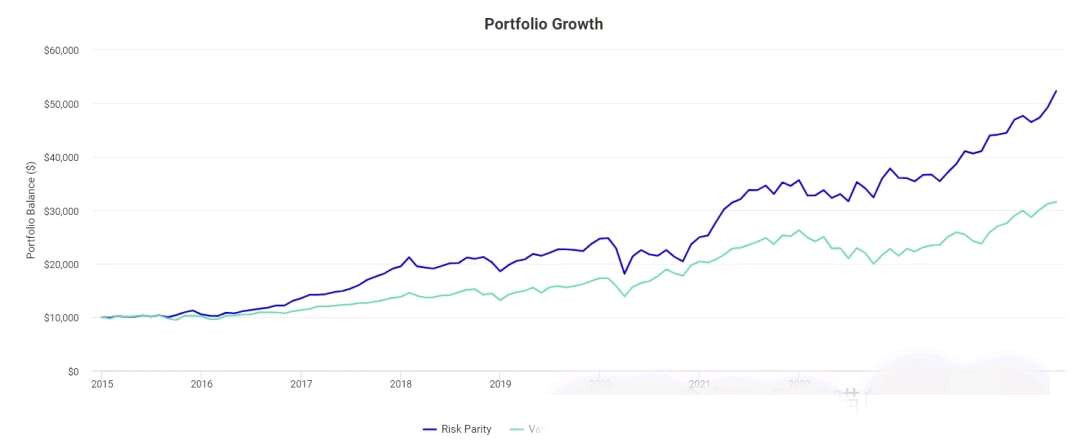
Having talked so much, let's do a simple backtest. Considering the impact of risks, here I use a simple risk parity to hold SPY, TPL, CBOE, and compare it with a single holding of SPY. The backtest is shown in the figure: