
How to Calculate Apple's Intrinsic Value: A Practical Guide Using Benjamin Graham's Formula

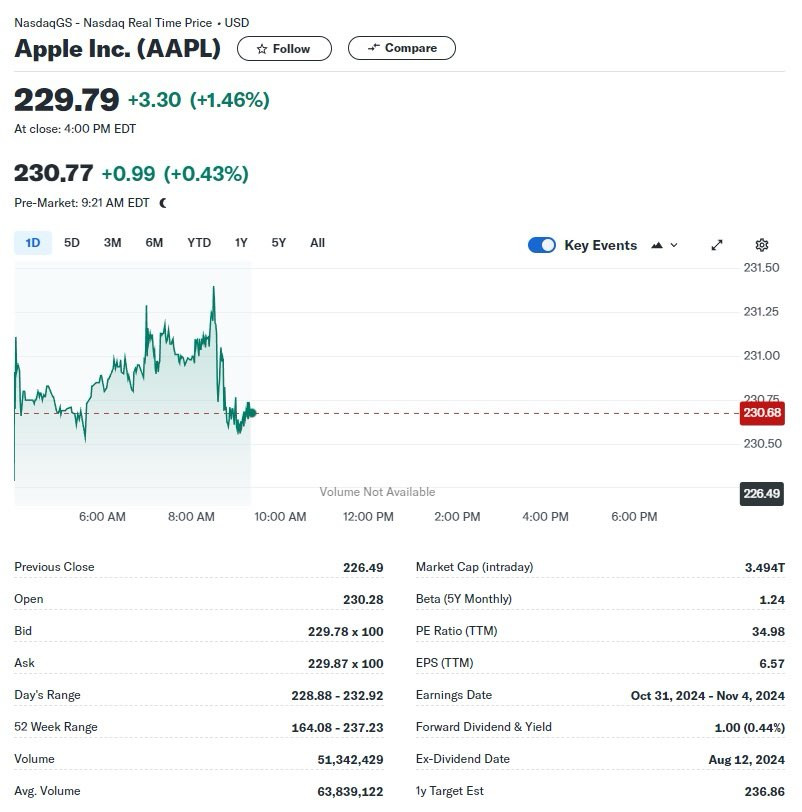
After reading the previous article, you should now have an understanding of Benjamin Graham's intrinsic value formula. (If you haven't read it yet, you can check out the previously published article.) Now, let's apply that theory by calculating the intrinsic value of Apple (AAPL). By the end of this exercise, you'll see how to use Graham's method with real-world stocks to make smarter investment decisions.
Step 1: Gather the Data (Based on August 30, 2024)
To calculate Apple's intrinsic value, we need the following key figures:
Earnings Per Share (EPS):
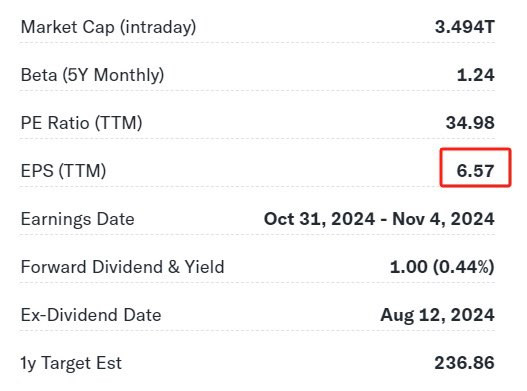
You can find the current EPS on Yahoo Finance. For Apple, the EPS is $6.57.
Growth Rate (Next 5 Years):
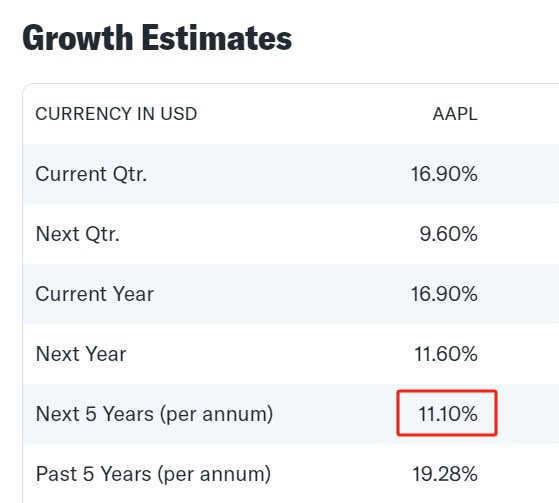
On the same webpage, click on 'Analysis' on the left side and scroll down. You'll see that the growth rate for the next 5 years is 11.10%. If you've reviewed multiple research reports and believe Apple's growth rate is closer to other data, like 10%, you can use that figure instead. However, for this example, we'll use the 11.10% rate.
Current AAA Bond Yield:
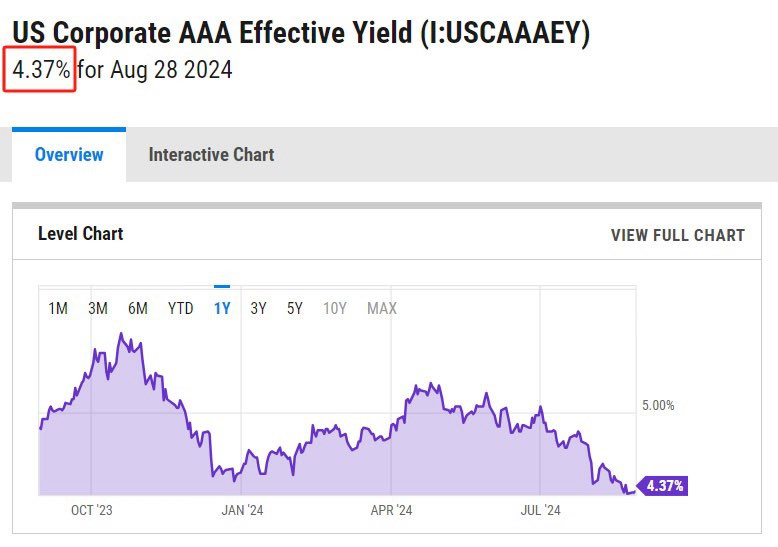
Look this up on a site like YCharts. As of now, it's 4.37%.
Step 2: Calculate Graham's Formula
The intrinsic value formula is:
Intrinsic Value = {EPS x (8.5 + 2g) x 4.4} / Y
Substituting Apple's data into the formula:
Intrinsic Value = 6.57 x (8.5 + 2 x 11.10) x 4.4 / 4.37
Calculating this gives:
Intrinsic Value ≈ $203.08
Note: The growth rate is not a fixed value; it depends on your analysis and judgment. The Current AAA Bond Yield also fluctuates daily. Additionally, as we mentioned in a previous article, many experts believe that a lower base P/E ratio of 7 (instead of 8.5) and a growth multiplier of 1x (instead of 2x) are more suitable for the current market environment. So, when you start investing, these factors need to be considered. Even slight changes can lead to different results.
Step 3: Apply a Margin of Safety
Graham always recommended using a margin of safety. Depending on your risk tolerance, you may want to apply a margin of safety ranging from 10% to 30%.
For this example, let's use a 20% margin of safety. To calculate the acceptable buy price:
Acceptable Buy Price = Intrinsic Value x (1 - Margin of Safety)
Using a 20% margin of safety:
Acceptable Buy Price = 203.08 x (1 - 0.20) ≈ $162.46
So, with a 20% margin of safety, $162.46 would be the price at which you might consider buying Apple to ensure you're paying a price that includes some cushion for potential risks.
Step 4: Compare to Market Price
Currently, Apple is trading at $229.79 per share. Since this is significantly higher than the acceptable buy price of $162.46, Graham's model suggests not buying the stock at its current price. Instead, you would wait for the price to drop closer to your calculated buy price to ensure a safer investment.
Conclusion
By calculating Apple's intrinsic value using Benjamin Graham's formula, you gain a data-driven approach to assess whether Apple is undervalued or overpriced. Keep in mind that no model is perfect, and market conditions can change. Therefore, always combine this analysis with additional research before making any investment decisions.