
Asia-Pacific Market Surge, Oil Price Collapse, and Global Economic Slowdown: Key Indicators Signal Uncertainty Ahead

Currency Surge in Asia-Pacific Markets
This morning saw a sharp rise in several Asia-Pacific currencies, including the Thai baht, Korean won, Indonesian rupiah, and the Chinese yuan, as the USD/JPY dropped to its lowest point since January. The Bank of Japan's statements on possible policy adjustments triggered this yen volatility. Meanwhile, both Japanese and Hong Kong stock markets exhibited weakness, with experts noting that yen carry trade unwinding remains a risk. Additionally, South Korea reported its lowest unemployment rate since 1999, and business confidence among large manufacturers saw a decline in September.
Oil Price Drop Signals Global Economic Slowdown
Global crude oil prices fell to their lowest levels since December 2021, following OPEC+'s downgrade of oil demand forecasts for 2024 and 2025. Brent crude futures dropped by 3.69%, and U.S. crude also saw a significant decline. The selloff hit energy stocks hard across multiple markets, with major oil companies like CNOOC, Sinopec, and PetroChina experiencing sharp declines. The downturn in oil demand and prices suggests a weakening global economy, as investment banks continue to lower their oil price forecasts, predicting an average of $60 per barrel by 2025.
Broader Economic Indicators Show Weakness
In addition to the turmoil in currency and oil markets, other economic indicators point to further signs of weakness.
The European shipping index has been in a sustained decline since July, signaling weakened global demand. Meanwhile, former President Donald Trump made comments during the U.S. presidential debate expressing his intent to boost U.S. oil and gas production if re-elected, potentially further affecting global energy markets. These indicators collectively suggest a broader global economic slowdown in the coming months.
Here are the summary for each Major Index
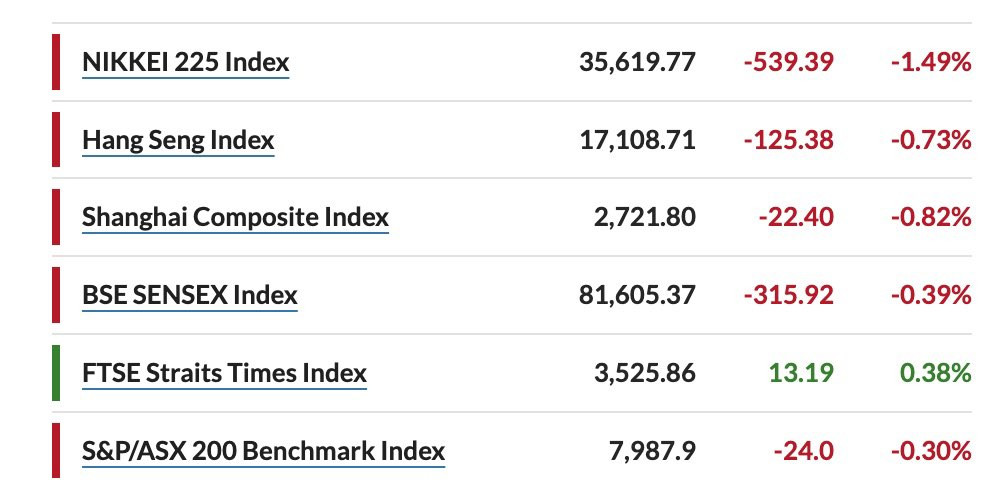
NIKKEI 225 Index: The NIKKEI 225 Index closed at 35,619.77, experiencing a significant drop of 539.39 points, which equates to a 1.49% decrease. This indicates a notable decline in Japan's stock market performance for the day.
Hang Seng Index: The Hang Seng Index in Hong Kong ended at 17,108.71, showing a decline of 125.38 points, or 0.73%. This reflects a moderate downward trend in Hong Kong's stock market.
Shanghai Composite Index: The Shanghai Composite Index closed at 2,721.80, falling by 22.40 points, or 0.82%. This highlights a downward movement in China's main stock market index.
BSE SENSEX Index: India's BSE SENSEX Index finished at 81,562.22, dropping by 359.07 points, representing a 0.44% decline. This suggests a relatively mild loss in India's stock market.
FTSE Straits Times Index: The FTSE Straits Times Index, representing Singapore, closed at 3,530.59, rising by 17.92 points, or 0.51%. It was the only major index in the region to show positive growth, reflecting gains in Singapore's stock market.
S&P/ASX 200 Benchmark Index: The S&P/ASX 200 Benchmark Index from Australia closed at 7,987.9, dropping 24.0 points, which is a 0.30% decline, signaling a mild loss in Australia's stock market. #Stock #Oil #XTIUSD