
The market is refocusing on U.S. CPI data, which is pivotal in determining whether the Fed will press the "pause button" on its rate-cut cycle.

In a recent report, Wall Street giant Bank of America noted that following unexpectedly strong September non-farm payroll data and a surprising drop in the unemployment rate, which dashed hopes for a Fed rate cut, the importance of this week's Consumer Price Index (CPI) report has significantly increased. If CPI comes in higher than expected, it could cause investors to further question whether the Fed will choose to cut rates next month. For several months, non-farm payroll data has been the primary U.S. economic indicator watched by global investors, as its strength or weakness is crucial to the Fed's rate-cut pace and timing. However, this week, investors have shifted their focus back to the U.S. CPI report, which will play a key role in determining whether the Fed continues cutting rates this year. The September CPI data is scheduled to be released Thursday evening, Beijing time.
The recently released strong U.S. non-farm payroll data and the unexpected drop in the unemployment rate have caused traders to significantly reduce their bets on the Fed continuing with a 50-basis-point rate cut. Since August 1, interest rate futures market pricing has, for the first time, indicated that the Fed's benchmark rate cut by the end of the year will be less than 50 basis points. This suggests that some traders are even pricing in the possibility that the Fed may pause the rate-cut cycle at the November or December FOMC meetings.
Traders in the interest rate futures market now believe there is an 85% chance that the Fed will opt for a 25-basis-point rate cut in November. By comparison, before the non-farm payroll report was released, the probability of a 25-basis-point cut barely exceeded 50%, and the chance of a 50-basis-point cut was once higher than that of a 25-basis-point cut.
In the U.S. Treasury market, as most global bond traders have at least temporarily abandoned their bullish bets on U.S. Treasuries, the yield on the 10-year U.S. Treasury note, often referred to as the "anchor of global asset pricing," has risen to its highest level since August, breaking above the critical 4% yield threshold. Short-term U.S. Treasuries, particularly those with maturities of two years or less, have performed especially poorly, marking a temporary reversal of the trend in a key part of the yield curve. This highlights the bond market's significant cooling of expectations regarding the Fed's future rate-cut path.
I believe the market’s focus is now shifting to whether rate cuts will even continue, From an economic perspective, things aren’t as bad, leading the market to reprice the Fed's rate-cut path. As such, I expect the Fed to opt for a 25-basis-point rate cut in November rather than sticking with a 50-basis-point reduction.
On Friday, U.S. government data showed that after an upward revision of 72,000 non-farm jobs over the past two months, non-farm payrolls in September far exceeded expectations, adding 254,000 jobs – the largest increase in six months. In comparison, the median forecast of economists was just 150,000, and the latest figure even surpassed the most optimistic expectations from media surveys. Another report from the U.S. Bureau of Labor Statistics, also released on Friday, showed that the unemployment rate unexpectedly fell to 4.1%, and average hourly earnings rose by 0.4% month-on-month, both surpassing economists' forecasts (which were 4.2% for unemployment and 0.3% for wage growth).
Combined with other data released last week, these figures show that U.S. companies' demand for workers remains healthy, layoffs are still very low, and earlier economic data demonstrates the resilience of the U.S. economy. The non-farm payroll report may significantly ease economists' concerns about the labor market cooling too quickly and alleviate fears of an impending recession. The U.S. labor market is closely linked to consumer spending, as employment levels and wage growth are crucial to overall consumption. The resilience of consumer spending will undoubtedly help drive the U.S. economy forward, given that 70-80% of U.S. GDP is consumption-driven.
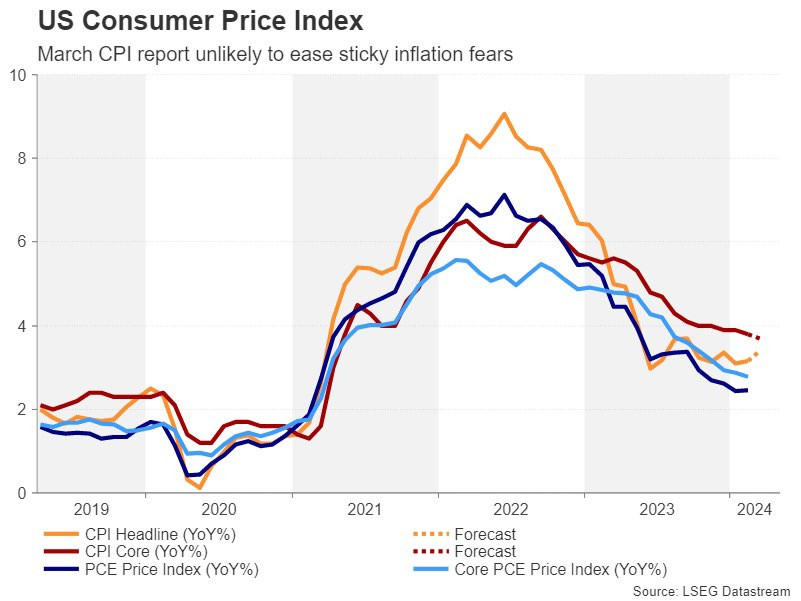
The September CPI data, set to be released this week, could provide the market with clearer insights into the Fed's rate-cut path. Bank of America forecasts a 0.3% month-on-month increase in core CPI for September, in line with economists' expectations. If this projection holds, it would mark two consecutive months of firm core CPI readings. For headline CPI, Bank of America's forecast matches the consensus expectation of a 0.1% month-on-month increase, potentially the smallest rise in three months. Year-over-year, economists expect overall CPI to rise by 2.3%, down from 2.5%, while core CPI is expected to increase by 3.2%, matching the previous figure.
Bank of America equity and quantitative strategist Ohsung Kwon stated in a Sunday report, "If our forecast proves correct, it will further solidify market expectations for a 25-basis-point rate cut in November." "At the same time, inflation is unlikely to weaken enough to justify a 50-basis-point cut. However, if inflation data is particularly strong, it could make the Fed's November rate cut less certain, and calls for a pause may grow louder." This critical CPI report will be released Thursday evening, Beijing time.