
US Earnings Season Preview: Slower Growth Expected, Tech Stocks Poised to Shine

This Friday, JPMorgan Chase, Wells Fargo, and BlackRock will kick off the new U.S. earnings season. The third quarter saw markets grapple with concerns about the economy, interest rate uncertainties, the upcoming election, and geopolitical tensions. Analysts are forecasting a noticeable slowdown in overall earnings growth, with tech stocks likely to be the standout performers. As the Federal Reserve begins to lower interest rates, attention will shift to macroeconomic prospects and forward guidance across various sectors.
Overall Earnings Growth Slows
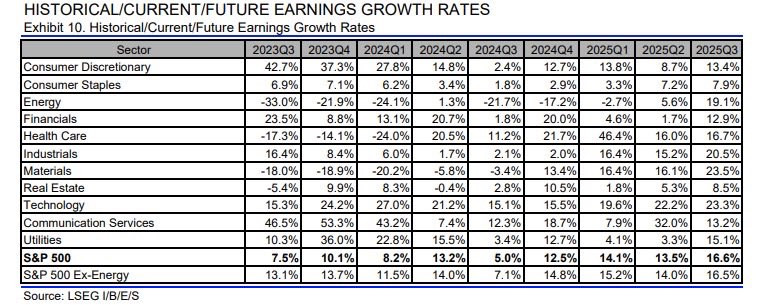
Since July, I have noticed that many institutions have revised down their third-quarter earnings expectations. According to data compiled by LSEG (London Stock Exchange Group), the earnings for S&P 500 companies are expected to grow by 5.0% year-over-year. This marks the fifth consecutive quarter of growth, but it falls short of the nearly 8% forecast made at the start of Q3 and represents the weakest growth in the past four quarters.
By sector, the technology industry is leading the growth, while cyclical sectors sensitive to economic conditions are dragging down overall performance. In my view, weaker revisions and guidance reflect persistent economic concerns and some seasonality related to the election year.
Overall, corporate profit margins have remained strong. According to FactSet, the net profit margin for S&P 500 companies is projected to hit 12.1% in Q3, close to the record highs of 2021. Although this is slightly lower than the previous quarter, it is still above the five-year average of 11.5%.
As more earnings reports come in, the 12.1% estimate could decrease, largely due to rising costs, layoffs, and budget cuts. I believe that many companies have been demonstrating discipline over the past few years, and a focus on cost control will continue. Tech remains a key driver of margin expansion in the future.
Looking ahead, with just a month until the U.S. presidential election, Democratic candidate Kamala Harris and Republican candidate Donald Trump are set for a tense and competitive race. The Federal Reserve has just begun lowering interest rates, and while there is optimism about a soft landing for the economy, questions remain about how quickly borrowing costs will come down. Meanwhile, escalating conflicts in the Middle East are raising fears of renewed inflationary pressures.
It's worth noting that there is substantial data suggesting U.S. companies are resilient, and earnings growth is expected to rebound to double-digit levels in Q4. According to Bloomberg Intelligence, a robust earnings cycle should continue to offset persistently weak economic signals, tipping the stock market in a positive direction. Even small-cap stocks, which have lagged behind and struggled this year, are expected to see profit margins improve.
Challenges for the Banking Sector
As is customary, major U.S. banks will open the earnings season, offering critical insights into the state of the U.S. economy and its outlook. With the beginning of an interest rate-cutting cycle, loan performance, IPO activity, and trading markets will receive greater scrutiny, while commentary on the economic outlook will also be closely watched.
Among various sectors, the financial industry is expected to see the steepest earnings decline. FactSet notes that while the Federal Reserve’s easing policy is not the primary factor affecting Q3 results, it is likely to impact short-term net interest margin (NIM) expectations.
Net interest income may again be constrained by slow loan growth. Commercial real estate and credit cards are expected to be key drivers of loan loss provisions, but the start of the rate-cutting cycle brings hope that the refinancing pressures on commercial real estate will ease.
Non-interest income is expected to show mixed results. As the IPO market continues to wait for a recovery, investment banking revenues remain constrained by weak M&A activity. However, wealth and asset management performance is likely to benefit from the strong performance of U.S. equities in Q3.
Of particular note is that Warren Buffett has been steadily reducing his stake in Bank of America this year. As of October 2, Berkshire Hathaway had cashed out approximately $9.751 billion, reducing its holding to 10.2%. Aside from tax reasons, there may be other clues in the latest earnings report that explain Buffett's decision.
Can Tech Giants Deliver?
Over the past two years, the explosive growth of artificial intelligence (AI) has driven earnings and has been a major factor behind U.S. stock market gains.
Current institutional forecasts show that technology and communication services are expected to be the fastest-growing sectors in Q3 earnings. Industry leader Nvidia continues to struggle to meet strong demand for its AI chips, and CEO Jensen Huang recently remarked that the demand for their next-generation AI chip, Blackwell, is "insane." Nvidia’s stock is expected to hit new highs this week.
At the same time, OpenAI recently announced a new round of funding, raising $6.6 billion, with a post-money valuation of $157 billion.
Microsoft is monetizing its AI cloud products, and Meta Platforms is increasing user engagement and advertising revenue through AI, leading several institutions to raise their price targets for Meta.
There is growing attention on whether companies can maintain their enthusiasm, particularly given the costs of technology and the return on investment timeline.
Alphabet CEO Sundar Pichai noted, "For us, the risk of underinvestment far outweighs the risk of overinvestment, as this technology has the potential to transform how things are done."
A recent report from Goldman Sachs indicates that discussions around AI are becoming more polarized. There is a "prisoner's dilemma," where despite the lack of clear revenue prospects, some companies feel compelled to invest in AI. For now, investors appear to favor the top-growth stocks in the sector.