
The Fed's Dual Mandate Faces New Challenges Amid Inflation and Employment Dilemmas

Following rare public divisions at its September meeting, the Federal Reserve is unlikely to have an easy time at its November meeting. Conflicting signals—higher-than-expected inflation and weaker-than-expected employment data—have complicated the Fed’s decision-making process.
On October 10, the U.S. Department of Labor released new inflation data, showing the annual CPI growth rate slowed from 2.5% in August to 2.4% in September, marking the lowest level since March 2021 and continuing a six-month decline. However, on a monthly basis, CPI rose by 0.2%, slightly above expectations. Core CPI, which excludes food and energy, increased by 3.3% year-over-year, reaching a new high since June, and rose 0.3% month-over-month, also exceeding market forecasts.
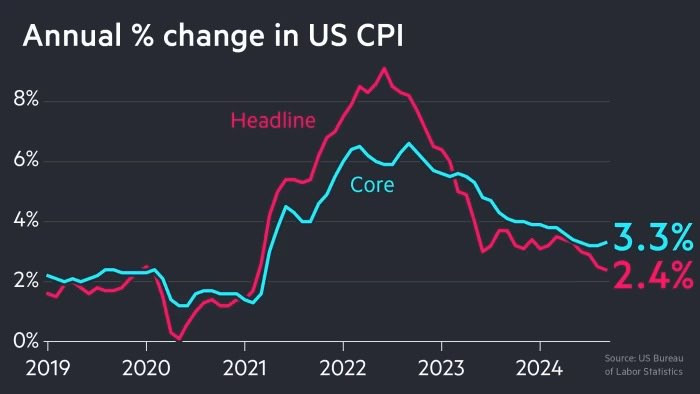
Meanwhile, unemployment claims surged. Initial jobless claims for the week ending October 5 climbed to 258,000, a level last seen in August 2023 and significantly higher than the previous week’s 225,000 and the market’s forecast of 230,000. Continuing claims for the week ending September 28 also rose to 1.861 million, surpassing expectations of 1.83 million and the prior week’s 1.819 million, raising concerns about labor market conditions.
Despite inflation coming in higher than anticipated, the sharp rise in jobless claims has drawn greater attention from the market, increasing bets that the Fed will cut interest rates by 25 basis points in November.
The Fed’s recent internal disagreements reflect varying interpretations of economic data among policymakers. Achieving its dual mandate of stable inflation and maximum employment remains a formidable challenge.
The “Last Mile” of Inflation Control Proves Difficult
As the Fed enters an interest rate-cutting cycle, the September inflation data highlights the difficulty of achieving the final stages of inflation control. Policymakers cannot afford to be complacent just yet.
In my view, the September CPI report indicates that both headline and core inflation exceeded expectations. Food prices contributed to headline inflation, likely influenced by hurricane-related disruptions, while core inflation remained persistent, driven by volatility in key components. “Supercore” inflation—core services inflation excluding housing—has rebounded for three consecutive months.
The main challenge in the “last mile” of inflation control lies in reducing the stickiness of core inflation. Several factors are contributing to this persistence.
First, housing inflation remains uncertain. With housing accounting for 36.4% of the CPI basket, unexpected fluctuations in rent inflation have repeatedly disrupted market expectations this year. While August saw a rebound in housing inflation, the month-over-month rate eased in September, but the trend's sustainability remains questionable.
Second, volatile items like hotel rates, airfares, and car insurance have experienced sporadic increases, making forecasting difficult and keeping core inflation sticky.
Third, wage inflation remains elevated, as the labor market remains tight and hourly wages have not shown significant improvement. If the Fed opts for a substantial 50-basis-point rate cut, it could trigger a demand rebound, raising the risk of secondary inflation.
Looking ahead, monthly CPI growth may remain resilient in the short term. Given that CPI’s base effect will weaken starting in October, there is a risk that year-over-year inflation may rise in the coming months.
On the inflation front, two forces are at play. First, oil prices have stabilized and started to rebound in October amid geopolitical tensions, and with energy prices down from last year, the annual decline in energy-related CPI will likely narrow. Second, strong demand in the service sector is evident, with the ISM Non-Manufacturing PMI rising to 54.9 in September from 51.5 in August. New orders in non-manufacturing sectors climbed to 59.4 from 53.0, and business activity PMI increased to 59.9 from 53.3. Combined with rising non-farm wage growth, these trends will likely support core services inflation.
At the same time, several factors may dampen inflation. Leading indicators suggest that rent growth is slowing, and the ISM Manufacturing PMI remains in contraction territory, with the price index at 48.3 and new orders at 46.1. Weak manufacturing activity indicates softening demand, limiting the potential for a strong rebound in goods inflation.
Employment Data Takes Center Stage
Although higher inflation might prompt the Fed to adopt a more hawkish stance, employment data has become the dominant factor supporting further rate cuts.
The release of CPI and jobless claims data on the same day initially confused markets, triggering simultaneous increases in U.S. Treasury yields. Market expectations for a November rate cut fluctuated sharply, first dropping to 75% before rising to 96% and eventually stabilizing around 91%. Current market forecasts suggest that the Fed will cut rates by 46 basis points—roughly 1.84 times—by the end of the year, with an additional 145 basis points of cuts expected by the end of 2025.
The Fed's policy focus has shifted from fighting inflation to stabilizing employment. In this environment of precautionary rate cuts, the Fed has increased its attention to labor market data. Factors such as hurricanes tend to skew employment data upward, adding noise to the recent initial jobless claims report and further fueling market expectations for a rate cut in November. However, the pace of rate cuts will likely slow from 50 basis points to 25 basis points.
The Fed’s September statement highlighted the goal of achieving “maximum employment and 2% inflation in the long term,” placing more emphasis on employment. In fact, before the September meeting, key data—such as CPI, PPI, and retail sales—did not support a 50-basis-point rate cut. The Fed’s decision to proceed with such a large cut underscores the weight it places on labor market conditions.
The Fed's rate-cut strategy can be divided into two categories: precautionary and accommodative. Precautionary cuts are made when the economy shows signs of slowing but not recession, while accommodative cuts occur in response to a recession. The current economic conditions suggest that the Fed’s rate cuts are precautionary, as inflation is progressing toward target levels and the economy has yet to show signs of recession. By starting the rate-cut cycle with a 50-basis-point reduction, the Fed aims to mitigate potential downside risks to the economy proactively.
While inflation exceeded expectations in September, the trend remains downward, easing inflation risks significantly. In this context, the market is less concerned about higher-than-expected inflation. The Fed's focus has clearly shifted toward the risks in the labor market, making employment data—such as non-farm payrolls and jobless claims—the primary driver of market sentiment. However, it is essential to note that this week’s jobless claims data may contain noise from external factors like hurricanes and labor strikes, which could distort the true state of the labor market.