
ETF Makes Bitcoin Investment Possible For All of You

In the past 10 years (2011-2024), the compound annual return of Bitcoin denominated in US dollars has reached an astonishing 100.68%, almost outperforming all assets, but Bitcoin and other cryptocurrencies have always been a game for a few people. The obstacles that prevent mass investors from investing in Bitcoin as easy as investing in stocks, funds and other assets are mainly doubts about the trust and compliance of exchanges as counterparty, difficulties in onramp and offramp, and the high threshold of how to store Bitcoin to avoid hacker attacks.
But ETFs make everything easier. We will guide you how to choose the Bitcoin ETF that best suits you.
What is Bitcoin ETF?
Growing interest and demand for cryptocurrencies have led to the emergence of Cryptocurrency ETFs in the market. In January 2024, the U.S. Securities and Exchange Commission (SEC) approved 11 spot Bitcoin ETFs, representing a significant advancement in the fusion of cryptocurrency with mainstream financial markets.
Bitcoin ETFs, in particular, have gained popularity and momentum as they trade on regulated exchanges like the NYSE, unlike the underlying cryptocurrency that operates on unregulated markets. This setup allows investors to avoid the necessity of creating a digital wallet and minimizes the risks associated with directly holding Bitcoin which protects investors from hacker. The global ETF market has seen several new Bitcoin ETFs introduced, which track Bitcoin's value through either spot or futures prices.
What is spot ETF
A "spot bitcoin ETF" refers to an exchange-traded fund that directly holds bitcoin. The performance of these ETFs is expected to closely track bitcoin prices, adjusted for fees and trading costs associated with the fund.
The spot price indicates the current price of a security available for immediate purchase, while futures prices reflect prices set for a future date. Stocks and bonds are traded at spot prices, whereas commodities often use futures prices, allowing buyers to secure a specific price for a transaction that will occur later.
The term "spot bitcoin" was adopted because bitcoin futures ETFs were introduced first, launching in October 2021. If spot bitcoin ETFs had been approved initially, they might simply have been referred to as "bitcoin ETFs."
Choose the best-suited spot ETF for you
Spot bitcoin ETFs are designed to provide exposure to bitcoin, and since they physically hold bitcoin, there's limited opportunity for issuers to differentiate themselves.
Nevertheless, these ETFs are not all the same. Investors can determine which option is best for them by considering three key factors: fees, liquidity, and trading costs. Buy-and-hold investors should prioritize fees, while those who trade actively should pay attention to liquidity. Additionally, all investors should be mindful of how trading costs can impact overall performance.
If you are Buy-and-Hold Investors: Prioritize Fees
Several issuers have previously offered access to similar strategies, and before accounting for fees, the returns of gold ETFs and S&P 500 trackers are nearly the same. In the case of spot bitcoin ETFs, fees are expected to be the primary factor influencing total returns.
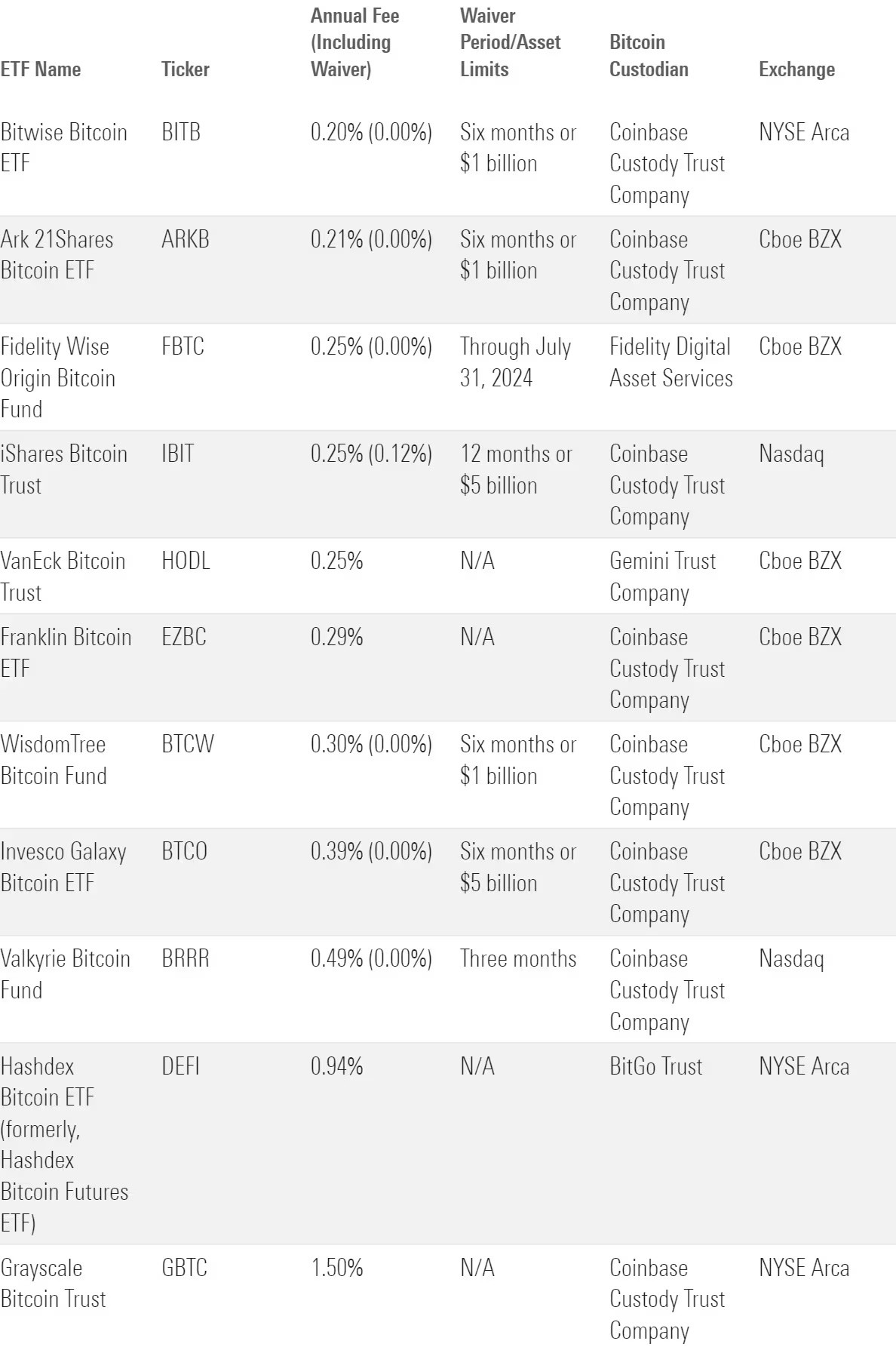
The Bitwise Bitcoin ETF boasts the lowest ongoing fee at 0.20%. Meanwhile, ETFs from ARK, Fidelity, VanEck, and iShares have fees that are just 5 basis points higher than Bitwise’s. To attract initial investments, issuers have also implemented fee waivers, with six bitcoin ETFs launching with a temporary 0.00% fee. These waivers typically last for six months and apply to the first $1 billion to $5 billion in assets. Since waivers are temporary, investors should focus on the long term and choose one of the lowest-cost ETFs once the waiver periods conclude, providing ample options.
Grayscale stands out with a proposed fee of 1.50%, which does not offer any additional benefits for investors. Therefore, those seeking bitcoin exposure should consider alternatives.
While the influence of fees on performance may be overshadowed by bitcoin’s inherent volatility, buy-and-hold investors risk losing potential gains by opting for more expensive ETFs.
If you are Active ETF Traders: Prioritize Liquidity
Investors have their own costs to worry about. Frequent trading and large trades come with liquidity costs that can add up quickly. Buy-and-hold investors are far less exposed to liquidity risks than market makers and day traders. For those looking to actively trade spot bitcoin ETFs, liquidity costs can be broken into two parts: crossing the bid-ask spread and depth of liquidity:
- Crossing the bid-ask spread incurs a cost for traders each time they buy at the ask price or sell at the bid price. Theoretically, fair value is positioned in the middle of the bid-ask spread, making the midpoint a useful benchmark. For instance, if two ETFs are valued at $10.00, it would be more cost-effective to buy at the $10.01 ask of a $9.99 bid/$10.01 ask spread than at the $10.05 ask of a $9.95 bid/$10.05 spread.
- Liquidity depth is another important consideration for investors, as they seek to buy or sell a sufficient number of shares near the current price. Insufficient liquidity can lead to less favorable prices when executing large trades. Generally, tighter bid-ask spreads indicate greater liquidity, meaning more shares are available for buying or selling close to the current price. This is particularly crucial for investors looking to trade large volumes without significantly impacting the market price.
For All Investors: A Fund’s Trading Costs
The SEC has diminished the trading advantages of spot bitcoin ETFs by mandating cash transactions for creations and redemptions. This change means that the ETFs must engage in trading bitcoin when new shares are issued or existing shares are redeemed, resulting in trading costs that must be borne by the fund and its investors. These costs include transaction fees, the expense of navigating the bid-ask spread, and market-impact charges.
While the differences between various issuers may be subtle, a unique scenario arises with Valkyrie, who has only two ETFs, competing against BlackRock, the world's largest asset manager. Issuers with more extensive resources and experience in capital markets may have an edge in this competitive landscape. Additionally, firms like Bitwise or VanEck, which might maintain stronger ties to the crypto community, could also benefit from their specialized knowledge.