
Gold Plants Flag Above Fresh All-Time High at $2,700 Amid Growing Global Easing Prospects

Gold (XAU/USD) solidified its position above the significant $2,700 mark on Friday, setting a new all-time high after breaking through this key psychological level the previous day.
XAU/USD Technical Overview
Gold continues its upward momentum, surpassing the $2,700 threshold and reaching fresh record highs. This latest achievement reaffirms the current bullish trend, with potential for further upside in the near term.
If Gold breaks past its new high of $2,714, it could aim for $2,750, a round number that often sees increased trading activity as traders cluster their orders around such levels.
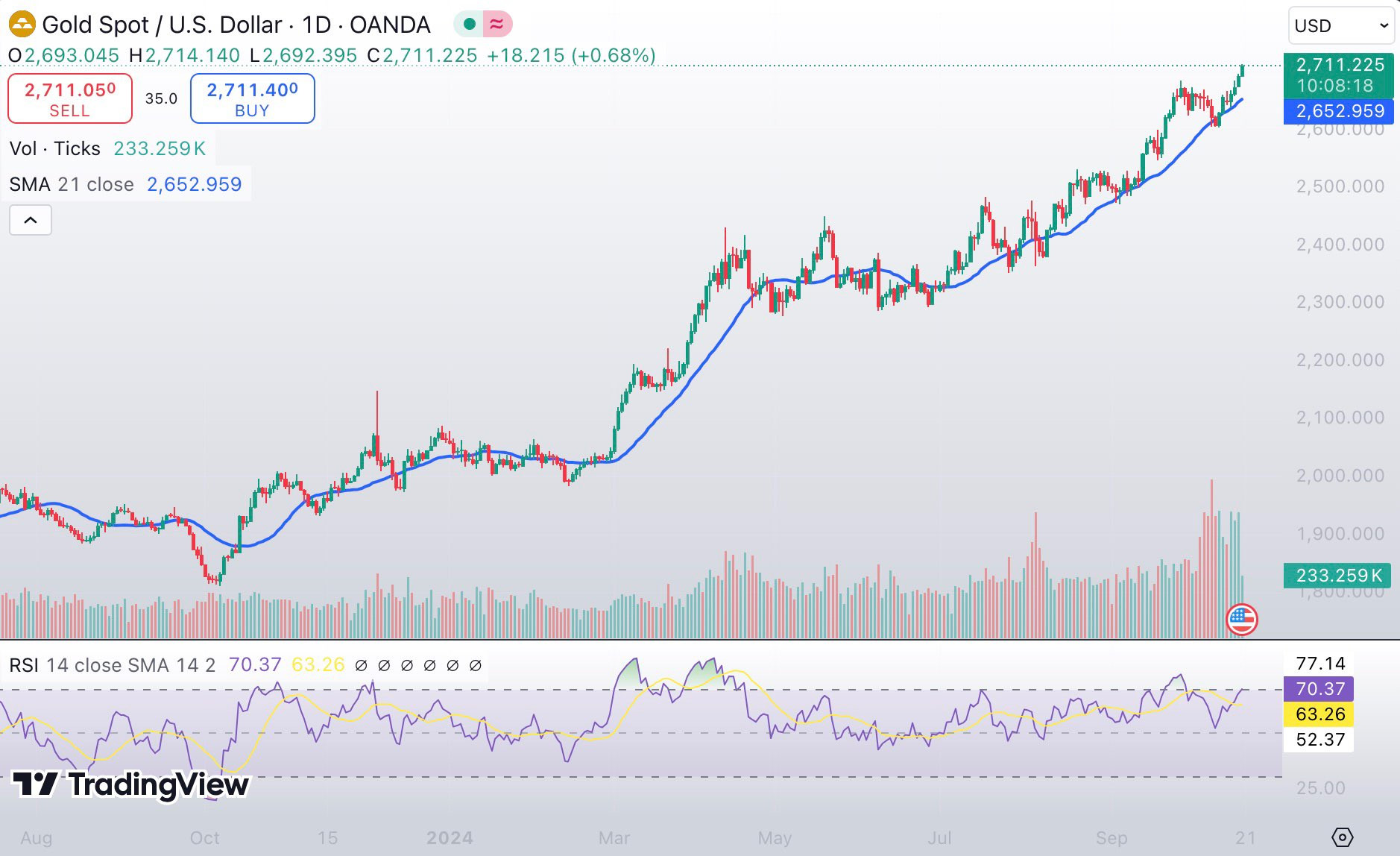
However, the Relative Strength Index (RSI) is in overbought territory, signaling caution for long-holders. The risk of a pullback increases, and should RSI revert to neutral levels, it could suggest an opportunity for long-holders to close positions and consider shorting in anticipation of a deeper correction. Key support levels are set at $2,700 (critical threshold) and $2,685 (September high).
Despite the risk of short-term corrections, the overall strong uptrend suggests any dips will likely be short-lived, with the bullish momentum resuming shortly after.
Fundamental Overview Gold’s climb past $2,700 is driven by increased prospects of global interest rate cuts, making the precious metal more attractive to investors. Gold, a non-interest-bearing asset, gains appeal as the opportunity cost of holding it decreases when central banks lower rates.
Gold Surges Above $2,700 as Central Banks Accelerate Easing
As central banks worldwide lean into monetary easing, Gold's ascent continues. On Thursday, the European Central Bank (ECB) slashed its deposit rate by 25 basis points (bps), marking its second consecutive cut. Analysts view this as a significant acceleration of the ECB’s easing cycle, with expectations of more cuts to follow.
“Our European economists see the ECB’s recent meeting as a clear signal of an accelerated easing trajectory, with continued 25 bps cuts likely until rates fall within the 2.00%-2.50% neutral range,” said Jim Reid, Head of Global Macro Research at Deutsche Bank. He added that there’s even potential for a 50 bps cut in December, depending on upcoming economic data.
Meanwhile, in Japan, inflation data for September showed a lower-than-expected Consumer Price Index (CPI) ex-Fresh Food reading of 2.4%, slightly under the Bank of Japan's (BoJ) 2.5% target for fiscal 2024. This fuels speculation that the BoJ might hold off on planned rate hikes.
In the UK, after a weaker inflation report, the Bank of England (BoE) is now widely expected to cut rates in November, adding to the global trend of monetary easing. Similarly, speculation is growing that the Bank of Canada (BoC) could implement a larger-than-expected 50 bps rate cut later this month, contributing to the bullish momentum in Gold.
Several other Asian central banks have also recently cut rates, further bolstering Gold’s rally.
Potential Headwinds from U.S. Data
Gold's surge may face some resistance from strong U.S. economic data, which could temper expectations for aggressive rate cuts by the Federal Reserve (Fed).
U.S. Retail Sales for September came in at a stronger-than-expected 0.4%, surpassing forecasts of 0.3%. Additionally, Initial Jobless Claims dropped to 241,000 in the week ending October 11, below the 260,000 predicted, suggesting the U.S. labor market remains resilient.
The Federal Reserve is still expected to cut rates by 25 bps in November, with a 92% probability according to the CME FedWatch tool. However, the continued strength of U.S. economic data suggests the Fed may proceed at a more measured pace compared to its global counterparts. This could act as a limiting factor for further upside in Gold.