
Tesla's Earnings Beat Expectations! Q3 EPS Rises 9%, Cybertruck Turns Profitable for the First Time, Shares Surge Over 10% After Hours

Tesla’s Q3 revenue grew nearly 8% year-over-year but fell short of expectations. However, earnings were surprisingly strong, with gross margins rising by 195 basis points to 19.8%. The automotive gross margin exceeded expectations, increasing to 17.1%. Carbon credit sales surged over 30%, marking the second-highest single-quarter revenue. Energy storage gross margin hit a record 30.5% for Q3, with deployment expected to double year-over-year. The Shanghai factory is set to begin delivering Megapack units in Q1 next year.
Tesla also plans to launch more affordable models in the first half of next year, aiming for a slight increase in vehicle deliveries this year. CEO Elon Musk estimated deliveries could grow 20-30% next year, with the new low-cost models priced below $30,000. The Cybercab, a robotaxi prototype unveiled recently, is set for mass production in 2026, targeting 2 million units per year. Meanwhile, Tesla's AI training capacity increased by over 75% in Q3, with 50,000 Nvidia H100 GPUs expected at its Texas plant by the end of October.
Amid a sluggish global automotive market and intensifying competition in the EV sector, Tesla posted a surprising Q3 profit rebound, driven by record gains in energy storage and declining production and material costs for vehicles.
In the automotive sector, Tesla reiterated its plan to start producing lower-cost models in the first half of next year. Additionally, it reported that the Cybertruck, which began deliveries in November last year, achieved its first positive gross margin. Despite economic headwinds, Tesla expects total vehicle deliveries for the year to slightly surpass last year’s figures.
On the earnings call, Musk provided a "rough estimate" that, despite potential external challenges, deliveries could grow 20-30% next year, though he emphasized that this was a "best guess." He also mentioned the prototype of the robotaxi (Cybercab) revealed at an event two weeks ago, aiming for mass production by 2026 with an annual output of 2 million units.
Analysts noted that Tesla's expectations for delivery growth reflect a rebound in EV demand. Tesla emphasized that demand in China continues to outpace that in the U.S. and Europe, making it a key driver of the EV market.
On October 23, after the U.S. market closed, Tesla released its financial results for Q3 2024.
Key Financial Data:
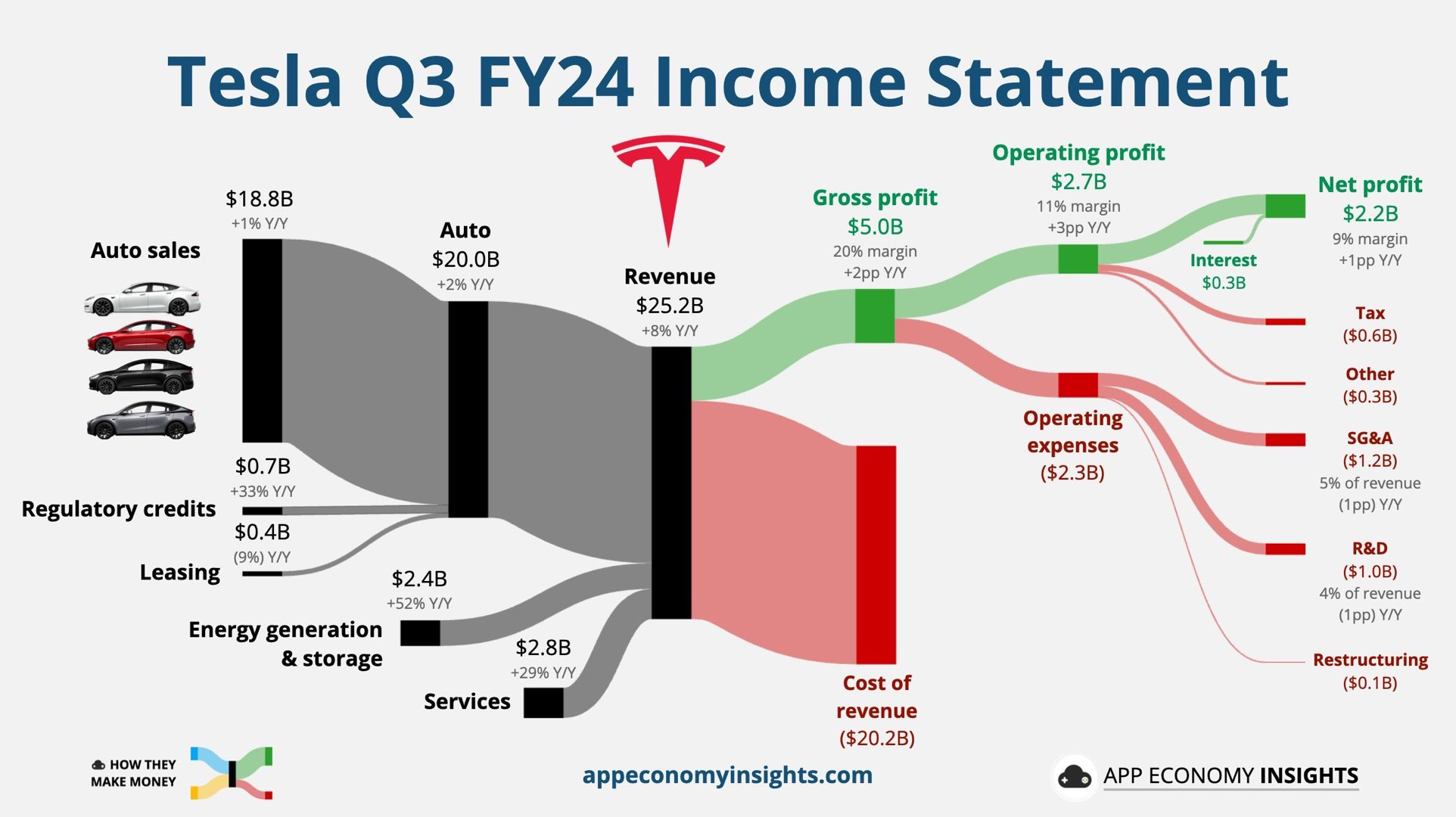
Revenue: Q3 revenue was $25.182 billion, up 7.8% year-over-year but below the expected $25.43 billion, while Q2 saw a 2% year-over-year increase.
EPS: Non-GAAP diluted EPS for Q3 was $0.72, up 9.1% year-over-year, exceeding the expected $0.60, while Q2 experienced a 43% decline.
Gross Profit: Q3 gross profit reached $4.997 billion, up 19.6% year-over-year, compared to a 1% growth in Q2. Gross margin rose to 19.8%, up 195 basis points, surpassing the expected 16.8%, while Q2's gross margin was 18%.
Operating Income: Q3 operating income was $2.717 billion, up 54% year-over-year, surpassing the expected $1.96 billion, while Q2 saw a 33% decline. The Q3 operating margin was 10.8%, an increase of 323 basis points, compared to the expected 8% and Q2's 6.3%.
Net Income: Non-GAAP net income for Q3 was $2.505 billion, up 8.1% year-over-year, while Q2 saw a 42% decline.
Free Cash Flow: Q3 free cash flow (FCF) was $2.742 billion, a 223% year-over-year increase, compared to an expected $1.61 billion, while Q2 showed a 34% increase.
Segment Data:
Automotive: Q3 automotive revenue was $20.016 billion, a 2% year-over-year increase, compared to a 6.5% decline in Q2.
Carbon Credit Sales: Revenue from selling carbon credits reached $739 million in Q3, up 33.4% year-over-year but down 17% quarter-over-quarter, marking the second-highest level on record.
Energy Storage: Q3 energy generation and storage revenue was $2.376 billion, up 52.4% year-over-year, compared to a 100% increase in Q2.
Services and Other: Q3 services and other revenue was $2.79 billion, up 29% year-over-year, with Q2 showing a 221.3% increase.
After the earnings release, Tesla's stock, which closed about 2% lower on Wednesday, surged over 10% in after-hours trading.
Higher Gross Margin, Record Automotive Margin, and Carbon Credit Revenue
Tesla’s Q3 revenue growth accelerated from Q2, rising nearly 8%, though still below the nearly 9% expected by analysts. However, earnings performance was the key surprise.
Prior forecasts suggested improved sales would boost earnings sequentially, but increasing demand incentives and costs of new model production were expected to lower EPS year-over-year. Contrary to expectations, Tesla’s Q3 EPS grew over 9%, while analysts had predicted a decline of nearly 9.1%.
The Q3 gross margin rose by 195 basis points, while analysts expected it to drop by about 110 basis points. Notably, excluding carbon credit sales, the automotive gross margin increased to 17.1%, up 250 basis points from Q2, while analysts had expected only a 20 basis point increase from Q2's 14.6%.
Tesla attributed the improved profitability to the following factors:
Lower average cost per vehicle, including raw materials, shipping, and tariffs.
Growth in energy storage and service margins.
Revenue from features like Cybertruck and the new Actually Smart Summon (ASS) function, which also boosted Full Self-Driving (FSD) revenue.
Increased vehicle deliveries.
Tesla's CFO, Vaibhav Taneja, mentioned that per-vehicle costs hit a record low in Q3, emphasizing a continued focus on cost reduction.
Record Energy Storage Margin, Shanghai Megapack Deliveries in Early 2025
Tesla’s Q3 earnings highlighted a boost from lower vehicle production costs and material costs, as well as improving energy storage margins.
Despite a decrease in Megapack production, energy storage gross margin reached a record 30.5% in Q3, up 596 basis points quarter-over-quarter.
Powerwall installations set new records for two consecutive quarters, with Powerwall 3 and Lathrop Megafactory production progressing smoothly. The Lathrop plant produced 200 Megapack units weekly, achieving a 40 GWh annual run rate.
Tesla expects its Shanghai Megafactory, still on track to deliver Megapack units starting in Q1 2025, to help energy deployment more than double in 2024.
Production of Affordable Models Begins Next Year, Slight Delivery Growth Expected
Tesla’s Q3 report highlighted the Cybertruck as another surprise. The vehicle’s U.S. production increased sequentially, turning profitable for the first time. The Semi truck production facility is also expected to begin operations before the end of 2025.
Tesla plans to start producing new, more affordable models in early 2025, using parts from both the next-generation and existing platforms, allowing production on the same assembly lines.
Musk stated that the lower-cost EV would be priced under $30,000, but he did not confirm the rumored $25,000 price for Model 2.
Tesla expects 2024 deliveries to grow slightly year-over-year despite macroeconomic challenges. This outlook suggests record Q4 deliveries, exceeding last year's Q4 peak.
In early October, Tesla reported Q3 deliveries grew 6.4% year-over-year, the first positive growth this year, although falling short of market expectations. Sales were down 2.3% year-to-date. To match last year's total, Tesla must deliver over 510,000 vehicles in Q4, representing a 30,000+ increase from Q4 last year.
In this earnings report, Tesla described being between two growth waves—the global expansion of the Model 3/Y platform and the upcoming surge driven by advancements in autonomous driving and new products based on Tesla’s next-generation platform.
Tesla added that this strategy would allow for a more cautious increase in production capacity with efficient capital expenditure during uncertain times, aiming to achieve over 50% production growth from 2023 without requiring new production lines.
AI Training Capacity Surged Over 75%, 50,000 Nvidia H100 Chips Expected by End of October
Tesla’s Q3 report provided updates on its Full Self-Driving (FSD) system, highlighting improvements with version 12.5, which enhanced safety and comfort due to increased training data, fivefold growth in training parameters, and new architecture choices. The company plans to expand these features in Q4.
Tesla also released the Actually Smart Summon (ASS) feature in Q3, allowing vehicles to autonomously drive to their owner within a parking lot. It also introduced supervised FSD for Cybertruck, achieving end-to-end neural network performance on highways for the first time.
Tesla emphasized a 75% increase in AI training capacity in Q3, with a cluster of 29,000 Nvidia H100 chips already deployed at its Texas Gigafactory. By the end of October, the factory is expected to have a capacity of 50,000 H100 chips.