
The investment logic of gold

First, let's understand what gold is: gold can be roughly regarded as an ultra-long-term bond with a 0 interest rate, so the opportunity cost of holding gold is the actual risk-free rate (10-year Treasury bond rate minus inflation).
A simplified version to understand the reasonable value of gold: it is inversely proportional to the interest rate, in the same direction as inflation, and in the same direction as risk. The first two can also be combined into the actual risk-free rate, that is, the cost of holding gold, which is the long-term center, while the latter is more of a medium- and short-term risk aversion demand, which determines the fluctuations of the center.
For a long time, when I invested in gold, I fell into a misunderstanding similar to that of most investors: the value of gold mainly comes from two points: fighting high inflation and hedging. But this is actually a very superficial understanding of gold.
Allocating gold is definitely not a separate investment behavior, but a part of the entire asset allocation. From the perspective of macro asset allocation, it can be roughly divided into two categories of assets: interest-bearing assets and non-interest-bearing assets. Common interest-bearing assets include equity, bonds, investment real estate, etc. Common non-interest-bearing assets include gold, homogeneous commodities (such as soybeans, oil and other commodities), differentiated commodities (such as artworks, cultural relics, luxury goods), etc.
If you are a believer in "value investing", you are likely to have an innate hostility towards non-interest-bearing assets, believing that non-interest-bearing assets cannot bring cash flow and intrinsic returns. There is nothing wrong with this, which is why most of my investment assets are interest-bearing assets such as equities and bonds. However, from the perspective of long-term asset allocation, a certain amount of non-interest-bearing assets is necessary, especially in recent years, there has been a major change in asset correlation: the correlation between stocks and bonds has turned from negative to positive.
Over the past two decades, equity-bond allocation has been the mainstream choice for US hedge funds, because inflation is low, the overall correlation between stocks and bonds is negative, and holding equity assets and bonds at the same time can achieve risk hedging. However, due to the massive money printing and high inflation since 2020, the correlation between stocks and bonds has now become the same direction, which means that if you do not hold real estate investments (due to low liquidity and other reasons), allocating interest-bearing assets is a completely same-direction risk, the potential volatility will increase significantly, and the Sharpe (my ultimate performance indicator) of the entire investment portfolio will be affected and decline.
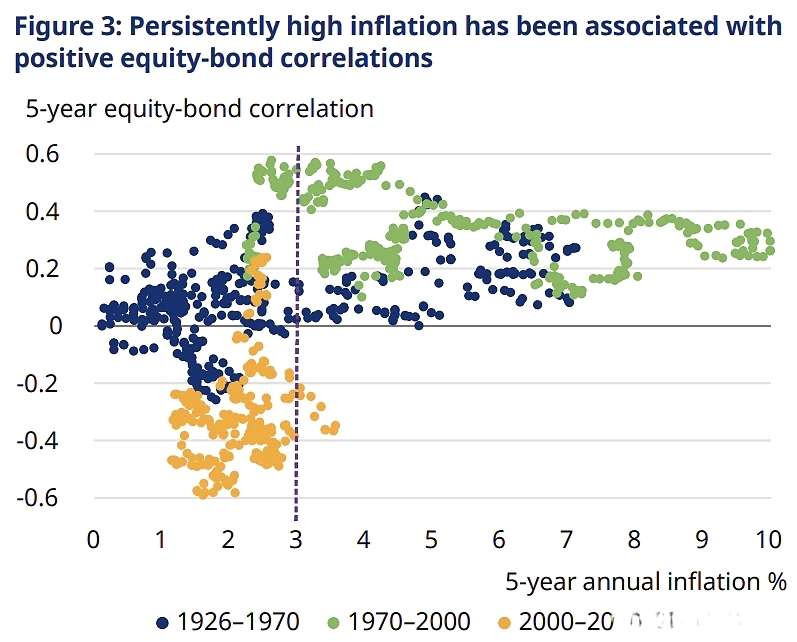
If you allocate assets from the perspective of hedging portfolio risks, you must consider the possibility of non-interest-bearing assets, especially for investors who hold a large amount of equity assets and bonds. Compared with gold, other non-interest-bearing assets have significant shortcomings: commodity prices are greatly affected by cycles and are difficult to allocate in the long term; there is a lot of artistic space for differentiated commodity valuation, and the realization efficiency is extremely poor.
Gold itself is an excellent and natural hedge: it can hedge the risk of legal currency, hedge the risk of inflation (fixed interest bonds), and in some cases, hedge the risk of equity assets (such as rising supply-side costs). Especially for extreme risks, such as the long-term high inflation that some overseas countries have experienced, the collapse of the legal currency economic system, war, etc., gold's stability against these extreme scenarios is unparalleled.