
Bank of Japan Maintains Interest Rate Target at 0.25%, in Line with Expectations

The Bank of Japan (BoJ) concluded its two-day monetary policy review on Thursday by keeping its short-term interest rate target unchanged at 0.25%.
This decision aligns with market expectations, which had anticipated no changes to the current policy stance.
BoJ’s Monetary Policy Statement
The BoJ’s Policy Board unanimously voted to maintain the following guideline for money market operations during the intermeeting period:
The bank will continue to encourage the uncollateralized overnight call rate to remain around 0.25%.
CPI and GDP Forecasts:
The board's core CPI median forecast for fiscal year 2024 remains at +2.5%, unchanged from July.
The core CPI forecast for fiscal year 2025 is revised down to +1.9% from +2.1% in July.
The forecast for fiscal year 2026 remains steady at +1.9%.
The board’s core-core CPI (excluding fresh food and energy) for fiscal year 2024 is now expected to grow +2.0%, up from +1.9% in July.
The core-core CPI for fiscal year 2025 remains at +1.9%, and for fiscal year 2026 it remains at +2.1%.
The board’s real GDP forecast for fiscal year 2024 remains at +0.6%.
The GDP forecast for fiscal year 2025 has been revised up to +1.1% from +1.0%.
The forecast for fiscal year 2026 remains at +1.0%.
USD/JPY Reaction to the BoJ Rate Decision
Following the BoJ’s decision, the Japanese yen made modest gains, with USD/JPY falling by 0.06% to around 153.32.
Japanese Yen Performance Over the Past Week
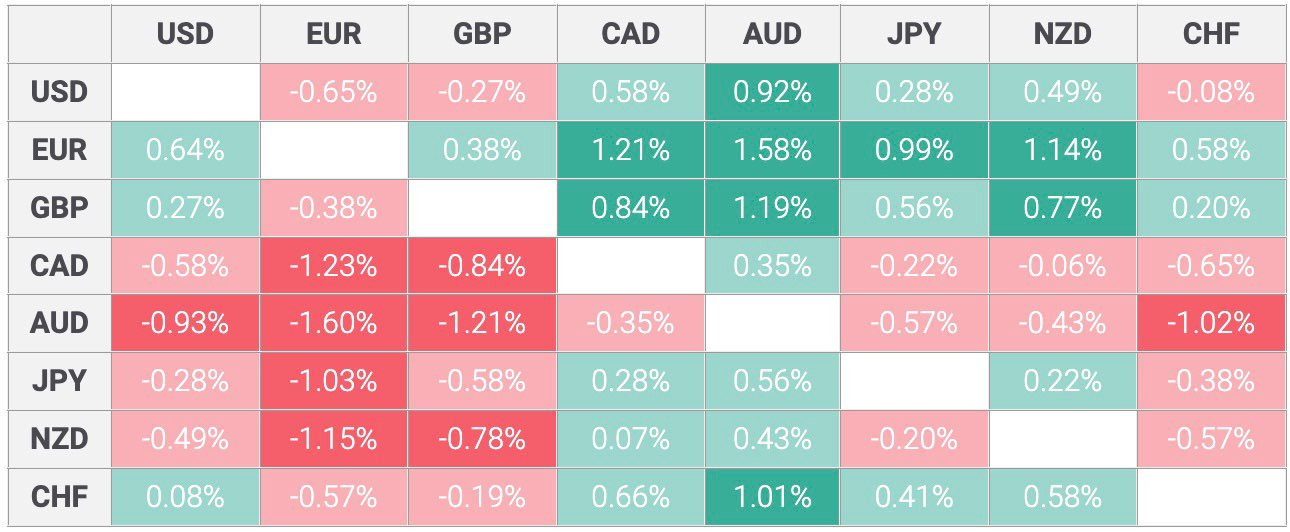
The table below shows the percentage changes of the Japanese yen (JPY) against major currencies in the past seven days, with the yen performing weakest against the euro.
The following section was published on October 31 at 23:00 GMT as a preview of the Bank of Japan’s (BoJ) policy announcement.
The BoJ is widely expected to maintain interest rates steady on Thursday, with all eyes on the bank’s quarterly forecasts and Governor Kazuo Ueda’s press conference.
What to Expect from the BoJ Rate Decision?
The BoJ is likely to hold rates steady for the second meeting in a row after its surprise 15-basis-point (bps) rate hike in July.
With the status quo outcome largely anticipated, market participants will focus on the BoJ’s outlook for future rate hikes amid Japan’s recent inflation trends, rapid yen depreciation, and political uncertainty. The ruling Liberal Democratic Party (LDP), led by Prime Minister Shigeru Ishiba, lost its parliamentary majority in the October 27 snap election, marking the first such loss in 15 years.
In this context, the BoJ’s updated forecasts for inflation and economic growth will be crucial for gauging the pace and timing of future rate hikes.
Tokyo’s October inflation data, a key indicator of national trends, showed a 1.8% year-over-year (YoY) rise in the Consumer Price Index (CPI), down from September’s 2.1%.
Meanwhile, the BoJ’s closely watched “core-core” CPI – which excludes both fresh food and energy – climbed 1.8% YoY, up from 1.6% in September, suggesting underlying price pressures are gradually increasing. This may prompt the BoJ to consider a rate hike in its December policy meeting.
Hawkish expectations may also be fueled by Japan’s political uncertainty, which could exacerbate the yen’s decline. Further yen depreciation could drive up imported inflation and short-term inflation expectations.
Overall, the BoJ is expected to adopt a wait-and-see approach, assessing domestic risks alongside uncertainties tied to the U.S. presidential election on November 5 and broader economic conditions.
BBH analysts previewed the BoJ’s decision, saying: “Recent comments from Ueda suggest there will be no policy changes at this meeting, so the focus will be on the BoJ’s policy guidance. We expect the BoJ to signal again that it is in no rush to remove policy accommodation, which would further weigh on the yen.”
Regarding macroeconomic forecasts, BBH analysts see downside risks.
How Could the BoJ’s Rate Decision Affect USD/JPY?
The yen hit a fresh three-month low against the U.S. dollar (USD) ahead of the BoJ decision, with USD/JPY nearing the 154.00 mark. Yen weakness is expected to persist if the BoJ holds rates steady.
However, should the BoJ hint at a potential rate hike in December, acknowledging the risks from yen depreciation, the yen could see a strong rebound. Any USD/JPY sell-off might be short-lived due to downside risks in inflation and growth forecasts.
Conversely, if the BoJ maintains a cautious tone in line with Governor Ueda’s recent comments, the yen may weaken further. Ueda remarked on October 23, “Underlying inflation has been rising slowly, and it will still take time for us to sustainably reach the 2% inflation target.”
“When there’s great uncertainty, you usually want to proceed cautiously and gradually,” Ueda added.
A downward revision to growth and inflation forecasts could further embolden dovish market sentiment. In such a scenario, USD/JPY could retest the 160.00 level.
From a technical perspective, I believe the daily chart’s Relative Strength Index (RSI) shows oversold conditions, indicating that USD/JPY buyers have become cautious ahead of the BoJ decision. However, they remain hopeful, as the 21-day Simple Moving Average (SMA) is nearing a bullish crossover with the 100-day SMA. If this crossover is confirmed on a daily close, the uptrend will be affirmed.
A dovish BoJ message could reignite the USD/JPY uptrend, pushing the pair toward the 155.00 supply zone, and possibly challenging the July 24 high of 155.99. Further gains could open the door for a test of the 156.50 psychological barrier. Conversely, a break below the critical 200-day SMA at 151.50 could trigger a meaningful correction toward the 150.30 region, where the 21-day SMA and 100-day SMA converge.