
Elcid Stock Skyrockets by 6,692,535% in a Single Day on India's Stock Market

Go Wire
November 1, 2024
GoGPT Summarizes Articles

In a striking turn of events, Elcid, a non-banking financial company based in Mumbai, India, witnessed an unprecedented surge in its stock price by a staggering 6,692,535%, closing at 236.25k rupees and claiming the title of India's highest-priced stock.
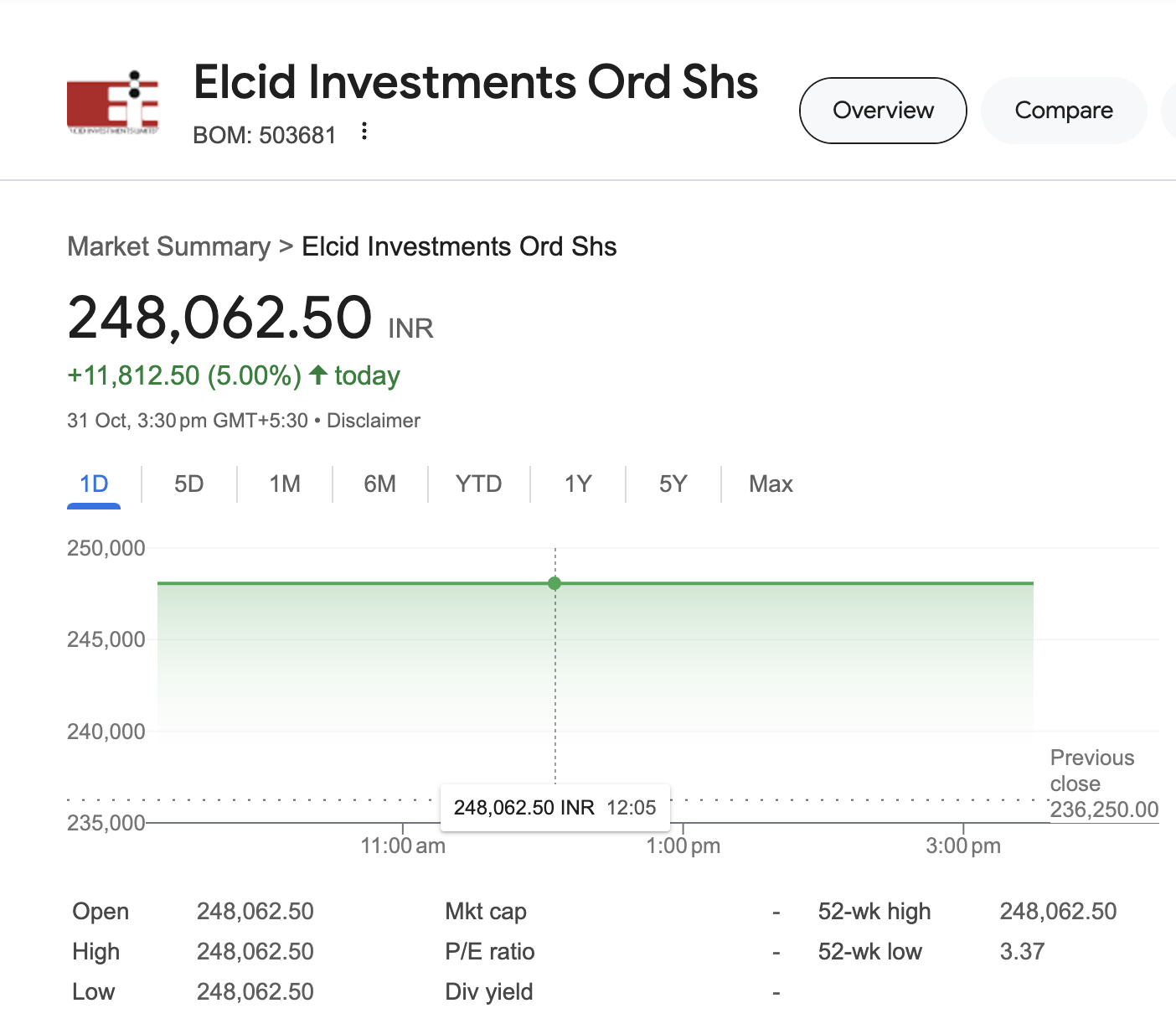
Elcid, primarily focused on investments in stocks, bonds, mutual funds, and other financial assets, holds a substantial stake in one of India's largest paint manufacturers, Asia Paints, valued at billions of rupees. The company's significant book value per share, far exceeding its historically traded price, resulted in minimal trading activity over the years, maintaining a low stock price despite its substantial intrinsic worth.
This remarkable surge in Elcid's stock price was catalyzed by regulatory interventions in India. The Securities and Exchange Board of India (SEBI) mandated special price discovery meetings aimed at accurately assessing holding companies like Elcid, whose market prices significantly lagged behind their book values. Through special auctions organized by the Mumbai Stock Exchange and the National Stock Exchange of India, liquidity was enhanced, aiding in the fair pricing of such stocks closer to their intrinsic values.
The astounding spike in Elcid's stock price in the auction, exempted from the usual 20% daily price volatility limit for stocks without derivative contracts in India, signifies a shift in the valuation methodology for holding companies facilitated by SEBI's regulatory framework. This unique mechanism allowed for a more efficient discovery of the companies' intrinsic values, leading to a significant revaluation of Elcid and other investment holding companies participating in the special auction.
Analysts highlight that SEBI's authorized special subscription auctions mark a significant change in the valuation approach for Indian holding companies in the stock market, providing a more accurate reflection of their true worth. Factors driving Elcid's surge include its undervaluation relative to its book value, the impact of the special subscription auctions, and the regulatory framework introduced by SEBI to facilitate fair price discovery for select holding companies in the market.
Despite staggering stock price increases in some companies, the overall performance of the Indian stock market has been disappointing since October.
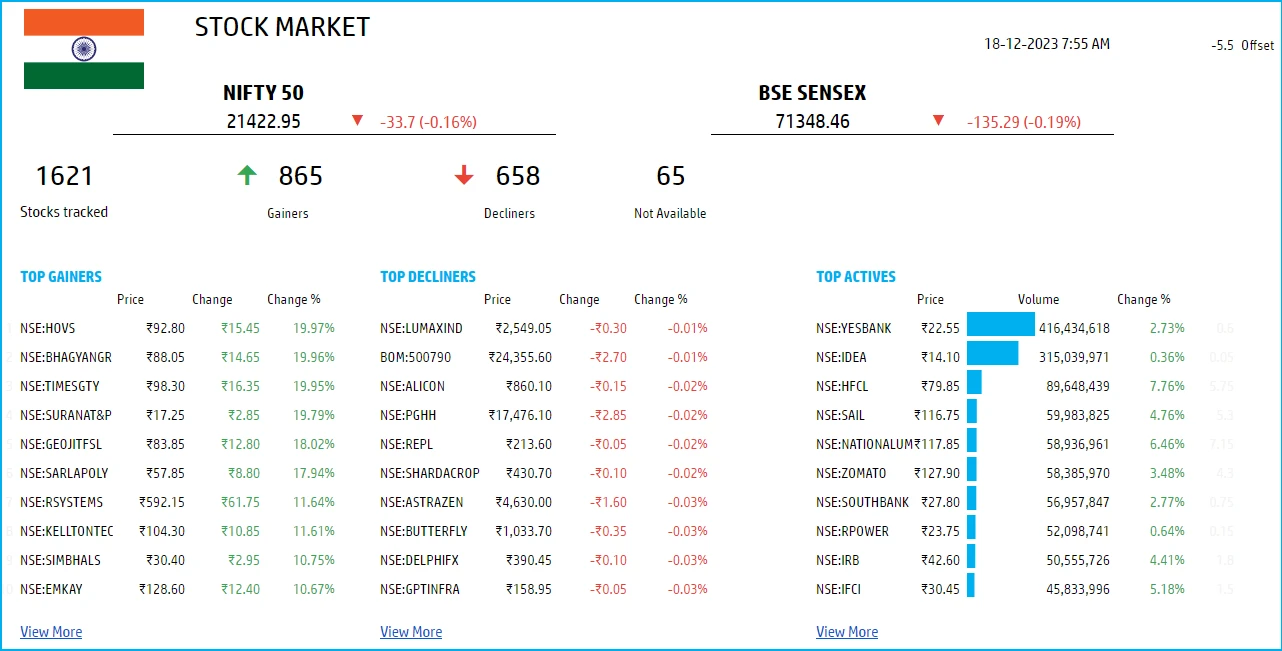
Due to sustained selling by foreign investors, the Indian NSE Nifty 50 index is poised to record its largest monthly decline since March 2020. The benchmark index fell nearly 6% in October, marking the first monthly decline since May, as soft corporate earnings dampened market sentiment amidst valuations above historical averages.
In the month leading up to October 29th, foreign institutions sold over $10 billion worth of Indian stocks. A report from Citigroup suggests that continued outflows from foreign investors may hinder the near-term performance of the Indian stock market. Citigroup analysts state that after this month's adjustments, Indian market valuations have moved away from their peak, but most indicators remain significantly above long-term average levels by almost a standard deviation.
HSBC Holdings mentioned that global institutional investors are reallocating funds from markets like India and South Korea towards Chinese mainland stocks, with the largest outflow of funds coming from the Indian stock market.
Recently, Goldman Sachs strategically downgraded its rating on the Indian stock market from "Buy" to "Neutral" citing the slowdown in Indian economic growth weakening corporate profit prospects.
Goldman Sachs strategists wrote, "While we believe India's structural positives remain intact, growth is cyclically slowing in many regions." They added that deteriorating corporate profit confidence, accelerated declines in earnings per share, and a weak start to the September earnings season indicate a challenging profit scenario for companies.
Goldman Sachs strategists also noted that high valuations in the Indian stock market may limit its near-term upside potential. This cautious stance highlights concerns over the sustainability of Indian corporate profits amidst weakening consumer spending and rising commodity prices.
Notably, financial reports from Indian consumer companies have also raised red flags. With inflation and unemployment dampening market sentiment, India's urban middle class has reduced expenditures for at least the second consecutive quarter. At least seven of India's largest companies, including retail divisions under Reliance Industries and consumer goods leader Hindustan Unilever, indicated softening consumer demand and challenging operating environments in their earnings for the July-September quarter.
For global giants seeking to leverage India's 1.4 billion consumer base for revenue growth, the disruptions in India's consumption narrative signal ominous prospects. R. C. Bhargava, Chairman of Maruti Suzuki India Limited, expressed concerns, stating, "The worrying factor is that growth is happening only in certain areas." The largest Indian automaker reported disappointing profits with no growth in the segment that once held an 80% market share, namely entry-level small cars, a metric for urban consumer demand.
Retail operations under Reliance Industries saw a 3.5% decline in operating revenue in the third quarter, partly due to softened demand for fashion and lifestyle products. Additionally, Ritesh Tiwari, CFO of Hindustan Unilever, noted that while rural demand is recovering, it cannot offset the lack of large-scale urban spending, with smaller towns and villages accounting for only a third of the company's sales. He mentioned that the recovery of demand growth will require several quarters.
Sonal Varma and Aurodeep Nandi stated, "We believe that the softness in Indian urban demand may persist." They explained that the pent-up demand surge post-pandemic has waned, monetary policy tightening, and the Reserve Bank of India's crackdown on unsecured credit are hampering economic activity.