
Fed November Rate Decision Outlook: Challenging the Path to Rate Cuts

Due to the U.S. election and daylight saving time changes, the Fed’s latest rate decision will be delayed by a day, with the final announcement set for 3 a.m. Singapore time on Friday, November 8.
Analysts widely expect the Fed to cut rates by 25 basis points, lowering the target range from 4.75%-5% to 4.5%-4.75%. However, the policy direction of the incoming U.S. administration and the conflicting economic data make the Fed's path forward increasingly uncertain. According to the CME FedWatch Tool, markets anticipate 25 basis-point cuts in both of the remaining meetings this year, while traders have scaled back expectations for rate cuts in 2025.
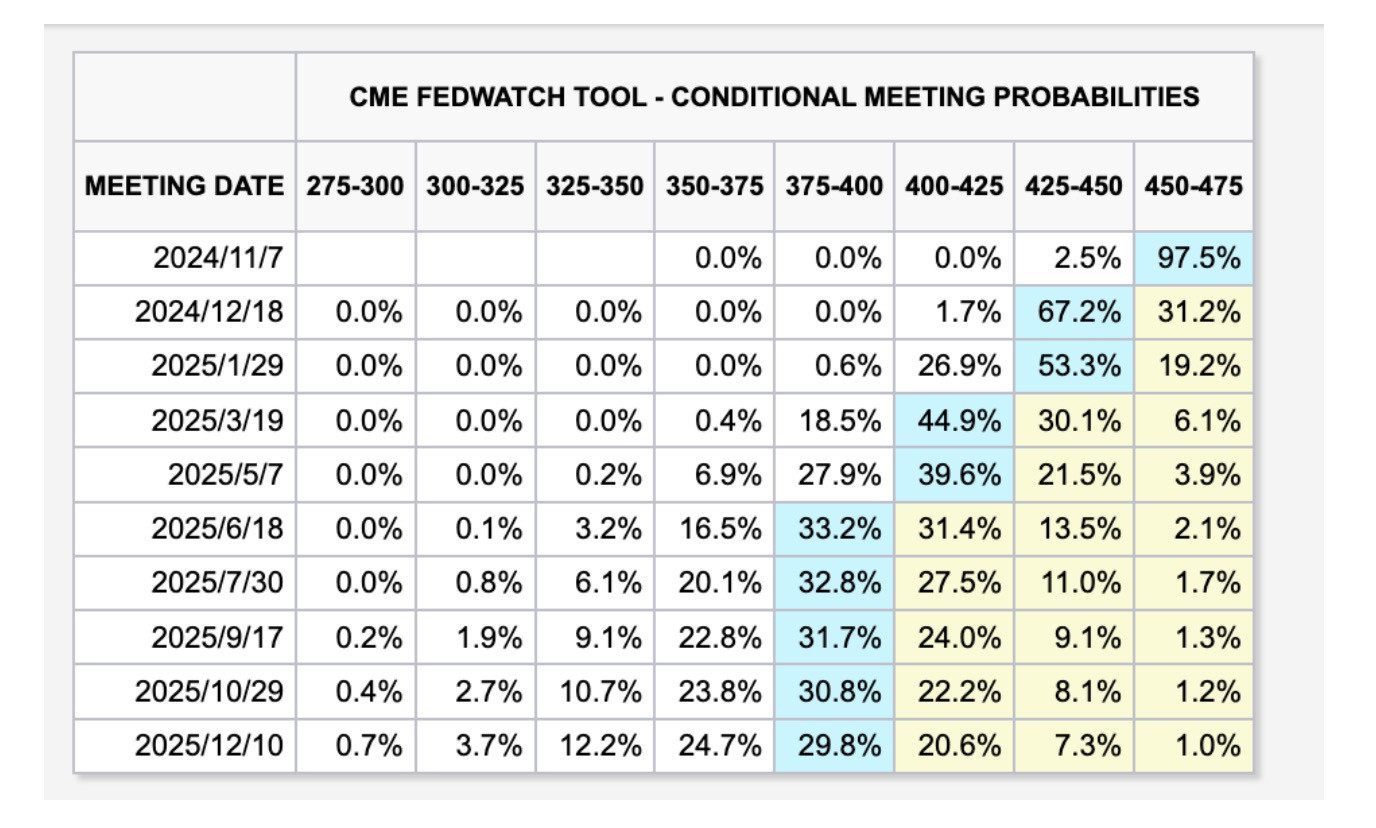
Current projections suggest that the Fed may implement two additional rate cuts in the first half of 2025 before halting, bringing the federal funds rate to a target range of 3.75%-4%.
Conflicting U.S. Economic Data
Since September, U.S. economic data has shown mixed signals. Consumer spending and GDP have strengthened, while manufacturing and employment metrics continue to cool. U.S. Q3 GDP grew at an annualized rate of 2.8%, driven by resilient consumer spending. However, labor demand has been softening, with September job openings plummeting to their lowest level in over three years, suggesting waning demand. Over the past three months, the U.S. private sector has added an average of only 67,000 jobs per month, the lowest since 2020. Furthermore, due to the effects of hurricanes and strikes, non-farm payroll growth in October fell sharply to just 12,000 jobs, far below market expectations of 100,000, while the previous two months’ data was revised down by a combined 112,000 jobs.
Economist Lindsey Piegza from Stifel notes that this contradictory and frequently revised data adds complexity to the Fed's decision-making. She highlights significant internal division within the Fed, with some officials expressing concern over inflation and taking a cautious stance on rapid rate cuts, while others focus on the weakening labor market and advocate for further, substantial cuts.
What Lies Ahead for the Fed?
Mike Medeiros, a macro strategist at Wellington Investment Management, suggests the Fed’s confidence in the current inflation outlook allowed it to begin a rate-cutting cycle in September, indicating potential further cuts.
However, policy adjustments could temporarily raise inflation and increase volatility. Medeiros points out that U.S. policy changes may accelerate labor market cooling, structurally reduce total trade volumes, and worsen fiscal conditions, all of which heighten the risk of short-term inflation. If fiscal pressures and price levels continue to rise, the Fed may have to reconsider its stance, pausing the rate-cutting cycle or even raising rates again if needed.
David Kelly, Global Chief Strategist at JPMorgan, believes the Fed could pause rate cuts as early as December, noting that political events, while not directly influencing the Fed, can shape the economic landscape in ways the Fed cannot ignore. The Fed’s decisions will be informed as more clarity emerges around fiscal policy.
Michael Feroli, JPMorgan's Chief U.S. Economist, recently adjusted his outlook, predicting two more 25 basis-point rate cuts in November and December, but expects the Fed to slow down in 2024 with one rate cut per quarter starting in March, potentially bringing the federal funds rate down to 3.5%.
BMO Wealth Management’s CIO, Yung-Yu Ma, stresses the importance of caution in the Fed's rate path. He suggests the Fed may have only two or three rate cuts remaining in 2025 after November and December’s expected 25 basis-point reductions.
Meanwhile, Nomura's Chief Economist for Developed Markets, David Seif, forecasts two 25 basis-point cuts this year, but only one in 2025, revising his expectation for the terminal rate upward by 50 basis points to 3.625%. He notes that recent policy signals could drive short-term inflation higher, slowing economic growth.
Finally, with the Fed's rate-cutting cycle underway, the debate around the endpoint of rate cuts is gaining prominence. Many Fed officials are expected to proceed with caution to avoid pushing rates below the neutral level, allowing flexibility to adapt to evolving economic conditions. What do you think? How will the Fed’s rate-cutting trajectory evolve in response to this complex economic landscape?