
Emerging Powerhouse or Global Giant? Performance Comparison and Investment Prospects of Grab and Uber

On November 11, Singapore’s Grab Holdings (GRAB.O) raised its revenue forecast for fiscal year 2024. The Southeast Asian tech company anticipates strong growth in its food delivery and ride-hailing businesses during the busy holiday season. With rising consumer discretionary spending and a gradually recovering economy, Grab’s core food delivery service is rebounding from the post-pandemic demand slump. The U.S.-listed Grab shares surged more than 10% in after-hours trading.
Grab’s CEO, Anthony Tan, expressed optimism about the long-term growth outlook in Southeast Asia, stating that the company is capitalizing on the upward trend in user demand. Grab now expects full-year revenue between $2.76 billion and $2.78 billion, up from the prior forecast of $2.7 billion to $2.75 billion.
Grab has been working to introduce more affordable ride-hailing options to attract price-sensitive customers, while also promoting premium services to boost profitability. According to CFO Peter Oey, Grab’s premium ride services offer profit margins that are 1.2 times higher than standard services. Grab’s third-quarter revenue reached $716 million, surpassing Visible Alpha’s estimate of $700.8 million. Oey noted that customer transaction volume grew 22% in Q3, with subscribers spending four times as much as non-subscribers.
The company also raised its annual core profit forecast from $250 million-$270 million to $308 million-$313 million. Delivery revenue grew by 16% year-over-year to $380 million, beating the forecasted $374.2 million. Additionally, Grab maintained its annual adjusted free cash flow forecast and exceeded expectations in its financial segment. On an adjusted basis, Grab earned $0.01 per share, surpassing the break-even forecast.
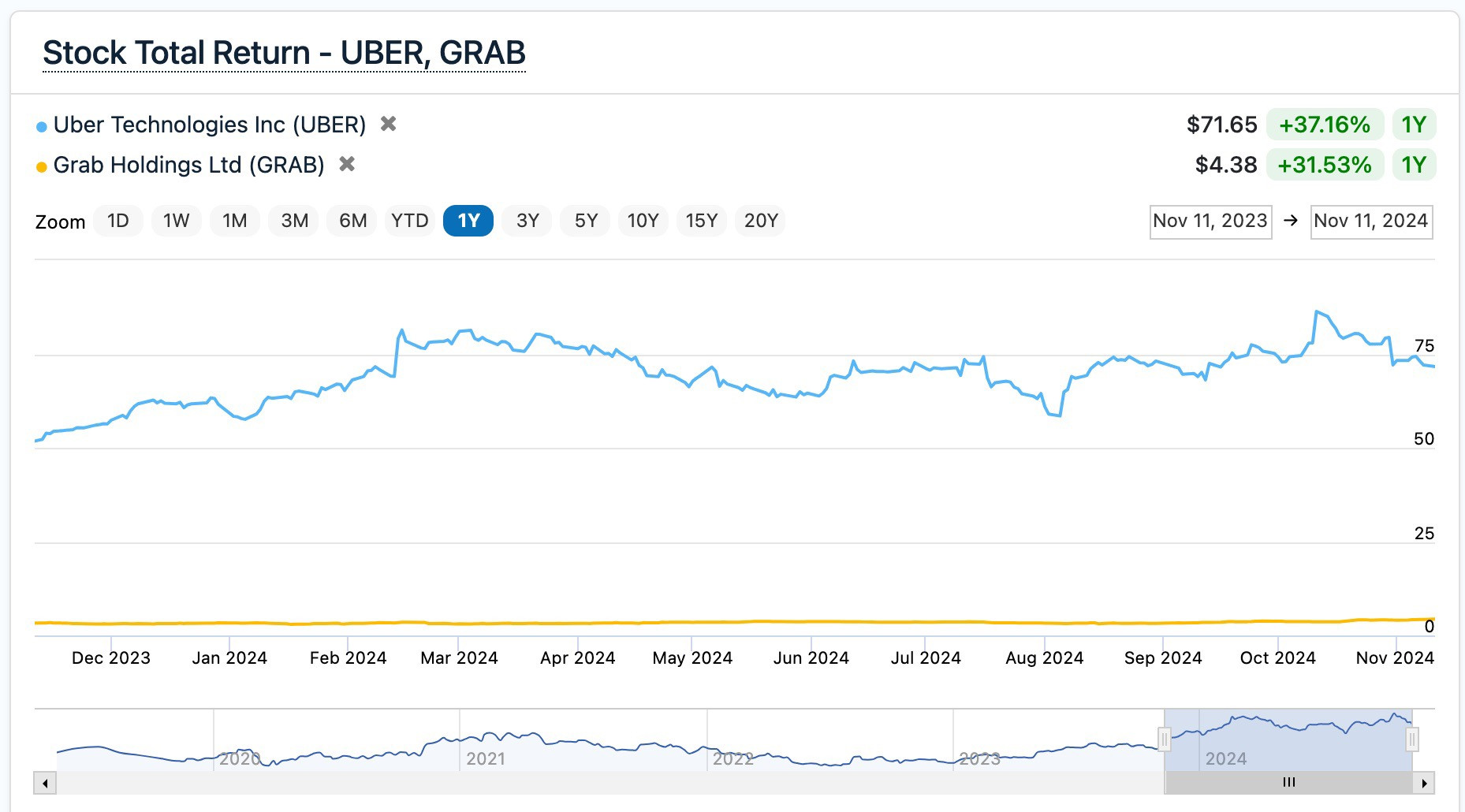
However, when looking at overall market performance, Grab lags significantly behind its global peer, Uber. Over the past year, Uber's total return reached +37.16%, outpacing Grab’s +31.53%. Although Grab’s share price has remained relatively stable, it lacks the upward momentum seen in Uber. Uber's stock shows more volatility and stronger growth, reflecting investors' confidence in its global market position.
In terms of annual returns, Uber posted an impressive recovery in 2023 with a gain of +148.97%, following a substantial decline in 2022. In contrast, Grab saw only a +4.66% increase in 2023 after a sharp -54.84% drop the previous year. Uber's long-term returns are notably stable, especially over the past three and five years, highlighting its consistent growth as a mature market player. Grab's shorter track record, on the other hand, reflects both the potential and volatility of Southeast Asia’s emerging market.
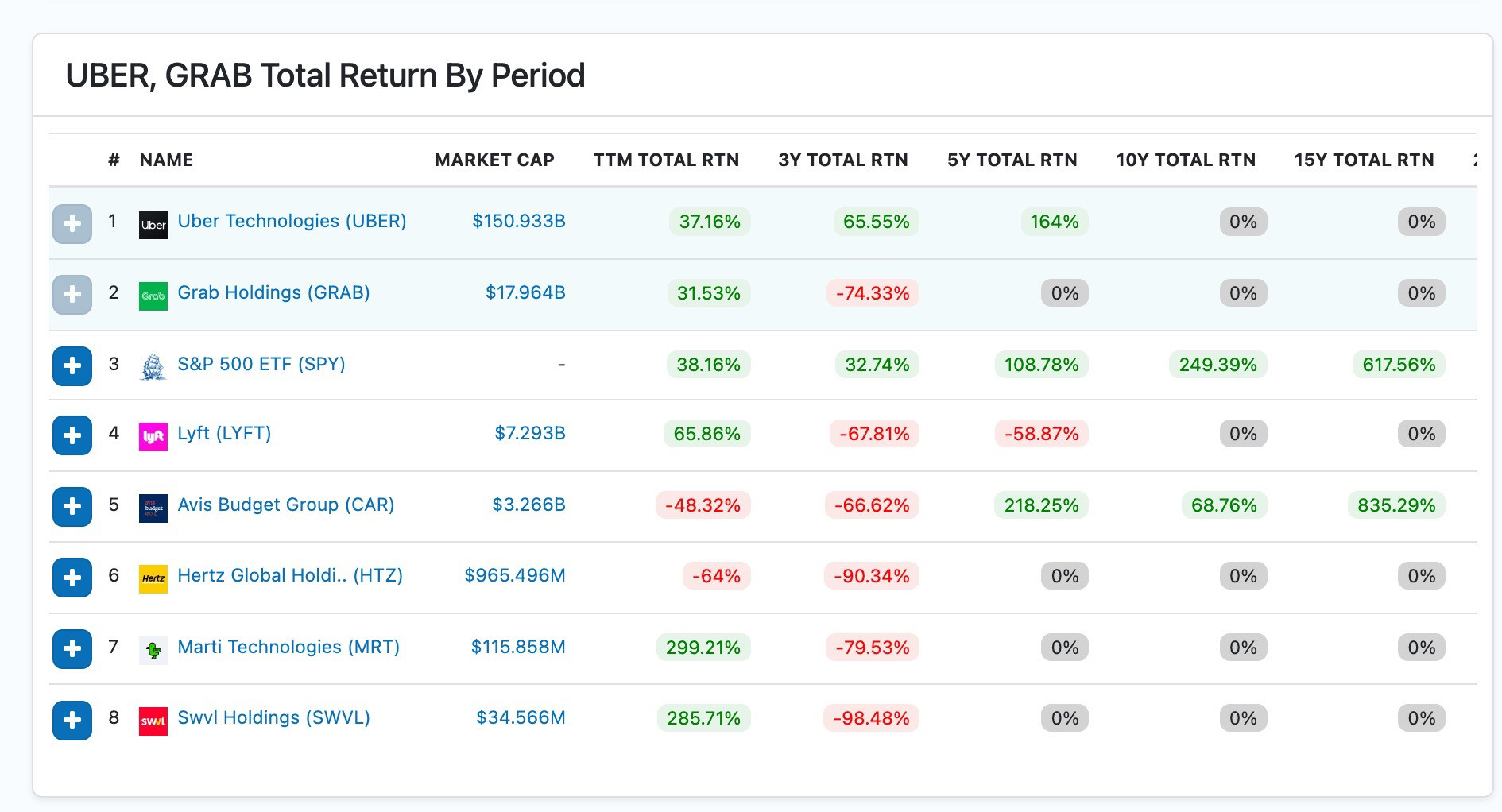
From a Compound Annual Growth Rate (CAGR) perspective, Uber has positive CAGR across multiple time frames, indicating steady annualized growth. In contrast, Grab’s three-year CAGR is negative, suggesting challenges in achieving stable long-term performance. Overall, Uber’s long-term growth potential and market position make it more suitable for investors seeking steady growth and global market opportunities, while Grab may appeal to those interested in high-risk, high-reward opportunities in emerging markets.
Market expectations indicate that Grab's full-year revenue target is $2.75 billion, with an expected loss of $0.04 per share. Recent forecast trends show a downward revision in Grab’s 2024 revenue projection from $2.77 billion to $2.75 billion, and a reduction in its 2025 forecast from $3.24 billion to $3.21 billion. The expected per-share loss has also widened in the past 90 days, from a projected loss of $0.02 to $0.04 in 2024, and from a projected profit of $0.06 to $0.03 in 2025.
Analysts’ one-year price target reflects potential upside for Grab. According to 23 analysts, the average target price for Grab is $4.59, with a high estimate of $6 and a low of $3.5, implying a 7.46% upside from the current $4.27 price. GuruFocus estimates place Grab’s one-year GF Value at $6.42, suggesting a potential upside of 50.35% from its current price. Additionally, the consensus rating from 25 brokerage firms is 1.8, indicating an “Outperform” rating.
In summary, Grab’s raised revenue expectations highlight Southeast Asia’s market vitality and economic recovery. However, Uber remains dominant in growth stability and long-term performance due to its global reach. Grab may be better suited for investors seeking high-risk, high-reward potential in emerging markets, while Uber appeals to those looking for stable growth in mature markets.
As for stock price outlook, Grab’s current price sits near historic lows, making it an attractive opportunity. With the recent upward revision in revenue expectations, Grab’s stock could continue to rise toward the resistance level around $5.7. If it breaks through, it may push even higher to the next resistance level around $10.11.
What do you think? Would you hold Grab?