
Gold Holds Firm at Key $2,545 Support: What’s Next?

Amid steady demand for the US Dollar and mixed economic data from China, gold prices are looking to extend their recent rebound in early Friday trading, seeking fresh momentum for a potential upward move.
XAU/USD Technical Analysis
The short-term technical outlook for gold remains largely unchanged, with any recovery likely to be limited unless the 14-day Relative Strength Index (RSI) turns bullish.
As of now, the RSI has slightly bounced back to around 34 after briefly entering oversold territory.
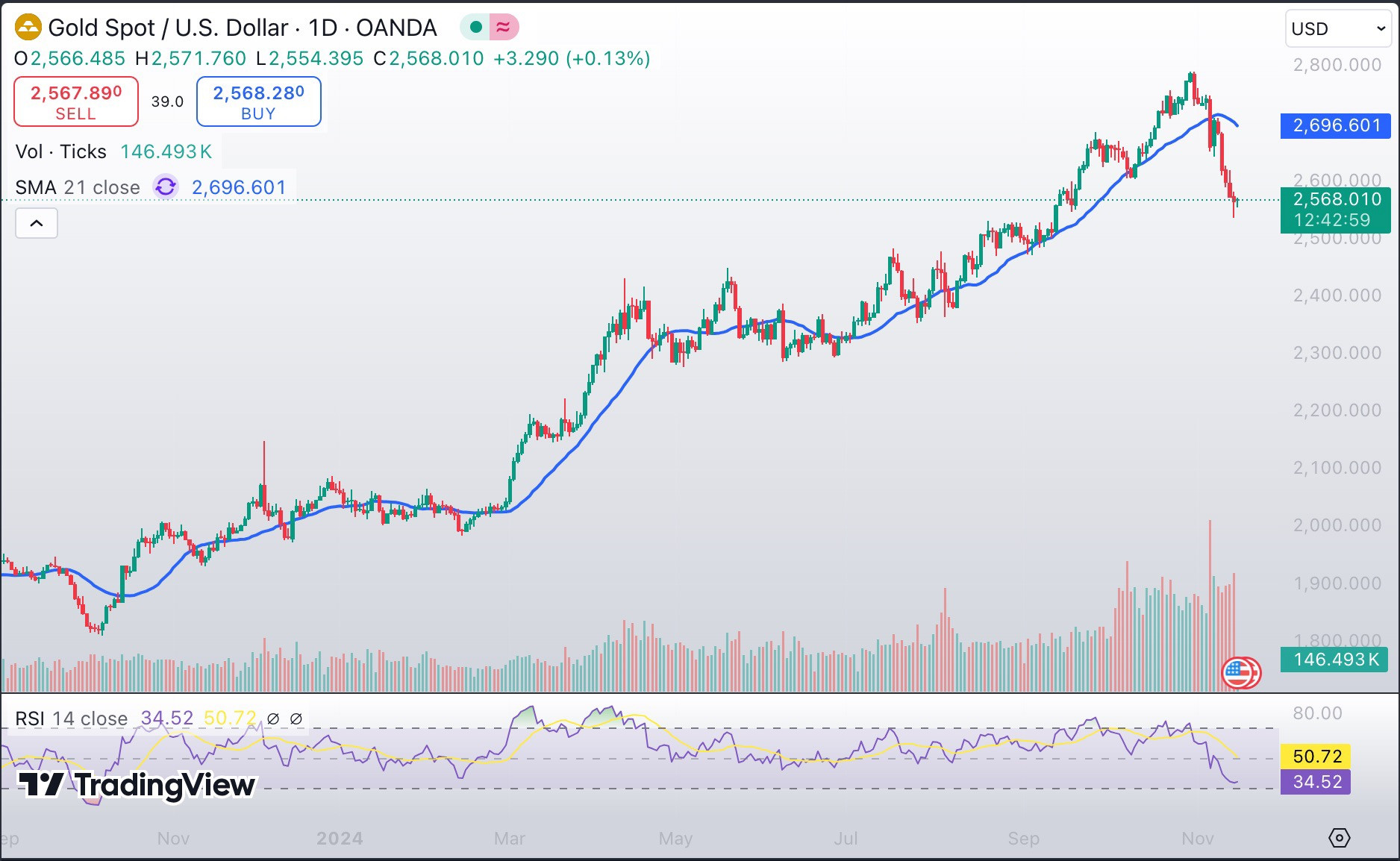
This RSI uptick coincides with gold’s rebound from the critical $2,545 support, which aligns with the 100-day Simple Moving Average (SMA) and the September 18 low.
To sustain a broader recovery, gold buyers need to reclaim the $2,580 demand area on a daily close, opening the door to test the $2,600 level.
Further resistance awaits at the November 13 high of $2,619, where bearish pressure could resurface.
On the downside, the immediate support remains the key level at $2,545. A decisive break below this point could trigger a fresh downtrend toward $2,500, with the next bearish target at the September 4 low of $2,472.
Fundamental Analysis
Despite China’s retail sales growth of 4.8% in October, industrial production disappointed with a 5.3% rise, falling short of expectations. Fixed asset investment growth for the year through October remained steady at 3.4%.
This mixed data from China has fueled concerns over the country’s economic outlook, as investors remain cautious about the effectiveness of stimulus measures. Asian stocks were mixed on Friday, weighed down by a decline in Chinese indices.
Uncertainty over the Federal Reserve’s future rate cuts also added pressure to the market. Fed Chair Jerome Powell stated on Thursday evening that there is no rush to cut rates, given the ongoing economic growth, solid job market, and inflation still above the 2% target. This dampened expectations for a rate cut next month, according to Reuters.
The US Dollar saw renewed strength as short-term US Treasury yields surged following Powell’s hawkish comments, pushing gold down to as low as $2,537. However, bargain hunting at lower levels helped gold recover some ground.
Investors will now turn their attention to a new set of US economic data releases, including the crucial Retail Sales report, for clues on gold’s next move. Meanwhile, additional speeches from Fed policymakers could offer further insight into the likelihood of continued easing beyond December.
According to Reuters, “Fed fund futures dropped, with December contracts down seven basis points, implying only 71 basis points of rate cuts by the end of 2025. The probability of a rate cut next month has dropped to 61%, down from 82.5% in the previous session.”
The Fed’s hawkish stance was further reinforced by the October US Producer Price Index (PPI) data released on Thursday. The annual headline PPI rose by 2.4% in October, up from 1.9% in September, indicating a slowing disinflation trend in the economy.
What’s Next for Gold Prices: Is Now the Right Time to Buy the Dip?
Given gold's current technical and fundamental outlook, a cautious approach may be advisable. Gold has managed to hold above the critical $2,545 support, and bargain hunters are starting to step in at lower levels, which could indicate some resilience. However, with a strong US Dollar and potential headwinds from the Federal Reserve’s hawkish stance, any significant upward momentum might be limited in the near term.
If you’re considering buying the dip, it’s essential to watch how gold performs around the $2,580 and $2,600 levels. A sustained daily close above $2,580 could signal a stronger recovery, while any break below $2,545 could open the door to further downside, with $2,500 as the next key support.
In short, while the current support level may attract some short-term buying, a more substantial upside may depend on a shift in Fed policy or a weakening US Dollar. If you’re a long-term investor with a higher risk tolerance, scaling into a position at current levels could be an option, but keeping an eye on the Fed’s policy updates and economic data is crucial.