
Nvidia's Emphasis on China: Recognizing the Country's Strategic Importance

WallStreetSerina
November 26, 2024
GoGPT Summarizes Articles
In recent days, a flurry of high-level executives from prominent American tech companies have been making visits to China. On November 25th, executives from Nvidia visited China and held meetings with senior officials from the Chinese Ministry of Commerce, signaling the profound importance that multinational tech giants place on the Chinese market.
According to the Ministry of Commerce's website, Wang Shouwen, China's Vice Minister of Commerce and International Trade Representative, met with Nvidia's Executive Vice President, Jay Puri, to discuss Nvidia's development in China and related topics. The Chinese side warmly welcomed Nvidia's continued commitment to the Chinese market.
As one of the most crucial global tech companies today, Nvidia's future business operations in China have garnered significant attention from the market. Nvidia's international revenue accounted for a significant portion of its total revenue, with China and Taiwan being the largest contributors, generating 15.44% and 14.69% of total revenue, respectively.
Seeking Balance in Policy and Driving Global Tech Collaboration
Jay Puri, responsible for Nvidia's global operations, emphasized China's significance as a key market for Nvidia. He stated that Nvidia views China as a vital market and is committed to enhancing communication with Chinese partners, providing high-quality and efficient products and services, and actively participating in China's digital economic development.
Regarding the meeting, Nvidia issued a statement to First Financial, saying, "We are pleased to have the opportunity to meet with government officials from every market we serve." The company did not provide additional information to First Financial journalists about the discussions, nor did they disclose whether Nvidia's CEO and founder, Jensen Huang, has plans to visit mainland China.
Amidst the global AI boom, Nvidia, a leading tech company providing the majority of AI chips for data centers worldwide, is increasingly pivotal across various industries. Nvidia's stock price has surged by nearly 190% this year.
However, as of the market close on November 25th, Nvidia's stock price dropped by over 4%, causing it to be surpassed by Apple, losing its position as the highest-valued company in the US stock market.
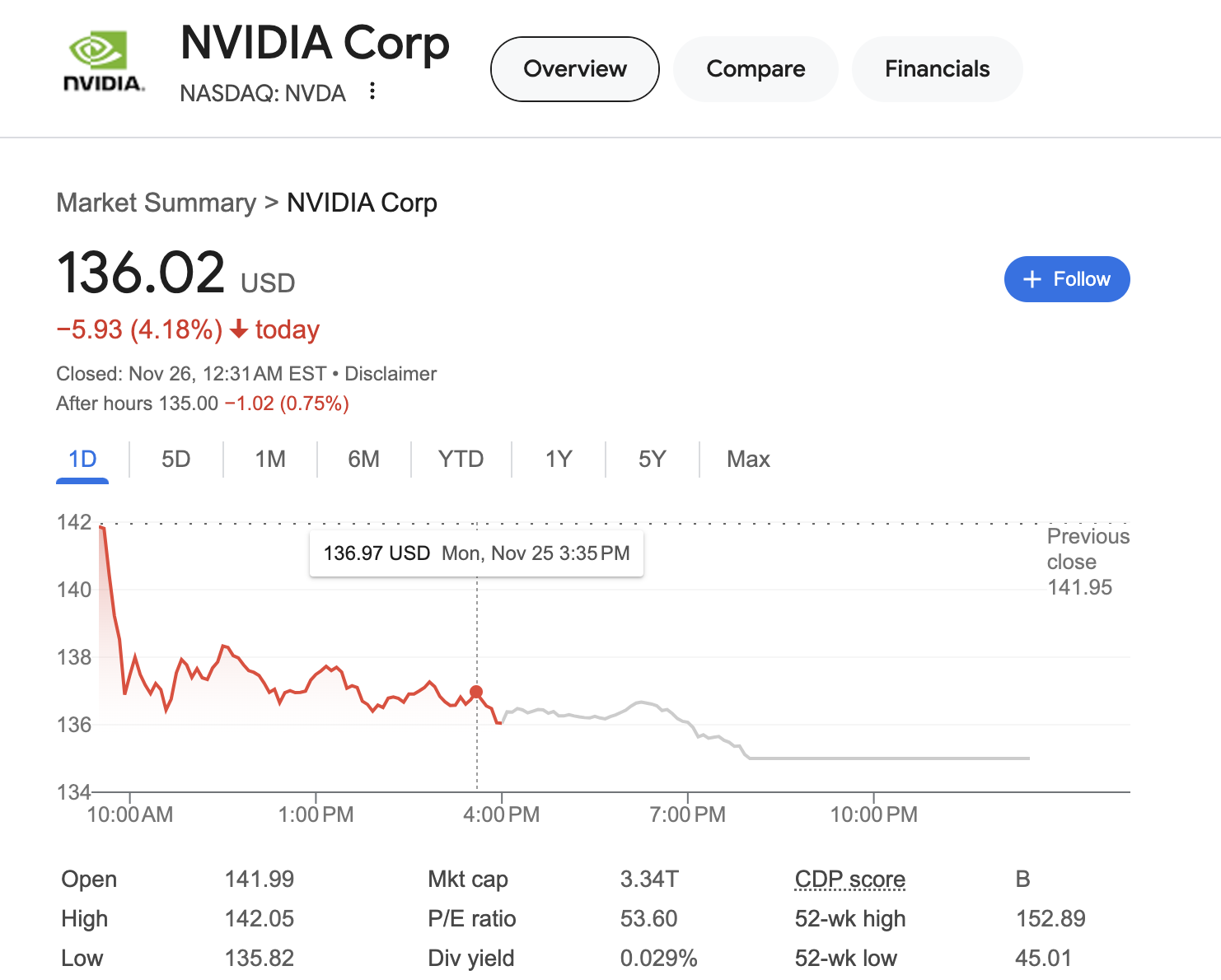
Nvidia's stock decline is linked to recent rare downgrades in investment ratings by some investment analysts. A report from Phillip Capital, a Singapore-based investment and wealth management firm, suggests that escalating US-China trade tensions could impact Nvidia's stock price if the US enforces stricter tariff policies, leading to a downgrade in their investment rating from "buy" to "accumulate gradually."
Nvidia's development in China is facing multiple challenges. In a recent earnings report, when asked about the possibility of the Trump administration imposing higher tariffs on high-tech products, Jensen Huang remarked, "Whatever decision the new government makes, we will, of course, support it. The company will fully comply with any ensuing regulations."
During his recent visit to Hong Kong, Jensen Huang reiterated, "Even if stricter export controls are implemented by the new government, we will strive to achieve a balance between compliance with regulations and continuing to advance technology cooperation, supporting and serving customers worldwide."
Facing Intense Competition in China
Due to export controls, Nvidia's revenue share in the Chinese market has decreased from approximately 24% in the 2019 fiscal year to around 13% currently.
Earlier this year, there were reports that the H20 chip was struggling to sell in China, necessitating price reductions. Despite the H20's focus on cost-effectiveness, technical limitations have hindered its ability to compete effectively with Chinese counterparts, thereby constraining demand.
According to an analysis report by research firm SemiAnalysis, chips tailored for the Chinese market also face challenges in manufacturing costs. The firm stated that due to the higher memory capacity of the H20 chip, its manufacturing cost exceeds that of the H100, yet its selling price is approximately half that of the H100, leading to a significant profit decline.
Given the global demand outstripping supply for Nvidia's advanced chips and the production constraints, the company faces the dilemma of whether to continue developing products with low profitability, mediocre sales, and intense competition.
During a financial earnings conference in May, Jensen Huang mentioned that Nvidia is still striving to serve the Chinese market to the best of its abilities. He stated, "Our business in China is much lower than in the past, and due to limitations in our technology, we are facing fiercer competition in the Chinese market. These are real challenges. Nonetheless, we will continue to make every effort to serve customers and markets there."
Jensen Huang has been less vocal about Nvidia's Chinese operations recently as he vigorously promotes the shipment of Nvidia's next-generation flagship AI chip, Blackwell, globally. This chip is expected to generate billions of dollars in revenue for Nvidia in the fourth quarter of this year, with significant sales growth projected for next year.
According to Jensen Huang's recent statements during his visit to Hong Kong, Nvidia intends to "retain" its business in China. Regarding Nvidia's future strategies in the Chinese market, the company told journalists, "We do not comment on unreleased products."
Some analysts believe that Nvidia still has significant potential in China. Gartner analyst Linghai Sheng told First Financial, "China currently has a massive demand for AI-related infrastructure, which undoubtedly contributes to Nvidia's business in China. Nvidia will not abandon this vast market. Apart from data centers, Nvidia also has substantial market potential in areas such as industrial intelligent manufacturing and autonomous driving."
#nvidia hitting 4 trillion