
Deliberate Concealment or Scapegoat? — The Mysterious Disappearance of $154 Million

Magical Investor
November 27, 2024
GoGPT Summarizes Articles
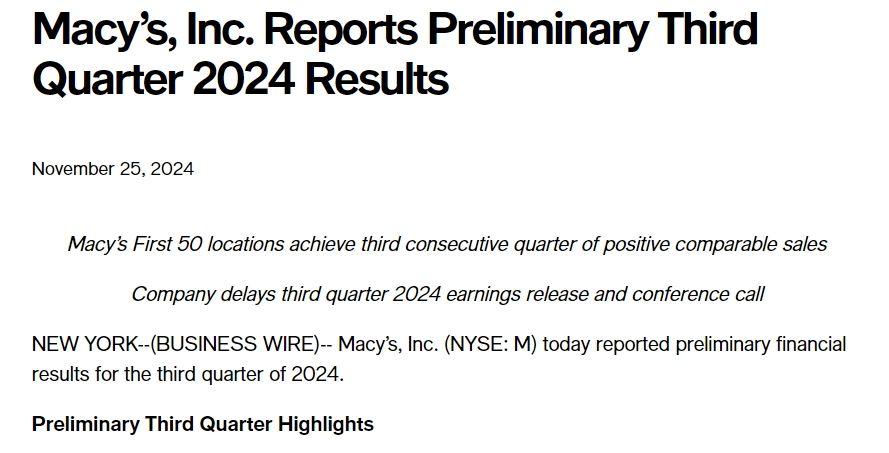
 On November 25th, Macy's (M) postponed the release of its Q3 earnings due to an internal investigation concerning an employee who concealed expenses totaling a significant $154 million.
The concealment involved $154 million in delivery fees. Macy's disclosed that an employee responsible for accounting small package delivery fees intentionally made "erroneous accounting accrual entries" and concealed expenditures ranging from approximately $132 million to $154 million from the fourth quarter of 2021 to November 2, 2024.
The scheduled release of the Q3 results, originally planned before the market opened on Monday Eastern Time, had to be delayed upon discovering this issue. Consequently, its stock price dropped by more than 8% in pre-market trading on Monday.
What's the Impact?
Macy's stated that the employee in question is no longer with the company and clarified that "there is no indication that the accounting error affected cash management activities or supplier payments."
Morningstar analyst David Swartz also remarked, "The preliminary data released on Monday largely aligned with expectations." He acknowledged the disappointing nature of the news but deemed it relatively inconsequential.
This incident sparked discussions on social media. Some users expressed skepticism, believing that an employee solely responsible for accounting small package delivery fees could not have acted alone, hinting at potential undisclosed factors.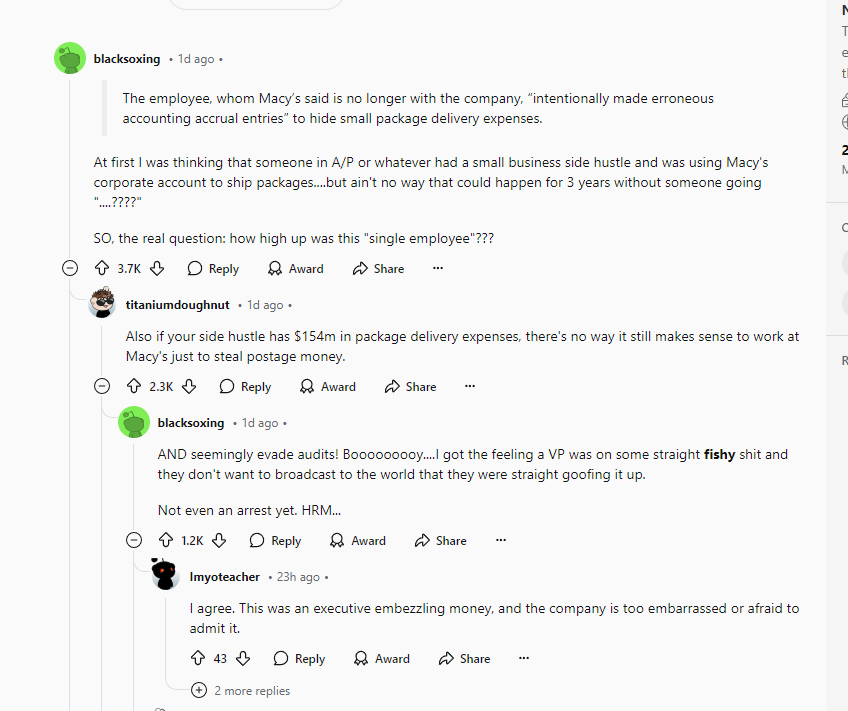
Despite Macy's annual operating expenses surpassing $8 billion, even if $50 million is underreported annually, it represents less than 1% of Macy's total annual expenses, making this incident relatively insignificant. The fact that Macy's stock price remained nearly unchanged further supports this notion. Nonetheless, the underlying narratives behind this event remain intriguing.
Future Stock Price Trend
Macy's preliminary financial report released on November 25th revealed a 2.4% decline in quarterly sales to $4.7 billion. The decrease was primarily attributed to underperformance in digital channels and reduced demand for cold-weather clothing due to warmer autumn weather.
Neil Saunders, an analyst at GlobalData Retail, noted, "The mid-market segment has been struggling, and Macy's has yet to fully leverage its stores' potential. The sales decline, while not surprising, underscores the company's overall downward trajectory."
As part of its transformation strategy, Macy's plans to shut down numerous underperforming stores. While the retained stores show relatively solid performance, overall sales have declined. In contrast, its high-end brand Bloomingdale’s experienced a 1.4% sales increase, and the beauty brand Bluemercury achieved a growth of 3.2%.
Moreover, the retailer, established 165 years ago, rejected a takeover bid from private investors in July and opted to independently pursue its brand revitalization strategy.
Regarding Macy's stock price forecast, two factors merit consideration. Firstly, the potential impact of the incoming administration, particularly any policies aimed at boosting domestic sales. Secondly, Macy's ability to successfully execute its transformation strategy and strike a balance between department stores and retail outlets.
Observing Macy's weekly candlestick chart, its trend remains within the oscillation range between $13.88 and $17.82. Investors should monitor closely for support levels and potential breakthroughs at these price points, as they will serve as crucial indicators for market entry timing.