
Next Week's Global Market Highlights: Non-Farm Payrolls Report Impact and New Middle East Front Initiated

Magical Investor
December 1, 2024
GoGPT Summarizes Articles
This week, U.S. stocks continued to strengthen, with the S&P 500 and the Dow Jones Industrial Average closing at historical highs. Since the beginning of this year, the S&P 500 Index has accumulated an increase of more than 26%. However, whether it can maintain this increase in the last month or even go further still requires an examination of the health of the U.S. economy.
Looking ahead to next week, the most important thing is naturally the regular feature on the first Friday of each month - the Non-Farm Payrolls Report. Looking back at the October data, the seasonally adjusted non-farm payrolls in the United States only recorded 12,000, less than one-tenth of the long-term average. However, it's unclear how much temporary factors such as hurricanes and strikes accounted for.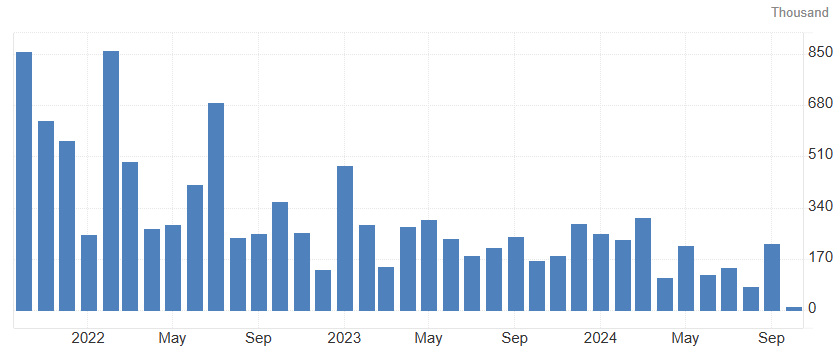
In recent months, the uncertainty regarding the Federal Reserve's interest rate path has increased. Some strong data have stirred concerns about a rebound in U.S. inflation. If the Federal Reserve really "cuts interest rates too much," it may erode the achievements obtained in the past two years through controlling prices with relatively high interest rates.
Sameer Samana, a senior global market strategist at the Wells Fargo Investment Institute, said that the Federal Reserve is questioning the economy, especially the labor market. They want to know exactly how much easing policy is still needed now.
Anthony Saglimbene, the chief market strategist at Ameriprise Financial, said that if the Non-Farm Payrolls Report exceeds expectations, it may shake people's confidence in the trend in December and lead to some selling.
In addition to the Non-Farm Payrolls Report, the final values of the services PMIs in Europe and the United States, as well as the number of job openings and initial jobless claims in the United States are also worthy of investors' attention. At next Wednesday, Federal Reserve Chairman Jerome Powell is invited to be interviewed, and on the same day, the Federal Reserve will also release the Beige Book on the economic situation.
Regarding Donald Trump, the U.S. stock market's performance shows that the market's expectations for his economic policies outweigh concerns about potential tariffs. A survey released by The Conference Board on Tuesday showed that 56.4% of consumers expect stock prices to continue to rise in the next year.
Shortly before this article was released, Trump said that he had a productive meeting with Canadian Prime Minister Justin Trudeau and discussed many important issues that require the two countries to jointly solve. Previously, he also mentioned that Mexican President Andrés Manuel López Obrador agreed to prevent immigrants from entering the United States from Mexico.
However, some analysts also have a sense of "fear of heights." Strategists at Yardeni Research wrote in a report that compared with tariffs, the more immediate risk facing the stock market rally is that investors are overly optimistic. "From a contrarian perspective, this indicates that a correction may occur."
In terms of geopolitics, new risks have emerged in the Middle East. On Saturday local time, the Syrian military issued a statement saying that opposition forces had entered most areas of the northern Syrian city of Aleppo. Meanwhile, the situation in the Russia-Ukraine conflict also faces the risk of "spiraling escalation."
Overview of Important Economic Events Next Week (U.S. Time):
Monday (December 1st): Final value of the euro zone's November manufacturing PMI, final value of the UK's November manufacturing PMI, euro zone's October unemployment rate, final value of the U.S.'s November S&P Global Manufacturing PMI, U.S.'s November ISM Manufacturing PMI, U.S.'s October construction spending monthly rate.
Tuesday (December 2nd): Federal Reserve Governor Christopher Waller gives a speech, New York Fed President John Williams participates in a conversation hosted by the Queens Chamber of Commerce, U.S.'s October JOLTs job openings.
Wednesday (December 3rd): Federal Reserve Governor Lisa Cook gives a speech on the labor market and monetary policy, Australia's third-quarter GDP annual rate, final value of the euro zone's November services PMI, final value of the UK's November services PMI, euro zone's October PPI monthly rate, U.S.'s November ADP employment number, European Central Bank President Christine Lagarde gives an introductory speech at the hearing of the European Parliament's Committee on Economic and Monetary Affairs, U.S.'s November S&P Global Services PMI, St. Louis Fed President James Bullard gives a speech, U.S.'s November ISM non-manufacturing PMI, U.S.'s October factory orders monthly rate, U.S.'s crude oil inventories for the week ending November 29th as reported by the EIA.
Thursday (December 4th): Federal Reserve Chairman Jerome Powell is invited to be interviewed, the Federal Reserve releases the Beige Book on the economic situation, euro zone's October retail sales monthly rate, U.S.'s November Challenger job cuts, U.S.'s initial jobless claims for the week ending November 30th, U.S.'s October trade balance, U.S.'s November global supply chain pressure index, the 38th OPEC and non-OPEC oil-producing countries' ministerial meeting is held.
Friday (December 5th): Richmond Fed President Thomas Barkin gives a speech, revised value of the euro zone's third-quarter GDP annual rate, U.S.'s seasonally adjusted non-farm payrolls in November, Federal Reserve Governor Michelle Bowman gives a speech, U.S.'s initial value of the University of Michigan Consumer Sentiment Index in December.