
Apple Leads Global Market Cap with Seven-Day Stock Surge! Warren Buffett's Missed Opportunity: Is It Still a Good Time to Invest in Apple?

Magical Investor
December 4, 2024
GoGPT Summarizes Articles
 At the close of trading on December 3, U.S. Eastern Time, Apple's stock price surged to new record levels.
Almost stealthily, Apple's stock has notched seven consecutive gains, propelling it back to the pinnacle of global market capitalization and marking a new historical peak.
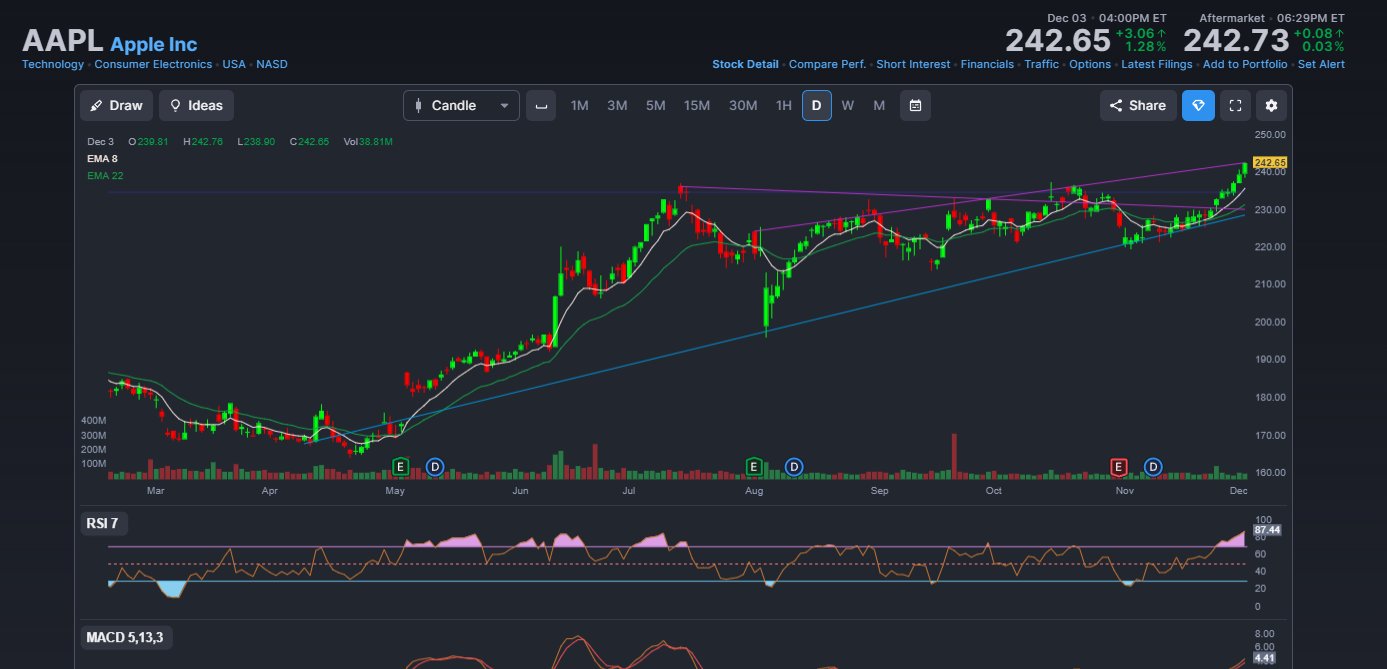
What exactly is fueling this sustained rise in Apple's stock price? How long will this upward trajectory persist, posing a primary query for investors worldwide?
There's no need for alarm. Let's delve into an analysis now.
Exceptional Financial Performance and the Knack for Rewarding Shareholders
On October 31, Apple released its financial report for the fourth quarter of fiscal year 2024 (equivalent to the third quarter ending on September 28).
The financial data reveals that Apple's revenue for this quarter soared to an impressive $949 billion, showing a 6% year-on-year growth, setting a new third-quarter record. Despite a 36% year-on-year decline in net profit, the earnings per share, excluding tax disputes, reached $1.64, marking a 12.3% increase.
This report clearly demonstrates that, despite global economic uncertainties and supply chain disruptions, Apple has achieved strong growth in both revenue and profit.
Driven by rising sales of products like the iPhone, Mac, and iPad, coupled with the expanding services business (including Apple Music and Apple TV+), Apple's financial performance has exceeded market expectations.
This firm financial foundation has bolstered investor confidence and fueled the ongoing uptrend in the stock price.
In addition to its impressive financial performance, Apple excels in rewarding its shareholders.
Since 2012, Apple has embarked on an unprecedented stock repurchase program, totaling $2,620 billion over the past three fiscal years ($950 + $776 + $894), making it one of the largest buyback initiatives in U.S. stock history.
This initiative has reduced outstanding shares and boosted earnings per share (EPS), driving the increase in stock prices.
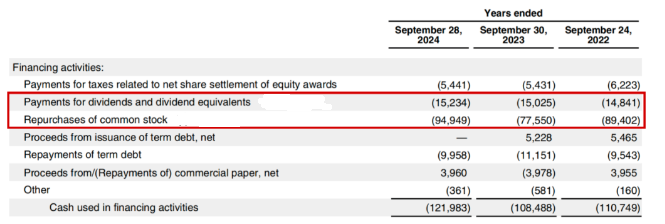
As indicated in the data mentioned earlier, during fiscal year 2024, Apple repurchased approximately $950 billion in stocks. Given Apple's current market capitalization of $36,000 billion, this translates to an annual investment return rate of 2.6% for long-term investors.
Stock buybacks also send a strong signal to the market: Apple's management is confident in the company's future prospects.
Consequently, investors view Apple as a reliable choice, maintaining its appeal even amid economic fluctuations.
Similarly, in fiscal year 2024, Apple distributed dividends totaling $150 billion. While Apple's annual dividend yield is around 0.4%, combined with substantial stock repurchases, it offers investors a combined return rate of 3%.
This reward strategy meets shareholders' cash flow needs and attracts institutional investors seeking long-term returns.
At this point, I must admit that I am considering allocating some of my idle funds to purchase Apple stocks. Haha!
Novel Growth Avenues Empowered by AI
Upon the release of the iPhone 16, some critics were quick to assert that Apple had failed to introduce any innovative or disruptive features this time around, implying that the company had lost its creative edge.
However, I hold a contrary viewpoint.
The mobile phone industry has now reached a stage of maturity. It is virtually impossible to introduce a revolutionary innovation every single year. Nevertheless, for a company like Apple to consistently effect minor optimizations and refinements annually is, in my opinion, truly remarkable.
Although consumers' responses to the newly incorporated artificial intelligence functions in the iPhone 16 were somewhat tepid, there is no disputing the fact that they possess enormous potential.
The introduction of Apple Intelligence has not only manifested Apple's potential in the realm of artificial intelligence but has also substantially enhanced the practical utility of its devices.
For numerous years, Siri has been regarded as one of the Achilles' heels within Apple's ecosystem. However, Apple Intelligence is set to endow it with a completely new manifestation. Presently, Siri is capable not only of comprehending more intricate sentences but also of furnishing intelligent feedback that is contextually relevant.
Furthermore, Siri's multi-device collaboration functionality has also been significantly enhanced. Users can initiate commands via any Apple device, and Siri will automatically synchronize with other devices to execute the corresponding operations.
This seamless experience augments the intelligence and fluidity of Apple's ecosystem and further cements user loyalty.
The core value of Apple Intelligence resides in its profound optimization of the entire Apple product ecosystem.
It not only fulfills users' heightened expectations regarding device performance but also forges a more intimate connection between Apple's hardware and services. The amalgamation of AI and the ecosystem has opened up a wholly new growth frontier for Apple, even in the face of a saturated hardware market.
Given its current lofty valuation, the question lingers: is it still viable to invest in it now?
Warren Buffett, famously known as the "Oracle of Omaha," sold off 600 million shares of Apple stock this year, keeping only around 300 million shares.
This decision sparked widespread discussions as, had Buffett not trimmed his holdings, he could have realized even greater unrealized profits from Apple's ongoing stock price surge.
Given the current context where the "Oracle of Omaha" seems to have missed out on maximizing gains, should we still contemplate investing?
In my view, the answer is a resounding yes.
I am optimistic about Apple's future and project a target price of $300 in the upcoming phase. I foresee this as the beginning of a new era of AI advancements for Apple.
To me, Apple represents not only a lucrative investment but also a pioneering company that sets new standards in the industry continually.
With its focus on expanding into emerging sectors like services and AI, Apple retains significant potential for growth in the years ahead.
Perhaps this is the true reason behind Buffett's decision to keep it as a core holding, despite scaling back his stake.