
November's Non-Farm Payroll Data Beats Expectations, Yet Market Reaction Remains Muted

Magical Investor
December 7, 2024
GoGPT Summarizes Articles

According to the Employment Situation Report released by the U.S. Bureau of Labor Statistics, non-farm payrolls in November saw a significant rebound, surpassing market expectations. Concurrently, the unemployment rate rose as predicted, reaching 4.2%.
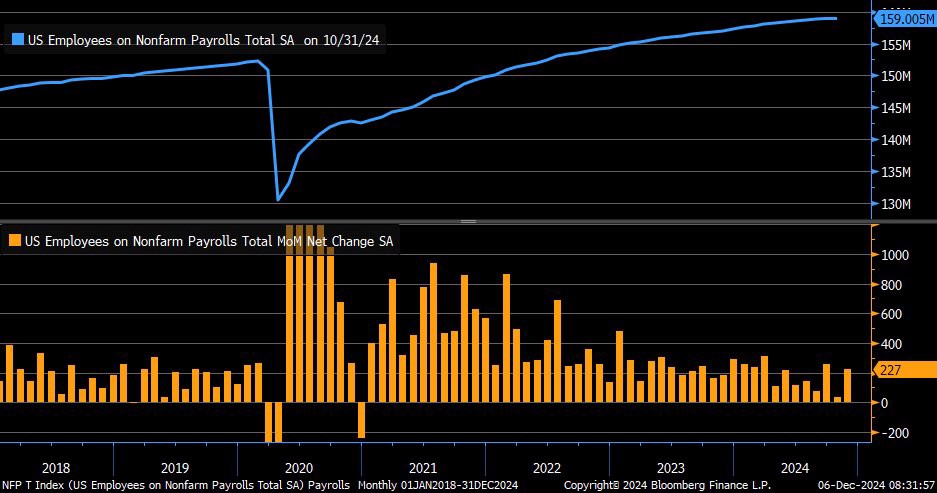
Specifically, seasonally adjusted non-farm payroll employment in the United States increased by 227,000 in November, marking the largest gain since March and surpassing the market's projected figure of 200,000. Furthermore, October's data was revised upward from 12,000 to 36,000.
Following the economic data release, the futures of the three major U.S. stock market indices experienced a slight short-term uptick, while the U.S. Dollar Index briefly declined.
As of the close of trading on December 6, Eastern Time, the Dow Jones Industrial Average decreased by 0.28%, the Nasdaq Composite Index rose by 0.81%, and the S&P 500 Index gained 0.25%. Despite surpassing expectations, the market's response was subdued.
Nevertheless, let's now briefly analyze this non-farm payroll report.
Sources of employment growth and unemployment data
In November, the trend from October continued, with the health care and social assistance sector making the most significant contribution to new job creation by adding 72,300 positions.
Following closely, the leisure and hospitality industry ranked second in creating new jobs, with an increase of 53,000 positions, surpassing October's figures.
The growth in November was predominantly driven by job additions in food services and drinking places, accounting for a rise of 29,000 positions in this specific category alone.
Government employment secured the third position in new job additions, incorporating 33,000 new positions. However, the government's employment ratio within the overall job landscape still falls below pre-pandemic levels.
Manufacturing and professional/business services experienced a notable resurgence. These sectors had faced setbacks in October due to a seven-week strike by Boeing machinists and the impacts of Hurricanes Helen and Milton. In November, they respectively added 22,000 and 26,000 job positions.
The financial industry saw a growth of 17,000 job positions in November, indicating optimistic expectations of eased financial regulations with the potential return of Trump, prompting companies to relax their hiring practices.
On the contrary, the retail industry witnessed a loss of 28,000 job positions, likely a key factor hindering overall employment growth.
Other major industries such as mining, construction, wholesale trade, transportation, information, financial activities, and other services remained relatively stable this month.
In November, the unemployment rate remained at 4.2%, with 7.1 million unemployed individuals, showing minimal changes. These figures are higher than a year ago when the unemployment rate was 3.7% and the number of unemployed was 6.3 million.
Within different demographic groups, the unemployment rate among Blacks slightly increased to 6.4%. Among adult men and women, teenagers, Whites, Asians, and Hispanics, the unemployment rates stood at 3.9%, 3.9%, 13.2%, 3.8%, 3.8%, and 5.3% respectively, with marginal variations.
What's the outlook for this report and how will it evolve in the future?
The impact of Hurricane Milton in October led to a temporary drop in newly added employment, with figures plummeting to 36,000 during that period.
Subsequently, as the effects of Hurricane Milton subsided, the suppressed employment numbers from October rebounded robustly in November, resulting in a seemingly positive figure of 227,000.
When considering the combined averages for October and November, the newly added non-farm payrolls in the United States amounted to only 130,000.
This trend aligns with the ongoing decline in U.S. non-farm payroll data since the Federal Reserve began raising interest rates. From an average monthly increase of 400,000 in 2022, employment growth halved to 200,000 in 2023, further decreasing to 150,000 in the first half of 2024 and continuing its decline to 100,000 in the latter half of 2024.
The data suggests that U.S. non-farm payrolls have been on a downward trajectory since the Federal Reserve's interest rate hikes, challenging the notion of a booming labor market often touted by U.S. politicians and the media. Even with the interest rate cut in September this year, the employment landscape in the U.S. has not shown signs of improvement.
Considering these factors, the current report is viewed as tentatively neutral. However, the prevailing trend indicates a potential need for the Federal Reserve to persist with interest rate cuts to stimulate economic recovery.
The market's response reinforces this notion, with traders increasing bets on a Federal Reserve interest rate cut in December. The likelihood of a rate cut is expected to rise from 67% before the report's release to 85%.
Looking ahead, the trajectory of employment growth in the U.S. will be heavily influenced by Trump's stance on immigration as he nears a return to power. Trump's proposed strict immigration policies, including a significant deportation operation, could significantly impact labor growth, potentially leading to a bleak outlook for non-farm payrolls in the near future.
As the labor market stabilizes, next week's inflation data is anticipated to have a more substantial impact on the Federal Reserve's decisions.
Jack Mcintyre, a portfolio manager at Brandywine Global, highlighted the evolving significance of economic data, noting that the upcoming inflation report will carry more weight due to inflation reemerging as a critical factor. While the November employment data met expectations and did not significantly alter market perceptions of the Federal Reserve's 2025 policy, the CPI data next week could potentially change this outlook.
Mcintyre suggested that the Federal Reserve may adopt a more patient approach, as they may no longer feel pressured to expand monetary easing. The terminal interest rate set by the Federal Reserve will be a pivotal factor alongside the strategy to achieve it.
#Fed Rate Outlook