
What is the investment theme for 2025 - Fiscal more than Monetary

Fed has kicked off cutting cycle and cut 75bps so far this year. US growth data and especially consumer remains resilient. Labor market has loosen but in near term there is no sign of falling apart. Front end rate pricing about 50bps additional cut in 2025 if they cut 25bps Dec (I believe they will). I think pricing is fair and maybe even a bit cheap here.
Therefore, I believe the theme will likely be on Fiscal side rather than monetary side(also important) - Trump Trade 2025.
Trump Theme 2025
Trump Red sweep will likely result more future growth but with higher deficit. Inflation impact can be uncertain depending on various scenarios of trade policies.
i. Congress would spend most of 2025 working in on Tax Cuts and Jobs Act (TCJA) cut. New policies implementations/impacts will likely not kick in until 2026. New fiscal policies will likely add material amount of deficit.
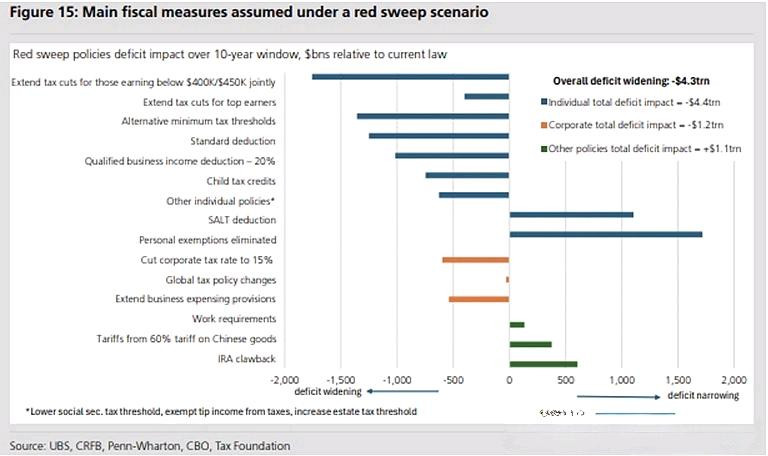
ii. Tariffs are the first line of attack but it’s a negotiation chip instead of a source of revenue. In fact, the net revenue impact from tariff largely depends on how much demand will fall due rising import prices. 60% tariff on 75% Chinese good is estimated to bring in only ~$375bn revenue over 10-year window.
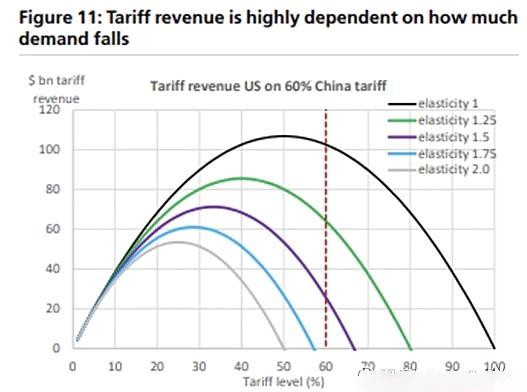
iii. Impact on tariff need to breakdown into scenarios. Baseline 60% tariff on 75% Chinese goods scenario will have mild impact on US growth and inflation. However, additional 10% tariff on global goods will have more meaningful impacts on growth and inflation.
60% tariff on 75% Chinese goods scenario
• China's growth is 20bp lower in '25 and 100bp lower in '26; roughly half of the slowdown comes from a reduced contribution from net exports, the rest from the indirect impact on consumption and investment.
• US GDP growth is just a few tenths weaker and PCE prices are roughly 36bps higher assuming 30% pass-through (Since Chinese imports are roughly 2½% of US consumption expenditures, a 60% tariff on all imported goods from China would work out to roughly a 1.3pp boost to the US price level, assuming 100% pass-through. That is an upper bound, however, given that it is possible that not all items are covered and pass-through is likely to depend on China's market share in specific product codes, and whether a given product is an intermediate, capital or consumer good.)
• China’s retaliation will be limited as its imports from the US is 1/3 of the US imports from China.
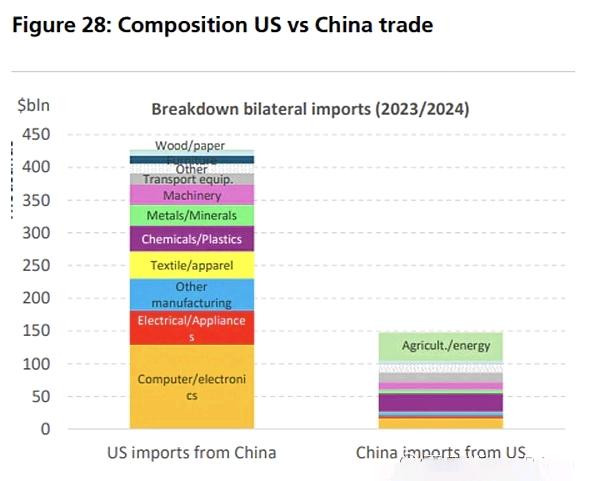
Additional rest of the world 10% global tariffs on top of 60% tariff on 75% Chinese goods scenario. (likely 2026 issue due to legal process to implement)
• Proposed tariff will be 5x larger than tariff escalation in 2018/2019.
• Because the dollar amount of imports from the US is smaller than the dollar amount of imports by the US from the RoW, the dollar amount of retaliation is also significantly smaller than the amount affected by US tariffs.
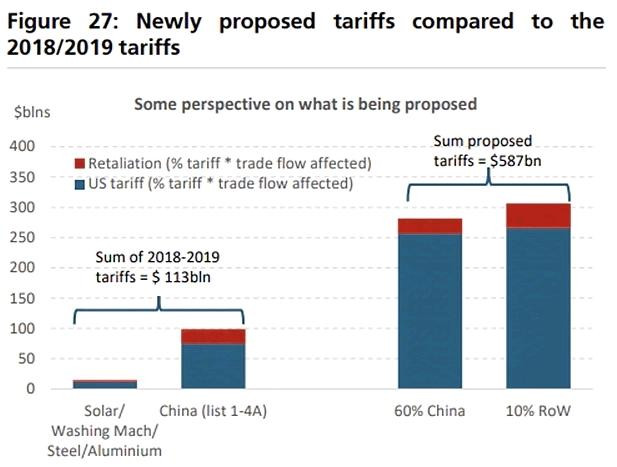
• Impact on real GDP in US rough~-0.5pp but with more severe impact on rest of world in 2026. If tariffs revenues are used to subsidize exporters in US, it seems that higher tariffs could boost US growth by net exports.
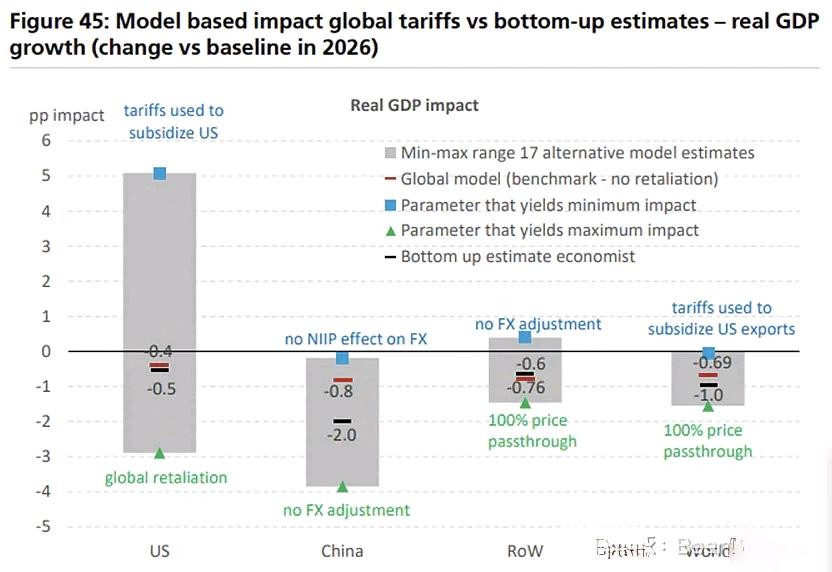
• However, private domestic demand and consumption in US will collapse (closed to level of prior recessions). Import collapse would disproportionally hurt US importers (assumed to absorb 50% of the tariff in their profit margin).
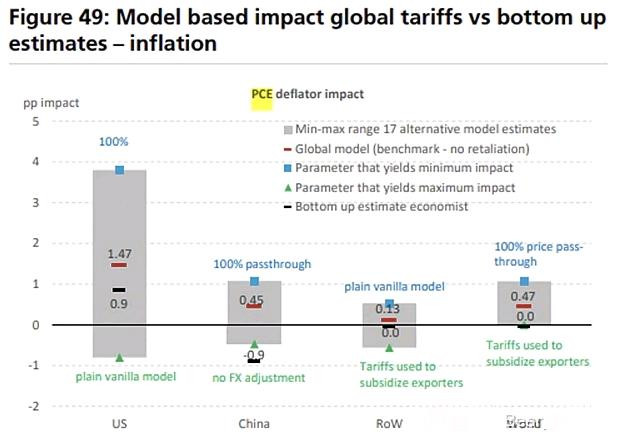
• US will add significant amount of inflation (+1.47pp PCE) with rest of world inflation impact relatively flat.
• For the US, the inflation impact is much higher with 10% RoW tariff scenario, in part because with a global tariff, it will not be possible to substitute towards non-tariffed goods (unless they are domestic).
Trump’s economic team are mainly pro-growth, de-regulation and acknowledge using tariff (at minimum see it a tool with value). Trump and his team ultimately want both dollar and energy dominance
i. Treasury secretary Scott Bessent’s (Trump nominated) 3-3-3 policy plan aims at injecting more growth in economy to reduce deficit:
- 3% GDP growth via deregulation. Basically, to encourage more private investment to revive economic growth.
- Reduce the budget deficit to 3% of GDP (halving the current percentage to where it has not been since the end of Obama’s time in office)
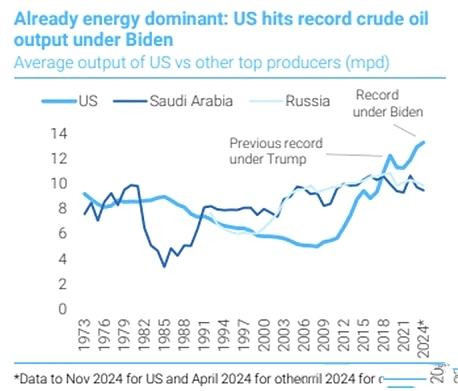
- 3MM barrel extra daily oil production on top of already 13.3MM domestic oil production and to achieve energy dominance which US is already at record oil output
US economy is resilient which allows Trump to do more aggressive negotiations with China, EU, and rest of the world. These are all pointing to further dollar strength in the coming years.
i. Fed pricing has reflected the likelihood of a US soft landing. With Trump policy and his economic team’s agenda, the likelihood of soft-landing should increase further which support slower/less Fed rate cut and support further dollar strength.
ii. Tariffs are bullish for the dollar.
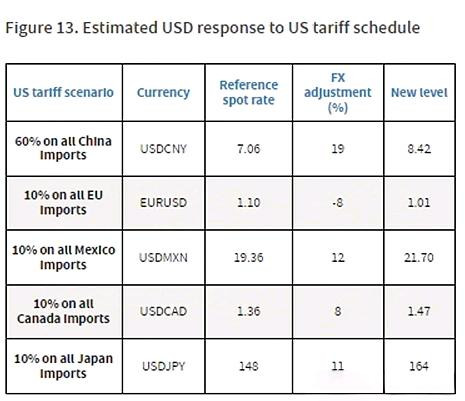
iii. Potential fiscal expansion from Trump will likely boost dollar strength. Fiscal expansion results in higher interest rates than would otherwise be the case and, via capital inflows, a stronger currency. These effects, in turn, 'crowd out' private investment, thereby dampening the effects of that fiscal effort on activity.
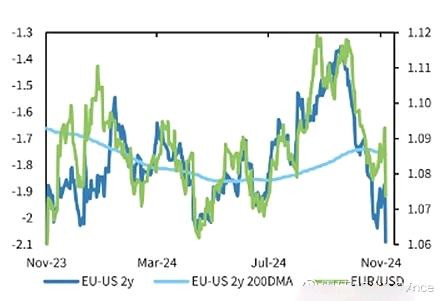
iv. CB rate differentials also imply a stronger dollar.
Summary
Trump theme on fixed income in 2025 is a bit unclear. Fiscal policy will be pro-growth and adding deficit. However, he and his team also want to lower deficit, especially Bessent.
Long USD, long Equity(especially small cap), and short oil (at least 30% downside imo) are probably better expression for the theme than mixed rates picture. However, these are conditioned on baseline tariff. If there is 10% global tariff scenario on top of baseline scenario, equity will face a lot of pressure.
Crypto will be likely to be the biggest beneficiary under Trump red sweep. Multiple nominees under Trump team (include Trump himself) are pro-crypto and de-regulation. They will likely adopt bitcoin as strategic asset and even use it to reduce deficit. However, due the increased market cap on Bitcoin, it will be hard to see explosive return(x10 x100…. etc), Option on $iShares Bitcoin Trust ETF(IBIT)$ , I think makes most sense. Avoid meme coins.