
All Eyes on U.S. CPI Data: Will It Seal the Deal for a Fed Rate Cut in December?

Shearing sheep
December 9, 2024
GoGPT Summarizes Articles

Hey everyone! So, it’s that time again – the end of the year, when central banks around the world make their final moves. This week, all eyes are on the U.S. Consumer Price Index (CPI) data for November, which is set to drop just ahead of the Fed’s next meeting. This could be a huge indicator for the future of U.S. interest rates, especially with markets already pricing in a potential 25 basis point rate cut in December.
Let’s quickly review the key data points from last week. The November non-farm payrolls (NFP) came in stronger than expected, with 227,000 jobs added to the economy – much higher than the forecasted 200,000. However, the unemployment rate rose to 4.2%, surprising many, as strong job growth typically leads to a lower unemployment rate. This could be due to a mix of returning workers after disruptions like hurricanes and strikes, but it also signals some softness in the broader economy.
Meanwhile, November PMI data showed continued weakness in the manufacturing sector, with the manufacturing PMI still in contraction territory below 50. The non-manufacturing PMI also missed expectations, reinforcing concerns about a slowdown in the broader economy. These signs of economic cooling have driven the market's expectation of a 25 basis point rate cut in December from the Federal Reserve, with the probability now sitting at 83%, up from 67% before the NFP and PMI releases.
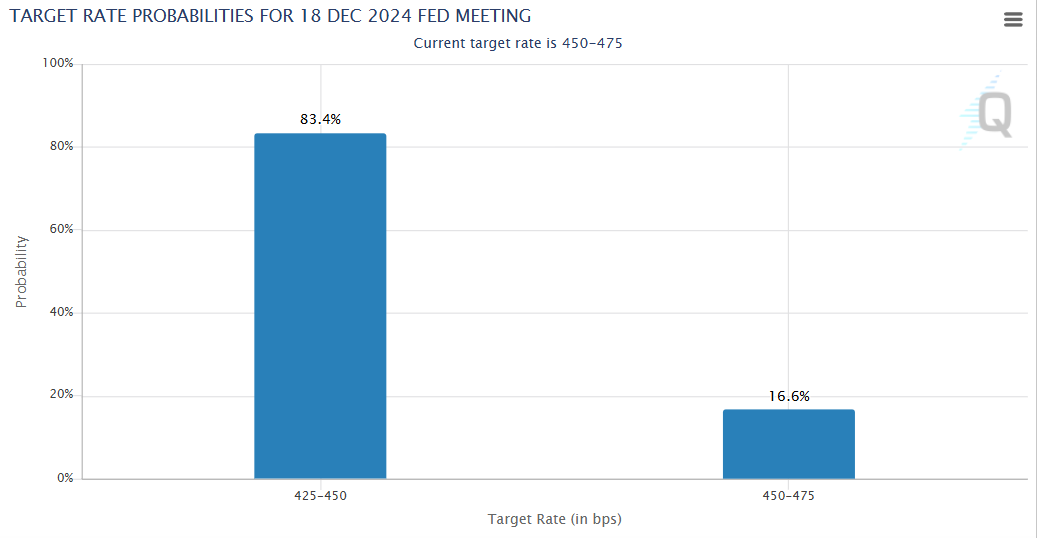
The Fed has been walking a fine line – trying to keep inflation in check without slowing the economy too much. Now, the CPI data, due out this Wednesday, is likely to play a pivotal role. The market expects the November CPI to come in at 2.7% year-over-year, up slightly from 2.6% in October, while the core CPI (which excludes food and energy) is expected to hold steady in the range of 3.2%-3.3% for the sixth month in a row. While inflation remains under control, these numbers suggest that progress in curbing inflation is slowing.
If the CPI numbers come in as expected or show a slight rise, it will reinforce the market’s belief that the Fed is likely to move ahead with a 25 basis point cut in December. However, there are still potential risks. For instance, if CPI surprisingly went upwards, it could reignite inflation concerns, leading to a reassessment of the Fed’s policy stance and potentially reducing the chances of a rate cut.
There’s also the PPI data to consider, which will be released on Thursday. The Producer Price Index (PPI) has shown a rebound recently, with both year-on-year and month-on-month figures mostly surpassing expectations, and reflecting a bounce-back from September’s data. Any stronger-than-expected PPI reading could signal that inflation pressures are picking up again, particularly in the manufacturing and service sectors. If PPI comes in higher than anticipated, it could cloud the Fed’s decision on whether to proceed with another rate cut or hold off.
These all set up a critical week for markets and the Fed. Traders are hoping for a smooth finish to the year with a clear path forward for the Fed’s policy, but there’s still a lot of uncertainty. The recent non-farm payrolls data gave the Fed some leeway for a rate cut, but it’s ultimately going to be the CPI and PPI reports that determine if the central bank is willing to go ahead with that cut in December, or if they’ll opt for a more cautious approach.
#Fed Rate Outlook#fedrate#ratecut