
Santa Claus Rally: What It Is and Means for Investors

Go Learn
December 10, 2024
GoGPT Summarizes Articles
As we approach the holiday season, investors often turn their attention to an intriguing phenomenon known as the Santa Claus Rally. Historically, the stock market has seen a rise in prices around the Christmas holiday, especially during the final days of December and the early days of January. But what exactly is the Santa Claus Rally, and what does it mean for investors? Let's take a deeper look.
What is the Santa Claus Rally?
The Santa Claus Rally refers to the tendency for the stock market to experience a rise in prices in the last week of December, leading up to Christmas, and into the first two trading days of the new year. While it doesn't occur every year, the rally is widely recognized as a trend that can offer investors a year-end boost. Yale Hirsch, the founder of the Stock Trader's Almanac, first coined the term in 1972, defining the timeframe as the final five trading days of the year and the first two days of the following year.
Historically, the stock market has shown a higher-than-average return during this period, with the S&P 500 index recording positive growth roughly 80% of the time since the rally's identification. However, it's important to remember that this trend, like any market pattern, isn't guaranteed.
Key Factors Behind the Rally
Several theories try to explain why the Santa Claus Rally occurs. Some of the most common explanations include:
1. Holiday Optimism and Spending: As the year winds down, investors often feel more optimistic, influenced by the general festive spirit and increased consumer spending during the holiday season. This seasonal cheer can fuel bullish behavior in the market.
2. Institutional Investors on Vacation: Another theory suggests that many institutional investors take a break around this time, leaving the market largely to retail investors. Retail investors, often more optimistic, may drive market prices higher during this period.
3. Tax Considerations and Year-End Bonuses: Some investors may buy stocks in anticipation of January's price movements, while others engage in tax-loss harvesting or reinvest year-end cash bonuses. These financial strategies can increase demand for stocks, potentially contributing to the rally.
4. End-of-Year Adjustments: Institutional investors may make adjustments to their portfolios at the end of the year, including settling their books. These adjustments can lead to increased market activity and price fluctuations.
The Historical Performance of the Santa Claus Rally
Looking at historical data, the Santa Claus Rally has proven to be a real, though not foolproof, phenomenon. The Stock Trader's Almanac compiled data from 1950 to 2022, showing that the Santa Claus Rally occurred 58 times, or roughly 80% of the time, with the S&P 500 rising an average of 1.4% during this period. In recent years, the performance has been more modest. For instance, during the 2022-2023 rally, the S&P 500 rose 0.8% over the final five trading days of December and the first two days of January.
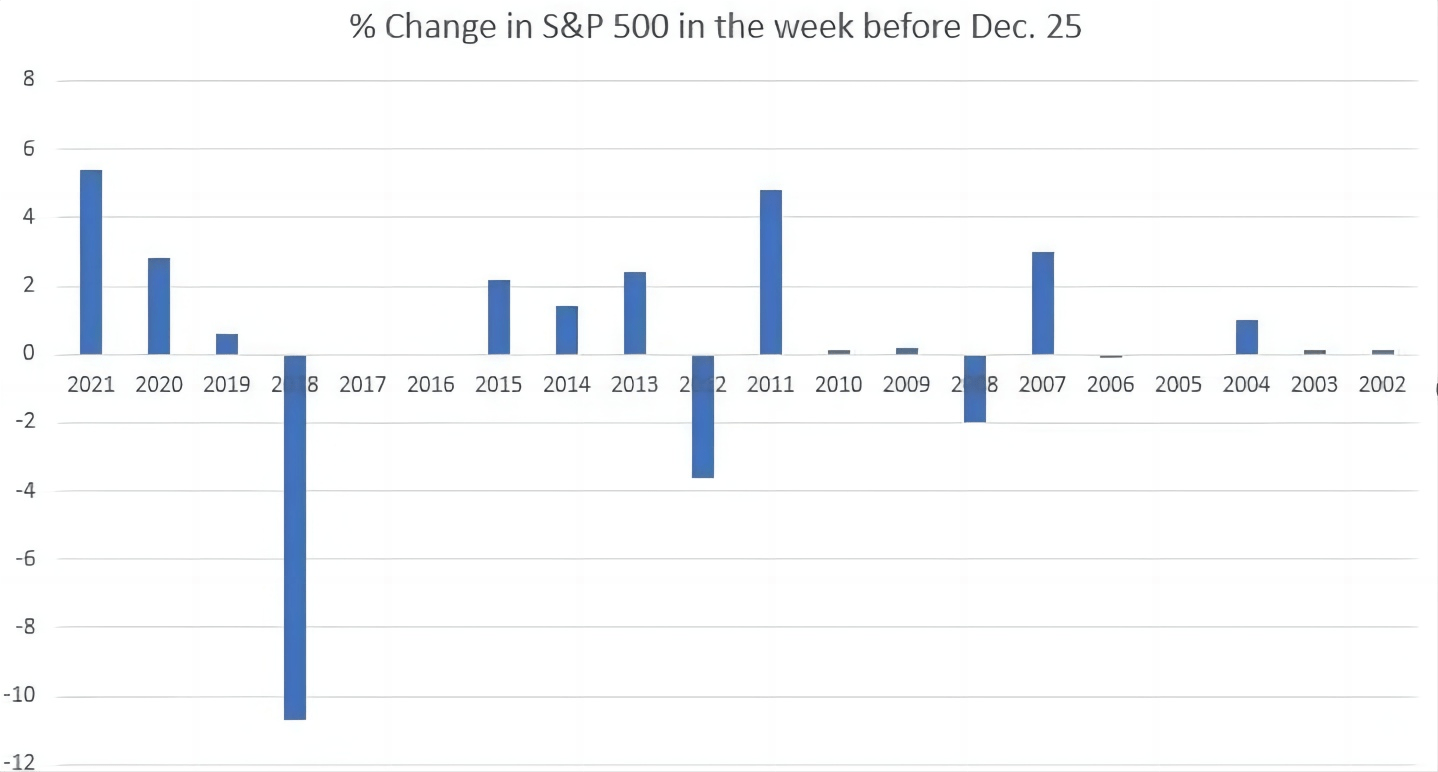
However, when we look at the performance of the market in the week leading up to Christmas, from 2002 to 2022, the evidence of a strong rally becomes less clear. In fact, the data reveals mixed results with periods of both gains and losses.
What Does It Mean for Investors?
While the Santa Claus Rally might bring temporary price increases, investors should remember that market conditions are influenced by many factors, and past performance doesn't guarantee future results.
1. For Short-Term Traders: Those looking to capitalize on short-term trends may attempt to trade during the Santa Claus Rally. However, this can be risky. Since market movements during the holiday season often coincide with low liquidity, the rally may not always play out as expected. Traders should be mindful of risk management, using strategies like stop-loss orders to minimize potential losses.
2. For Long-Term Investors: For those focused on long-term goals, such as retirement planning or wealth accumulation, the Santa Claus Rally is likely just a fleeting event. It doesn't typically have a significant impact on the long-term performance of your portfolio. Staying the course with a diversified investment strategy is usually the best approach.
3. The January Effect: Another related phenomenon is the January Effect, which suggests that stock prices, especially for small-cap stocks, tend to rise in January. This effect is sometimes linked to the end-of-year tax strategies and year-end bonuses, as well as the optimism brought on by the start of a new year. The Santa Claus Rally and the January Effect may work in tandem, but they should not be relied upon as part of an investment strategy.
Trading the Santa Claus Rally
Traders often look to exploit cyclical trends, and the Santa Claus Rally is no exception. However, trading around this event requires caution. Market movements in the holiday period are typically more volatile due to low trading volume. Position-sizing, stop-loss orders, and a clear plan for profit-taking are all essential when considering trades during this time.
For those who prefer a hands-off approach, it's important to remember that the Santa Claus Rally doesn't fundamentally alter the long-term outlook for stocks. If you're investing for the long haul, focus on your personal goals, risk tolerance, and a diversified portfolio, rather than trying to time the market based on short-term seasonal trends.
Conclusion
In summary, the Santa Claus Rally is an intriguing, often profitable, but unpredictable market trend. While historical data suggests a positive market performance during the final days of the year, there's no guarantee that it will continue. For short-term traders, the holiday period may present opportunities, but risk management is key. For long-term investors, the Santa Claus Rally is just another fleeting market event. Staying disciplined and sticking to a long-term investment plan is the best approach.
Let's Hear Your Thoughts!
#Santa Claus Rally#investingeducation