
Adobe's Stock Plunges Over 13% Post-Earnings: What's Behind the Slide?

Magical Investor
December 13, 2024
GoGPT Summarizes Articles

On Thursday in the local time zone, Adobe's share price plummeted by over 13% as a result of its fiscal 2025 performance guidance failing to meet market anticipations.
Adobe stands as a global behemoth in the realm of visual software, with its renowned products encompassing Photoshop for image manipulation, Illustrator for vector graphic design, and Acrobat for PDF editing. As of the closing on Wednesday, Adobe boasted a latest market capitalization of $208.9 billion.
Yesterday's notable downturn marked the company's largest decline in almost two years. Let's explore the specifics of what transpired.
Good performance, but concerns about the future
Let's initially scrutinize Adobe's performance in the fourth fiscal quarter of 2024.
The data reveals that during the fourth fiscal quarter, Adobe's operating revenue reached $5.61 billion, marking an 11% year-on-year increment, while the market had projected $5.54 billion. The GAAP operating profit for the fourth fiscal quarter amounted to $1.957 billion, reflecting a 12.28% year-on-year growth.
For the entirety of fiscal 2024, Adobe attained revenue of $21.505 billion, a 10.8% year-on-year increase; its GAAP net profit was $5.56 billion, a 2.43% year-on-year rise; and its GAAP earnings per share stood at $12.36, with non-GAAP earnings per share at $18.42. The company also repurchased approximately 17.5 million shares throughout the year.
In fact, this performance is by no means lackluster.
Shantanu Narayen, Adobe's Chairman of the Board and CEO, also stated, "Adobe achieved record-breaking revenue in fiscal 2024."
However, the company's performance guidance for the upcoming fiscal year has fallen short of market expectations.
The company anticipates revenue of $23.4 billion for fiscal 2025, which is beneath the $23.8 billion forecasted by analysts. Its projected earnings per share range from $20.20 to $20.50, lower than the $20.52 expected by analysts.
This has undeniably exacerbated investors' apprehensions that this creative software juggernaut might be supplanted by emerging artificial intelligence (AI) startups.
A rocky transformation journey, trailing behind Microsoft, Autodesk, and even confronting competition from Sora
Adobe is widely celebrated for its software crafted for creative professionals. The company has been incessantly incorporating generative AI features into its applications, such as embedding its proprietary model Firefly into products like Photoshop.
At its annual user conference in October, Adobe introduced an AI-powered tool for video production, which has been assimilated into the editing application Premiere and is progressively being made available to the general public.
David Wadhwani, the head of Adobe's creative business, disclosed during the earnings call that the company will shortly launch "novel Firefly products with elevated prices", inclusive of video models.
Nonetheless, the prospects of Adobe's AI transformation remain hazy. Investors have been persistently fretting that its rivals might usurp Adobe's market share.
And this is precisely the prevailing scenario. Companies like Microsoft and Canva are expeditiously integrating AI into their platforms, subjecting Adobe to increasingly cutthroat competition.
Even the recent unveiling of Sora by OpenAI will present a formidable competitive challenge to Adobe's video models.
What lies ahead in terms of the future trend? Will the stock price continue its downward spiral?
In actuality, I reckon that although Adobe's fiscal 2025 performance guidance is below par, it is not as dire as it initially appears.
In the current epoch where artificial intelligence is in a state of perpetual evolution, novel trends and opportunities will surface at any given moment within this industry.
Given that Adobe has embarked on its transformation in this direction at an early stage, it is undeniably a judicious decision. Thus, I am relatively sanguine about its long-term trajectory.
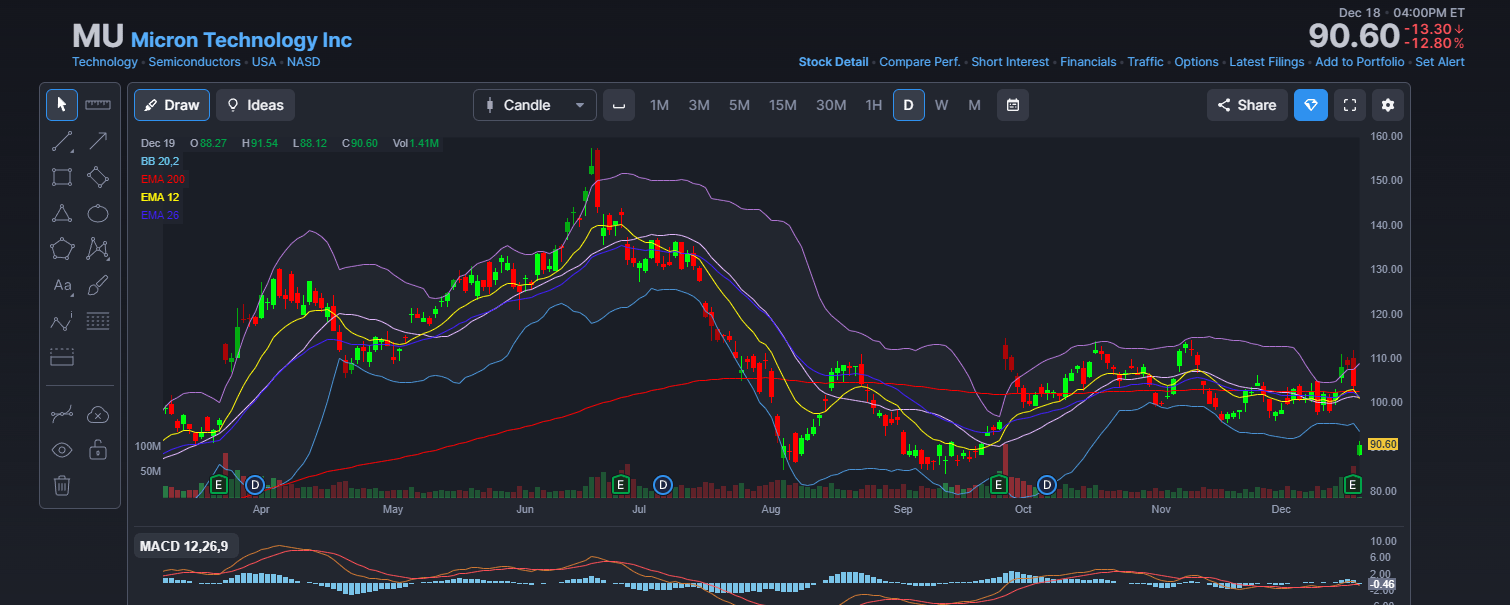
Now, let's shift our focus to the technical aspect. From the vantage point of the daily chart, since the bearish candlestick on the 12th was a gap-down opening, it has left a substantial void above. In the short term, there could potentially be a feeble rebound with an attempt to fill the gap prior to determining the ensuing trend.
From the perspective of the weekly chart, this week's negative candlestick has entirely engulfed the upward movement of the previous week, which is a quintessential downward trend pattern.
Consequently, in the short term, investors would be well-advised to exercise caution and might consider adopting a wait-and-see stance. If the stock price endures a significant further decline, it could potentially present an opportune moment for bargain-hunting.
#🏦 earnings season begins! what to watch? 👀