
Dow Jones Records ten-Day Slide, Marking Longest Decline in Nearly 50 Years: Are Non-Tech Stocks Neglected?

Magical Investor
December 19, 2024
GoGPT Summarizes Articles
Against the backdrop of the Nasdaq continuously hitting new highs after breaking through 20,000 points and the S&P 500 index constantly hovering around historical highs, the Dow Jones Industrial Average has declined continuously in the past ten trading days, thus creating the longest consecutive decline record since 1978.
Investors can't help wondering how the Dow Jones Industrial Average has fared so poorly when the Nasdaq and the S&P 500 are performing strongly.
Let's take a look.
UnitedHealth Drags Down the Dow Jones
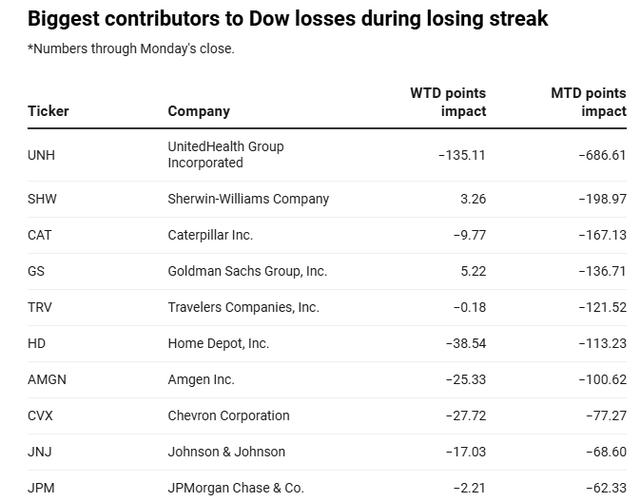
The main reason for this decline of the Dow Jones Industrial Average probably lies with UnitedHealth.
The CEO of UnitedHealth, the second-largest weighted stock in the Dow Jones Industrial Average with a weighting of 7%, was shot dead in New York two weeks ago, causing its stock price to plunge by 20% in te trading days and dragging down the index for ten consecutive days of decline.
The reason behind this is that a 26-year-old master's student from the University of Pennsylvania, an Ivy League school, was disabled due to a surfing injury and hoped to relieve his condition with a cancer drug.
However, this drug is very expensive and its standard use is not for treating his condition. As a result, UnitedHealth refused to provide insurance coverage.
So this man got angry and 3D-printed a gun and shot the CEO of UnitedHealth Insurance.
However, the public opinion trend caused by this incident is actually in favor of the murderer because people are very angry about medical insurance.
Many people have complained about their experiences of being rejected for claims. Everyone believes that the American medical insurance system puts profits above service.
The motto of the University of Pennsylvania is "Laws without Virtue are Useless", and both teachers and students support the murderer, believing that he has done something that changes history.
Instead, the boss of UnitedHealth came out to apologize and admitted that there are flaws in the medical system.
This is probably the main reason for the recent weakness of the Dow Jones Industrial Average.
The Market Is Shifting to Technology Stocks
While the Dow Jones Industrial Average has been falling for nine consecutive days, the Nasdaq has been continuously hitting new highs.
Behind this divergent trend, it shows that the market is steadily shifting to the "Seven Giants of U.S. Stocks".
In fact, for a long time, one of the aspects that the Dow Jones Industrial Average has been much criticized for is its price-weighted nature, which means that it cannot capture the huge gains of large-cap stocks like the S&P 500 index or the Nasdaq does.
The calculation method of the Dow Jones Industrial Average is to add up the prices of 30 component stocks and then divide by a factor that takes into account changes such as stock splits and the addition of new stocks.
And due to the relatively low weighting of technology stocks in the composition of the Dow Jones Industrial Average, the dividends it can enjoy from the AI wave are also limited.
Although Amazon, Microsoft, and Apple are all in this index and have all risen by at least 9% this month, this is not enough to get the Dow Jones Industrial Average out of trouble.
The Interest Rate to Be Announced by the Federal Reserve
Part of the reason for the profit-taking of non-technology stocks is also the interest rate decision to be announced by the Federal Reserve on Wednesday.
The FedWatch tool of the Chicago Mercantile Exchange Group shows that traders expect a 95% probability that the Federal Reserve will cut interest rates by 25 basis points.
However, investors are worried that the Federal Reserve may make mistakes and risk creating a stock market bubble or causing more inflation.
In addition, the U.S. retail sales data for November was better than expected, which has intensified concerns that the Federal Reserve may take unnecessary actions.
This has also indirectly caused the recent decline of some non-technology stocks.
Although the Dow Jones Industrial Average has fallen for ten consecutive days, the total decline in the entire nine-day period is 3.6%, and the overall decline is not large at all.
The market has not caused much panic. It's just a relatively good gimmick.
However, behind this, we still need to be vigilant because although there are the above multiple reasons, we can also vaguely feel that the U.S. stock market now has a taste of a technology bubble. Other stocks are being gradually abandoned, and institutions and investors are crazily chasing after those technology stocks.
Update: On Wednesday, the Federal Reserve made its move and cut interest rates by 25 basis points, bringing the target range to 4.25%–4.50%.