AI for ESG Research: A New Conference Paper

Recently I was interested with ESG, and found one related paper about AI for ESG Research.
Share with you and discuss it if you are interested or do related work.
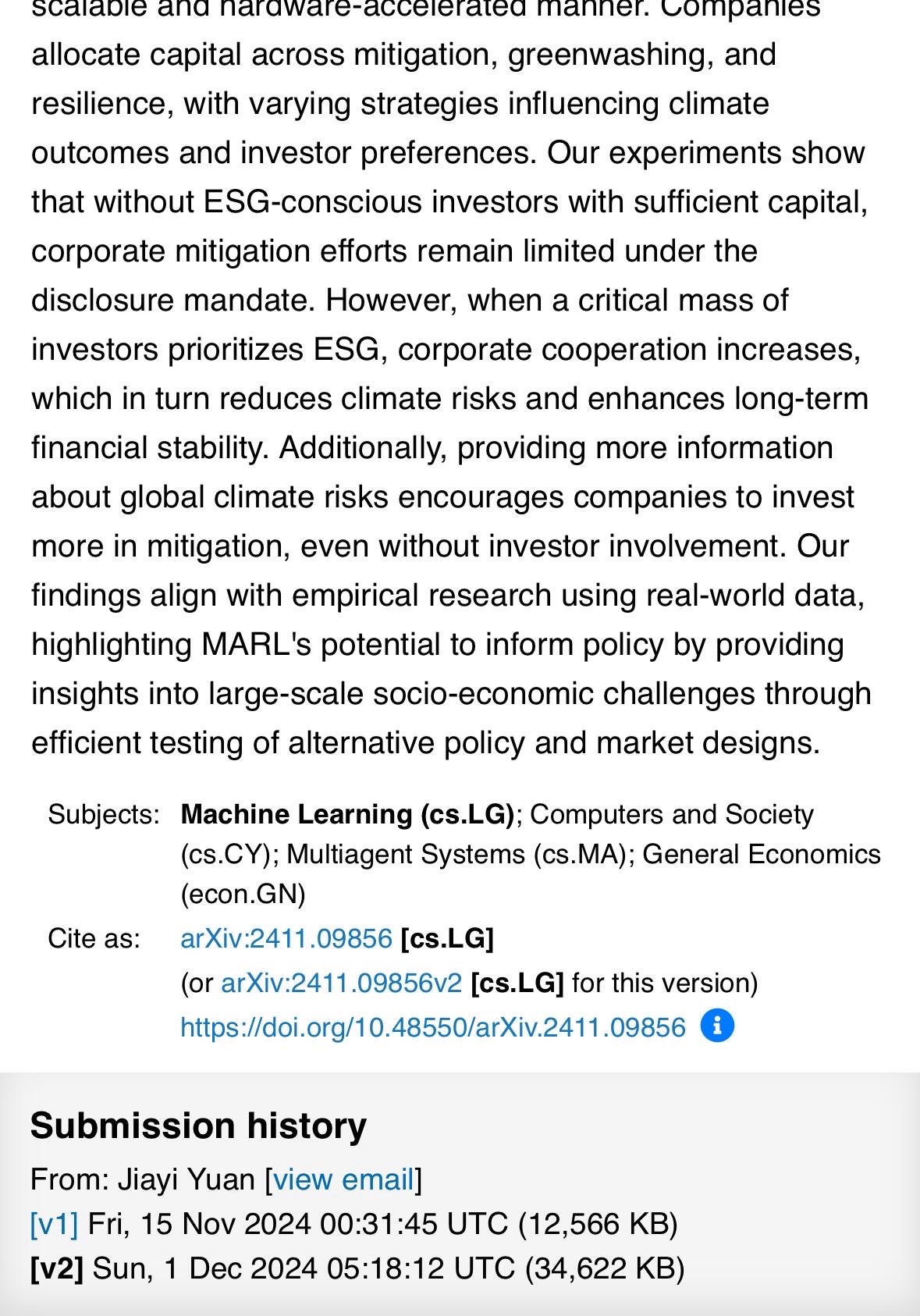
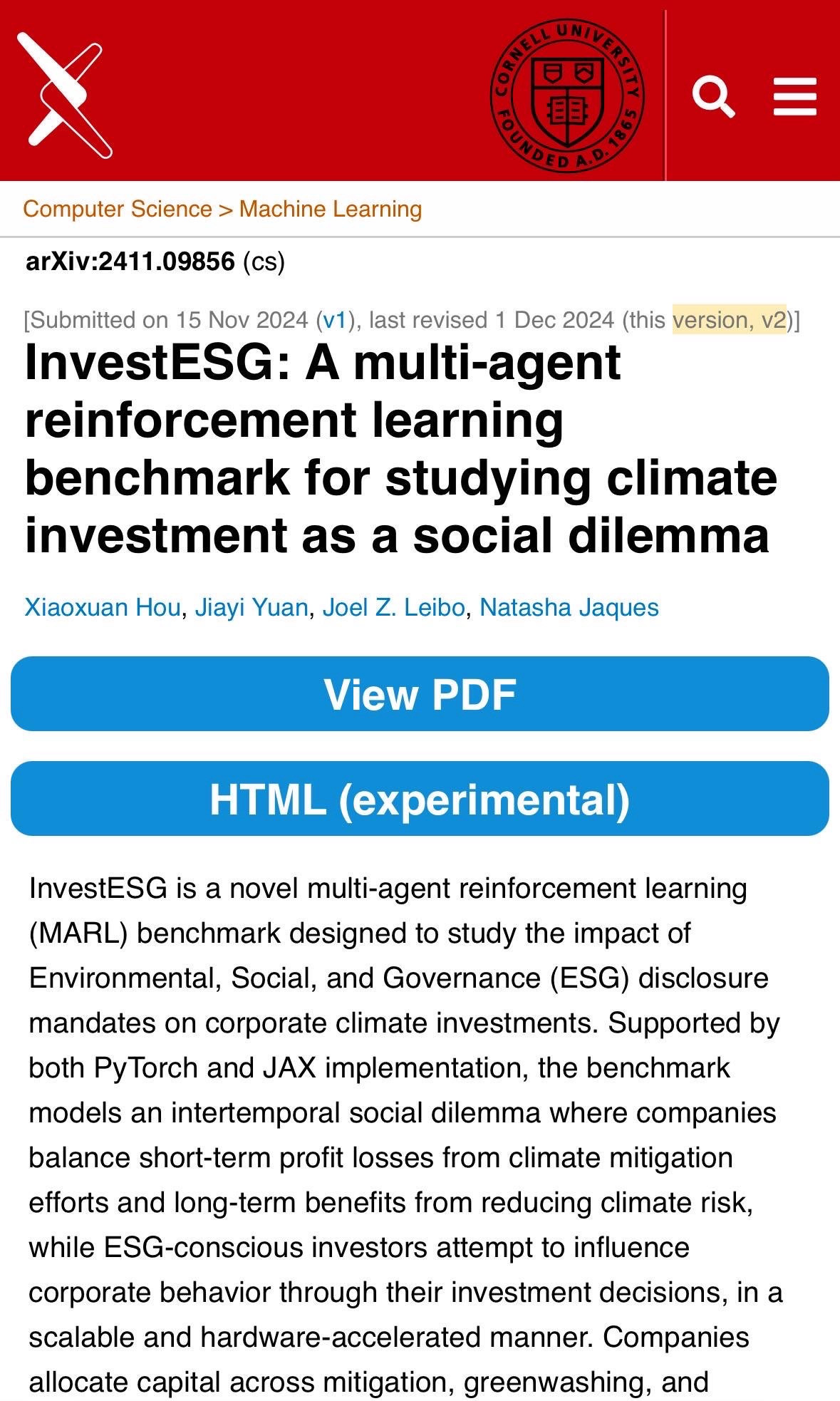
This paper introduces InvestESG, a novel multi-agent reinforcement learning (MARL) benchmark designed to simulate interactions between companies and investors in the context of climate-related investments.
Purpose and Background:
• Objective: To explore how ESG (Environmental, Social, and Governance) disclosure requirements influence corporate climate investments.
• Real-world challenge: Although corporations contribute to 70% of global emissions, they lack sufficient motivation to voluntarily reduce emissions.
Model:
Two types of simulations were developed:
1. Corporations: Can invest in climate mitigation, greenwashing, or resilience.
2. Investors: Make investment decisions based on financial returns and ESG scores.
The model reflects a social dilemma where short-term profit motives conflict with long-term climate benefits.
Key Findings:
a) Impact of ESG Disclosure:
1. Merely mandating ESG disclosure is insufficient.
2. Without ESG-focused investors, corporate mitigation efforts remain limited.
3. When investors place high importance on ESG, companies increase cooperation and mitigation actions.
b) Effect of Information:
1. Providing more information on climate risks encourages corporate investments in mitigation measures.
2. This holds true even without investor involvement.
c) Greenwashing and Resilience:
1. Companies may engage in greenwashing (appearing climate-friendly without meaningful action).
2. Resilience investments help companies survive climate events but do not reduce overall climate risk.
Technical Implementation:
1. Supports both PyTorch and JAX.
2. Incorporates state-of-the-art MARL algorithms.
3. Scalable to simulate multiple corporations and investors.
4. Integrates real-world climate risk modeling based on IPCC data.
Practical Significance:
1. Aligns with findings from empirical studies using real-world data.
2. Offers insights for policymakers considering ESG disclosure requirements.
3. Serves as a platform to test various policy approaches.
Given ongoing discussions in multiple countries about ESG disclosure requirements, this research is particularly relevant. It demonstrates that while ESG disclosure alone is insufficient, combining it with ESG-focused investors and effective information sharing can significantly drive corporate climate action. This has critical implications for policymakers contemplating climate-related regulations and disclosure mandates.