
Outlook for 2025 (Part II): Review of the U.S. Stock Market in 2024 and How to Position in Advance

Magical Investor
December 23, 2024
GoGPT Summarizes Articles
 In the previous issue, we talked about the inflation expectations for 2025. This time, we'll review the U.S. stock market this year and make predictions and analyses on how the U.S. stock market will play out in 2025.
Of course, no one can predict the market. What I'm presenting here are just my personal thoughts.
2024: Oscillating and strengthening, with no end to the rally in sight
New highs in long trades
At the turn of the year from the last bell in 2023 to the opening of 2024, asset management institutions set a new high in the volume of long trades in S&P 500 index futures, registering the largest amount of long positions opened since December 2019, reaching $15.4 billion. Coupled with $2.8 billion in short covering, the total demand amounted to $18.2 billion.
Let's go back to the beginning of the year. At that time, the market was quite optimistic about the interest rate cut expectations for this year. As time went on, the expectations for interest rate cuts faded throughout almost the entire first half of the year. In particular, the strong non-farm payroll data in January completely postponed the market's idea of the first interest rate cut in March.
However, judging from the strong performance of U.S. stocks in the first quarter, it can be seen that U.S. stocks did not engage in much trading based on interest rate cuts at that time and were thus hardly affected. The logic supporting the rally was mainly the reality of strong economic resilience and the grand narrative centered around the AI industrial revolution.
Institutions on Wall Street maintained their bullish stance.
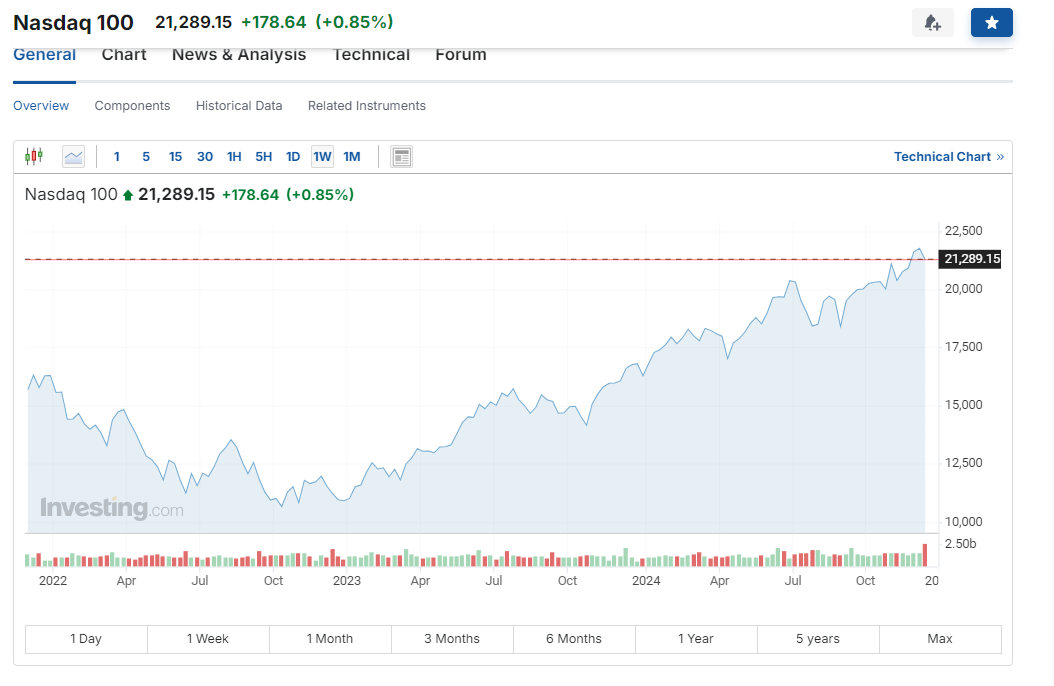
As they expected, U.S. stocks rallied strongly in the first quarter. During the period from January 5, 2024, to March 28, 2024, the S&P 500 Index rose by 11.86%, the Nasdaq Index rose by 13.98%, and the Dow Jones Index rose by 5.62%.
Oscillations began in the second quarter and interest rate cut expectations reignited
After entering the second quarter, as the U.S. CPI rebounded on a year-on-year basis for two consecutive months and the core CPI showed strong stickiness, the market began to trade on reflation.
During the same period, both stocks and bonds suffered losses, while copper started a rally.
Fortunately, in early May, the U.S. stock market got a few lifelines.
Federal Reserve Chairman Jerome Powell took a dovish stance at the FOMC press conference and ruled out the possibility of a rate hike.
Powell said that he thought another rate hike was "unlikely" and that he was confident in the restrictiveness of the policy. The FOMC would need to see evidence of insufficient policy restrictiveness to raise rates, but such evidence had not been seen yet.
He also stated that if the progress on inflation stalled, the FOMC would respond by delaying interest rate cuts, indicating that the bar for a rate hike was high.
Powell said that he predicted that the overall inflation rate would fall this year.
This undoubtedly led to the reignition of interest rate cut expectations. Coupled with Nvidia's better-than-expected earnings guidance, U.S. stocks started the second rally within the year.
A volatile third quarter, just waiting for the right moment
In the third quarter, the job market further showed unexpected signs of weakness, causing interest rate cut expectations to turn into recession expectations.
Coupled with the reversal of the yen carry trade, which further magnified market fluctuations from a capital perspective, U.S. stocks experienced significant pullbacks. After the market recovered from the liquidity shock, it began the final rally accompanied by large fluctuations.
Year-end trading and hawkish rate cuts
Although the high volatility in the fourth quarter had certain seasonal factors, the market's view on U.S. stocks was indeed very ambivalent during this period. On the one hand, regarding the unconventional start of a 50 basis point interest rate cut, the market was torn between trading on a worse reality or better expectations. On the other hand, the U.S.
presidential election brought political uncertainty before and policy uncertainty after. Therefore, the final rally was much more bumpy than the previous two.
And later, Powell's "hawkish rate cuts" also made the U.S. stock market experience a lot of turmoil
Will the U.S. stock market continue to rise in 2025? What to buy?
Currently, investors remain optimistic about the performance of the U.S. stock market next year.
Most investors believe that in 2025, the return of the S&P 500 Index may far exceed Wall Street's expectations, with room for an increase of between 15% and 25%.
Market strategists generally predict that by the end of 2025, the S&P 500 Index will reach around 6,500 points, an increase of 7% from the recent level of 6,060 points.
However, there are also a small number of investors who are wary. Will the current AI wave be like the Internet wave back then? Is the risk of a bubble burst still there?
In 2024, the "Magnificent Seven" tech stocks, consisting of Alphabet, Amazon, Apple, Microsoft, Meta Platforms, Nvidia, and Tesla, dominated the stock market.
Whether this bullish situation will continue is also a question.
But I think that in 2025, large technology companies may be the safest investment choice. The market is still benefiting from the shift towards artificial intelligence, and the "Magnificent Seven" also have defensive characteristics.
When the market experiences possible volatility again, the "Magnificent Seven" can remain relatively stable.
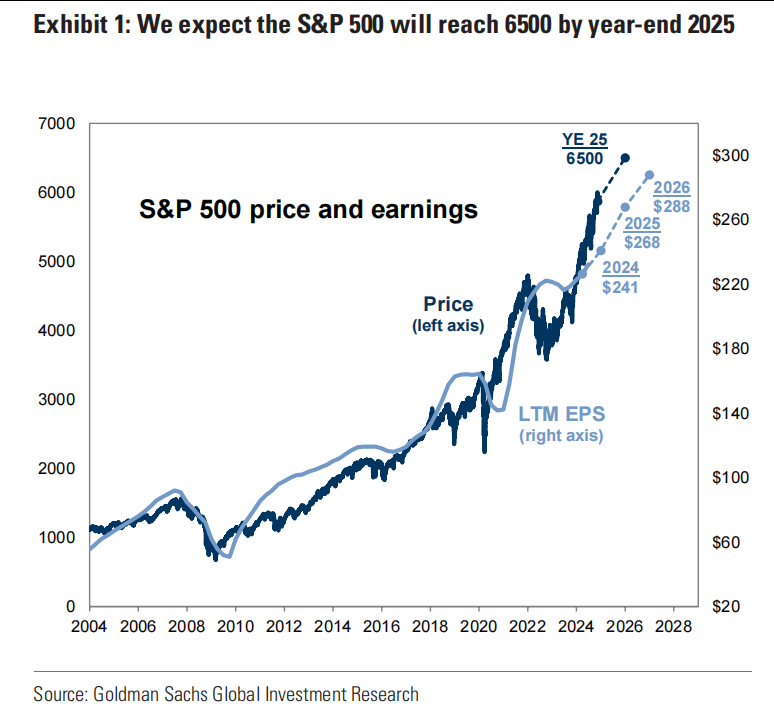
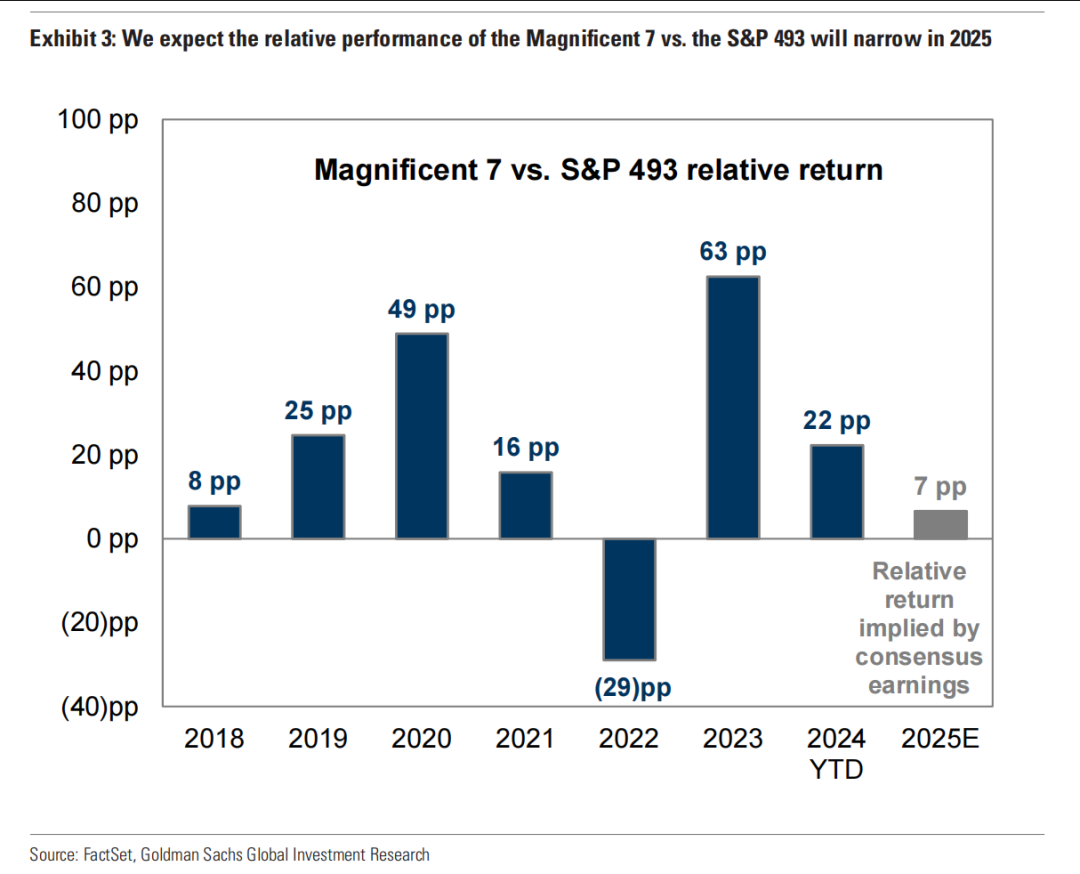
I've also read Goldman Sachs' 2025 strategy recently and summarized a few points for you:
1. The S&P 500 Index will reach 6,500 points by the end of 2025.
2. The "Magnificent Seven" will outperform the S&P 500 Index.
3. It is recommended to allocate the AI Phase III stock portfolio: companies that monetize AI. (I highly agree with this point.)
4. Recommended industries include materials, software services, and public utilities.
I quite agree with points 1, 2, and 3. As for industries, I still prefer finance and industry.
Firstly, the financial sector is highly sensitive to the economic cycles. If the U.S. economic growth continues to exceed market expectations next year, it will be beneficial to the performance growth of the financial industry and will also slow down the pace of the Federal Reserve's interest rate cuts, resulting in loan interest rates remaining at a relatively high level, which may directly increase banks' interest spreads.
Secondly, the industrial sector will benefit from the relatively tough tariff policies advocated by Trump. The trend of manufacturing returning to the U.S. will accelerate. In addition, value stocks mostly belong to cyclical sectors and usually perform strongly when the economy is in a growth phase and may attract capital attention next year.
I've talked a lot today. I've reviewed 2024 and looked ahead to 2025. If I get enough likes, I may also come up with an issue later to explain in detail some of the individual stocks that I'm optimistic about.
Besides, my personal investment list is almost finished, and I can share it with you all to have a look then.
#2024 Investment Recap: Share Your Best Insights!