
Bitcoin's Next Move: Will It Hit a New All-Time High by Mid-January?

Shearing sheep
December 30, 2024
GoGPT Summarizes Articles
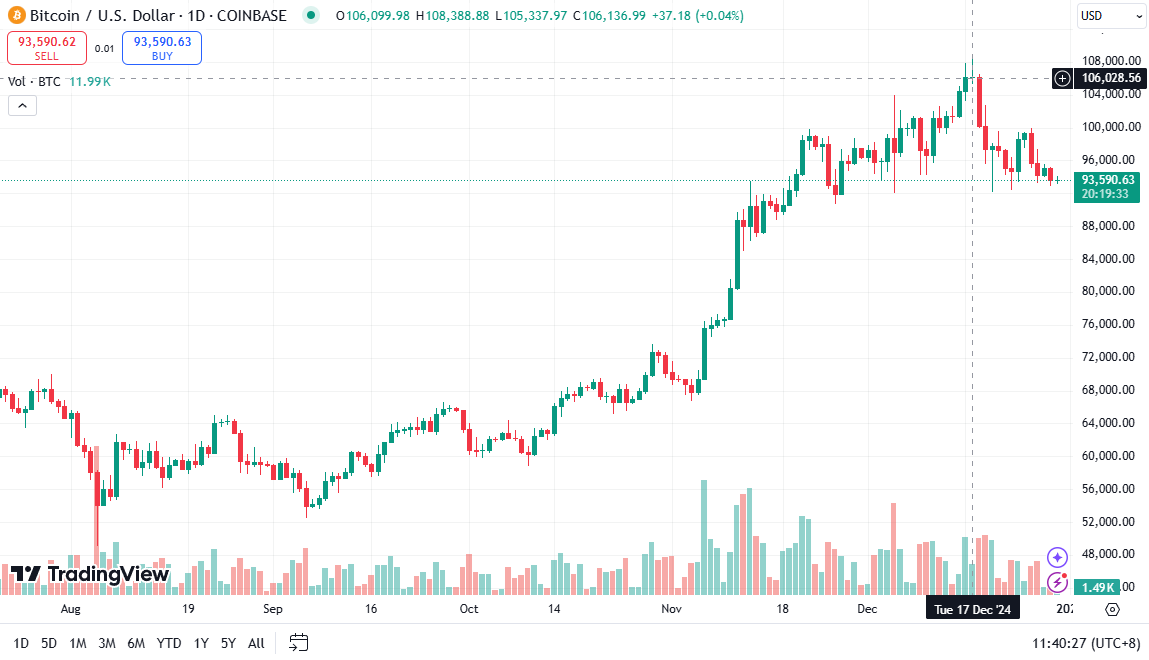
Bitcoin has been on a rollercoaster lately. Just earlier this month, it surged past $100,000, even reaching a record high of $108,309 on December 17. But then, after the Fed's surprise announcement signaling fewer rate cuts in 2025, Bitcoin took a dive, now hovering around $93,000. So, what's next? Is Bitcoin set to hit a new all-time high by mid-January, or are we headed for more turbulence?
The Cycle Theory
Let's look at the past. According to Vetle Lunde from crypto research firm K33, if Bitcoin's cycles follow previous patterns, we could see it reach a new high around January 17, 2025. If this cycle mirrors the past, Bitcoin might hit anywhere between $146,000 and $212,500. Wild, right? But Bitcoin's price movements are heavily influenced by halving events—when mining rewards are cut in half, making it scarcer. The last halving was in April, so we're still riding that post-halving wave. However, Bitcoin has a relatively short asset history, having been launched in 2009. This makes its sample size small, and its historical price data may not be statistically significant. Past performance doesn’t always predict future outcomes.
The Trump Effect
Some analysts suggest Trump's re-election bid might be behind Bitcoin's recent rally. Lunde believes Trump's election could have triggered a strong fourth-quarter push in the market. If Bitcoin hits its peak around mid-January, it would line up with Trump's inauguration on January 20. It's possible that political momentum could wrap up the rally nicely.
But I wouldn't be too quick to attribute all of Bitcoin's movement to politics. Sure, Trump's re-election bid could have an impact, but Bitcoin has always had a mind of its own. The real key here is whether it can maintain its momentum without relying on political catalysts. Still, it's worth keeping an eye on.
The Bearish Signals
Despite Bitcoin's earlier surge, market sentiment is showing signs of cooling. We've seen consecutive outflows from Bitcoin exchange-traded funds (ETFs), and even MicroStrategy, a major Bitcoin buyer, has slowed its pace. They recently acquired 5,262 BTC at an average price of about $106,662—way less than their earlier massive purchases.
And while the stock market is gearing up for a potential “Santa Claus rally” (historically, the S&P 500 has closed higher 77% of the time during the final trading week of the year), Bitcoin hasn't followed suit. In fact, Bitcoin has only risen half of the time during the past 14 “Santa Claus” periods since 2010. So, while stocks might rally, it doesn't necessarily mean Bitcoin will follow suit.
Bill Gates' Bitcoin Skepticism
Bill Gates, the Microsoft co-founder, has been outspoken about his doubts on Bitcoin. Back in 2018, he famously said that if given the chance, he would bet against Bitcoin, calling it a “purely speculative” investment. He argued that, unlike traditional assets that generate value, Bitcoin doesn't produce anything tangible and therefore shouldn't be expected to rise in value. Gates even described Bitcoin as a “greater fool theory,” where investors are essentially betting on finding someone else willing to pay more.
Gates isn't entirely against blockchain technology, however. He has acknowledged the potential of blockchain to revolutionize industries but remains firm in his belief that Bitcoin itself is a risky and volatile asset.
I can understand Gates' concerns about Bitcoin being speculative, especially considering its lack of tangible value like traditional assets. Still, I don't think that automatically makes it a bad investment—especially for those who view it as a store of value or a hedge against inflation. But there's no denying that Bitcoin is a rollercoaster ride, and it's not for the faint-hearted.
Technical Insights
For a technical perspective, Tyler Richey, a technical analyst and co-editor at Sevens Report Research, points out that Bitcoin's trading volumes have been steadily dropping since it breached the $100,000 mark, which, historically, signals a loss of bullish momentum.
However, Richey suggests a “relief rally” back toward $100,000 is a natural response to the recent weakness. He notes that if Bitcoin can break through the resistance zone between $100,000 and $101,500, a retest of the recent highs around $106,000 to $108,000 would be expected. On the other hand, if Bitcoin can't push higher, we might see a dip back into the low $90,000s. If that happens, the bullish outlook could be in jeopardy, with support levels around $90,000 coming into focus.
Richey also notes that if Bitcoin breaks past $108,000, a potential target of $118,000 could be in play.
The Verdict: A Peak or a Dip?
So, will Bitcoin hit a new all-time high by mid-January? It's definitely a possibility, but not a certainty. The historical cycle theory is compelling, but factors like recent market sentiment and political uncertainties could mess things up. Some analysts remain bullish on Bitcoin's potential, especially given its recent price action, while others are wary of the fading buying interest. The market sentiment is shifting, and with the fading interest from institutional buyers, I think we may see more turbulence before any significant new highs. That said, if it breaks through key technical levels, I'll be watching closely for a potential rally.
What do you think? Will Bitcoin break through and hit new highs, or is it heading for a dip? #btc $BTC
#Bitcoin Surpasses $100000: How High Will It Climb?#$BTC/USDT COINBASE(BTC)