
NVIDIA's Share Price Drops by Over 6% in a Day: Is the AI Giant Losing Steam?

Magical Investor
January 8, 2025
GoGPT Summarizes Articles
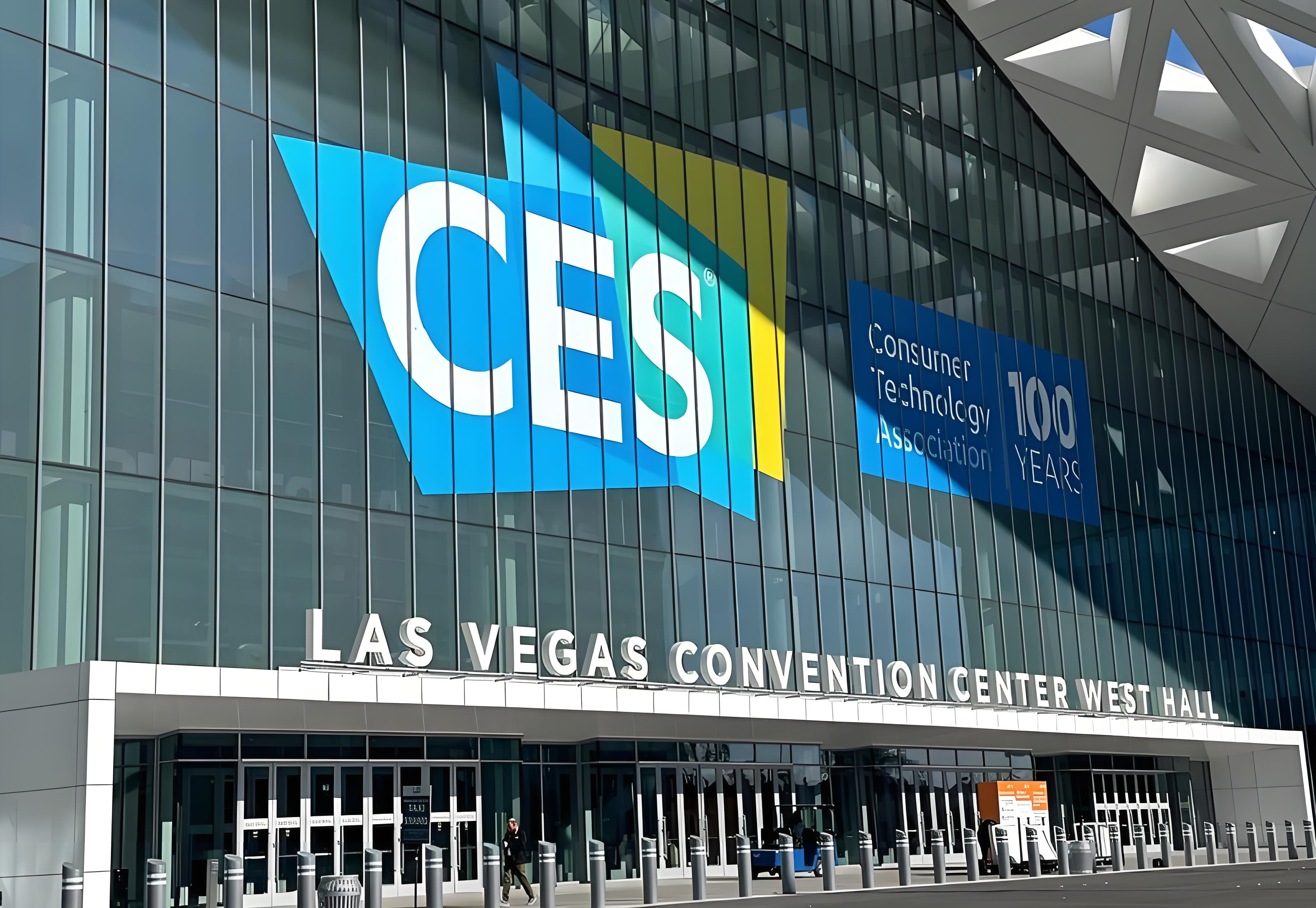 From January 7th to 10th, 2025, local time in the United States, CES 2025 (Consumer Electronics Show) was held in Las Vegas.
On Monday, Jensen Huang, the CEO of NVIDIA, delivered a keynote speech to over 6,000 attendees at the opening of the CES conference.
He introduced a series of new products and technologies, including but not limited to the GPU RTX 5090 based on the Blackwell architecture and Project Digits, the world's smallest personal AI supercomputer.
Despite the extensive and promising announcements, NVIDIA's share price plummeted overnight, dropping by more than 6%. What led to this?
NVIDIA Ignites CES 2025
GeForce RTX 50 Series
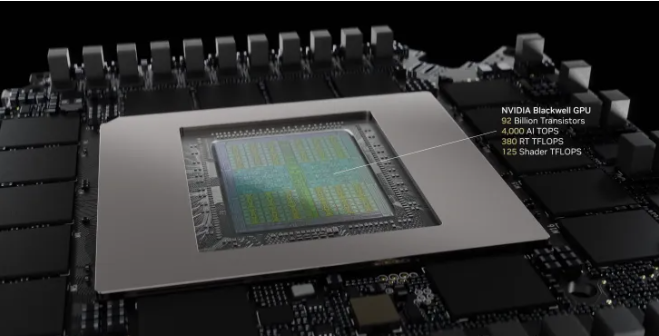
After months of rumors, NVIDIA's new - generation PC graphics cards finally made their appearance. As NVIDIA's consumer - grade GPU product line, the new GeForce RTX 50 series was officially launched.
The new chip family features the NVIDIA Blackwell architecture, the fifth - generation Tensor Cores, and the fourth - generation RT Cores. It has upgrades in the AI rendering field, covering aspects such as neural network shaders, digital human technology, geometry, and lighting.
Regarding prices, the RTX 5090 is priced at a high $1999. The RTX 5080, 5070 Ti, and 5070 are priced at $999, $749, and $549 respectively. Jensen Huang even claimed that the RTX 5070 can offer the performance of the RTX 4090 at a price of $549, mainly thanks to the advancement of DLSS 4 technology.
Launch of the World's Smallest Supercomputer
Jensen Huang also talked about the supercomputer Project DIGITS launched by NVIDIA during the event.
Equipped with the new GB10 super - chip, Project DIGITS has become the world's smallest AI supercomputer capable of running 200 - billion - parameter models.
This can be seen as NVIDIA's prelude to entering the AI PC market. Just as the Apple Mac brought revolutionary changes, this new "computer" prototype from NVIDIA may chart a new course for the PC market.
There have long been rumors that NVIDIA would enter the AI PC sector, and now it has actually created a new computer, showing remarkable progress. With Arm's strong push in the PC market, the x86 architecture will continue to face pressure.
After the "Wintel" alliance, NVIDIA is now initiating a new game in the AI PC arena.
From Robots to Autonomous Driving
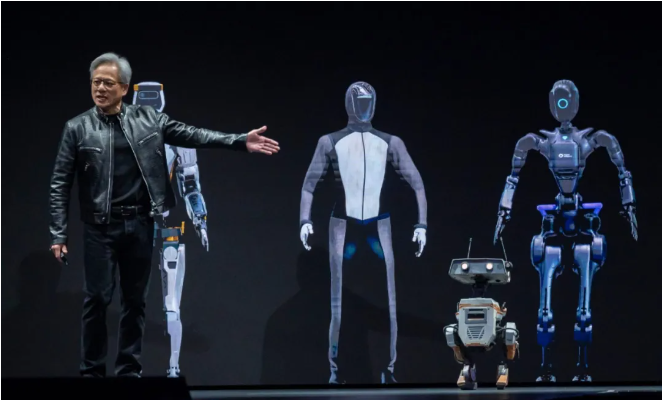
In addition to the new chips and desktop systems, NVIDIA presented the new Cosmos platform for developing Physical AI.
In the practical applications of Physical AI, robots and autonomous driving are the key areas.
NVIDIA stated that three computers - "DGX + Omniverse + AGX", which span different software and hardware product lines of NVIDIA - can assist developers in building the next - generation robots and autonomous driving systems.
Based on this large - scale platform, NVIDIA also updated its products in the automotive and robotics fields.
In the automotive domain, Jensen Huang announced the launch of the next - generation automotive processor "Thor", which is now in full - scale production.
Partner automakers include BYD, Li Auto, Xiaomi, Zeekr, Tesla, Mercedes - Benz, etc. Moreover, Toyota, Aurora, Continental Group, etc. are using its automotive technology suite to support advanced driving and autonomous driving systems.
Another area that Jensen Huang has his eyes on is robotics. He has repeatedly stated that the era of robots is approaching.
This time, NVIDIA introduced the NVIDIA Isaac GR00T Blueprint for synthetic motion generation, which can help developers generate a vast amount of synthetic motion data to train humanoid robots through imitation learning.
Meanwhile, regarding NVIDIA's robotics and autonomous driving segments, I came across a comment from a brokerage analyst, which I'd like to share with you: "The robotics and autonomous driving technology markets alone represent another $1 - trillion incremental market opportunity that NVIDIA can tap into in the next few years.
This indicates that we believe the company's market capitalization will exceed $4 trillion and may eventually reach $5 trillion within the next 12 to 18 months."
Is Being Too Dominant a Liability? NVIDIA Mired in a Monopoly Quagmire
Currently, NVIDIA is facing a challenging period. On December 9th, 2024, China initiated an anti - monopoly investigation of NVIDIA due to one of its acquisition projects.
Coincidentally, both the EU and the US are also accusing NVIDIA of monopolistic behavior.
In September last year, the US Department of Justice launched an anti - monopoly investigation into NVIDIA on the grounds that NVIDIA's global market share in AI chips has exceeded 90%, giving it an absolute monopoly position.
The EU was the first to take tough action against NVIDIA. France was the first country in the world to launch an anti - monopoly investigation of NVIDIA, starting as early as September 2023.
Subsequently, the EU got involved and launched an investment supervision investigation of OpenAI, but it was later cancelled due to insufficient evidence.
However, France didn't let NVIDIA off the hook. According to French judicial regulations, France may impose a fine of 10% of NVIDIA's global turnover, amounting to a one - time confiscation of $44 billion.
So why is NVIDIA suspected of monopolistic practices? Ultimately, it's because of its overwhelming dominance.
Tech giants like Microsoft, Google, Facebook, and Tesla are all major customers of NVIDIA's AI chips.
In terms of market share, according to statistics released by Techsight, in 2023, global data center GPU shipments reached 3.85 million units.
NVIDIA accounted for 98% of the market share, while AMD, in second place, had a market share of 1.2%, and Intel had less than 1%.
While holding a 98% share of the global GPU market, NVIDIA achieved an astonishing gross profit margin of 74.6% in the third quarter of 2024.
Just how extraordinary is this figure? Let's compare it with the financial performance of other "monopoly - like" companies in the semiconductor industry.
In the third quarter of this year, ASML, the lithography machine giant, had a gross profit margin of 50.8%.
Tokyo Ohka Kogyo, which accounts for over half of the photoresist market shipments, had a gross profit margin of 41.4% in the second quarter.
TSMC, which monopolizes the production capacity of semiconductor manufacturing processes below 5nm globally, had a gross profit margin of 53.2%. SK Hynix, the HBM chip giant, had a gross profit margin of 45.6%.
All these are far lower than NVIDIA's.
As is well - known, in the current AI industry, only a handful of large - model and application manufacturers can achieve profitability.
Most of the industry's funds flow into the hardware infrastructure sector. Among them, NVIDIA, while monopolizing the market, has also siphoned off most of the industry's profits, making it a target of criticism.
As for the sudden drop in NVIDIA's share price, it's quite understandable.
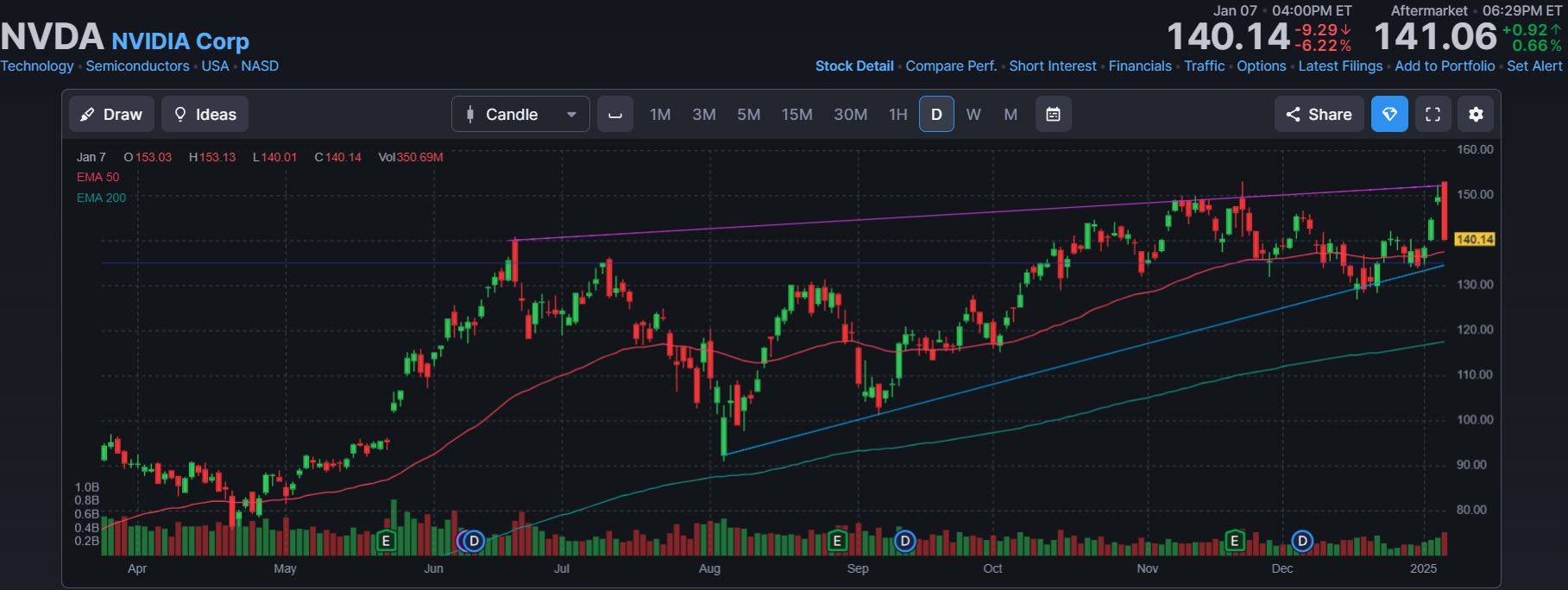
Many short - term speculators tried to hype NVIDIA's stock taking advantage of the CES hype. However, as is commonly known, for such highly - anticipated events, it's difficult to drive the stock price upward unless the announcements are truly spectacular. Once the event date arrives, expectations are realized, and short - term funds tend to flee.
So it's not hard to understand why NVIDIA's share price fell after the CES conference.
In fact, from my personal perspective, the announcements made by NVIDIA at this conference are still promising.
For instance, I'm particularly fond of that supercomputer. If AI can iterate at an accelerated pace, this computer, when integrated with AI, might very well turn into an all - powerful home intelligent science butler like those in the movies.
As for whether one should invest in NVIDIA now, I don't think it's a question worth considering. Those who were optimistic about it had already bought in years ago. But in the short term, this sharp decline may have largely released the panic sentiment (since there isn't really any significant negative news). So, it's okay to do some bargain - hunting and engage in a short - term trading for a profit.$NVDA $TSLA $MSFT
#$Nvidia Corp(NVDA)#$Microsoft Corp(MSFT)#$Tesla Inc. Common Stock(TSLA)