
A Comprehensive Overview of the Asian Market: How Will Each Market Unfold in 2025, and Who Will Stand Out? (Part One)

Magical Investor
January 9, 2025
GoGPT Summarizes Articles
 In the past month, the performance of Asian stock markets has been volatile. In China, the A-shares have been experiencing consecutive daily declines, and the Hang Seng Index has shown no signs of improvement. Conversely, the Nikkei 225 Index has been rising steadily amidst Japan's economic recovery.
Meanwhile, due to political unrest in South Korea, its stock market has also witnessed fluctuations.
In this article, I will present my judgments on how the Asian market will evolve in 2025.
The Chinese Mainland and Hong Kong Stock Markets
The year 2025 doesn't seem to be a smooth one for Chinese investors.
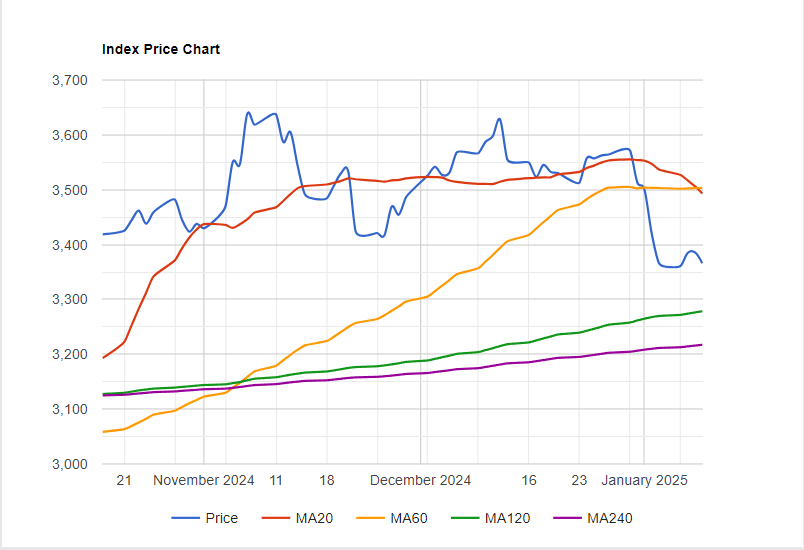
Since December 31, 2024, the CSI 300 has entered a downward channel, and on January 2, it dropped by nearly 3%.
On January 8, the Shanghai Composite Index once fell below the 3200 - point mark, attracting widespread attention from the market and causing concern among investors.
So, what has led to this decline, and how will it develop in the future?
Let me first talk about my own situation. The Chinese mainland market has been one that I have frequently invested in over the past few years, and I have achieved good returns in these years.
In 2021, my rate of return in the Chinese mainland market was 258%, and last year, in 2024, my total rate of return in the Chinese mainland market was 112%.I think this is a relatively good result.
In fact, the decline of the Chinese market is often unreasonable. It is very difficult to predict such a market, and we can only look for possible reasons after the decline occurs.
However, at least from the perspective of the macro - economic fundamentals, the current market adjustment is not caused by fundamental factors, but is affected by the centralized position - adjustment at the end of the year and the beginning of the year.
Many ETFs and public funds usually adjust their positions during this period.
I think this wave of market adjustment will continue until a few days before the Chinese Spring Festival.
There may be small - scale rebounds in the middle, but the downward trend is hard to change.
And a few days before the Spring Festival, I think there may be a wave of bargain - hunting funds entering the market.
With the real estate market being lukewarm, how to further strengthen the construction of the stock market is a question that the Chinese government needs to consider.
Hong Kong Stock Market:
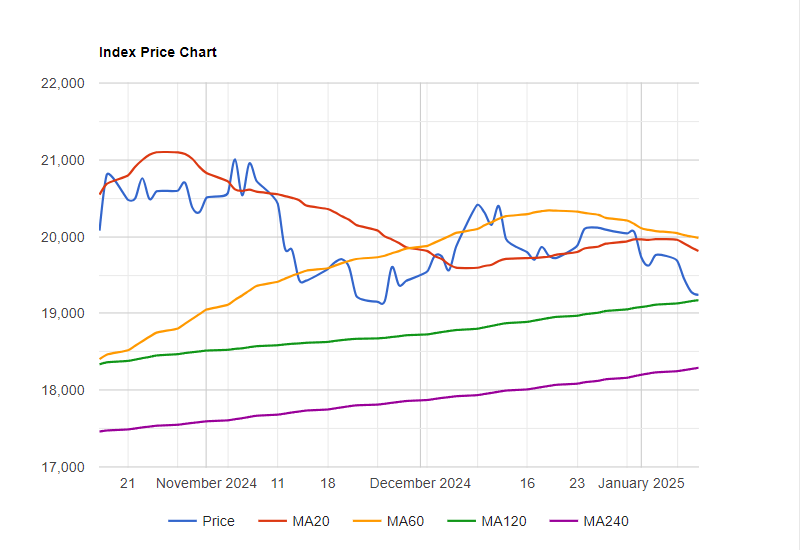
At the beginning of this year, the Hong Kong stock market has also continued to decline. On January 8, the Hang Seng Index once fell by more than 2% during the session.
Currently, the Hong Kong stock market has not completely shaken off the volatile pattern, that is, the rebound is intermittent, and the structure is the main line.
Therefore, in terms of investment strategy, it is more inclined to gradually lay out on the left - hand side when the market is depressed, and moderately turn to take profits on the right - hand side when the market is exuberant.
However, I think the Hong Kong stock market is also expected to recover in the future.
The current correction of the Hong Kong stock market has approached the level before the policy stimulus.
Setting aside the policy stimulus from the Chinese government, we can list other factors that may affect the Hong Kong stock market and then summarize the possible future trends.
1. On January 20, 2025, Donald Trump will be officially inaugurated. So, it is estimated that there will be some tariff measures around the Chinese Lunar New Year of the Snake.
Therefore, during this period, the Hong Kong stock market may be significantly suppressed, and some active funds may withdraw in advance and wait and see.
But there is no need to be too pessimistic. There are not many stocks in the Hong Kong stock market that are greatly affected by tariffs. Stocks in sectors such as technology, state - owned enterprises, finance, electric vehicles, and consumption are not directly affected much.
2. In fact, there are many global investors in the Hong Kong stock market. Therefore, the monetary policy of the Federal Reserve will be a key variable affecting the capital liquidity of the Hong Kong stock market.
In 2025, with the relatively strong resilience of the US economy and the resistance to the decline of inflation, the Fed's rate - cut pace will slow down. So, the foreign capital liquidity of the Hong Kong stock market is under certain pressure.
However, at the same time, in a low - interest - rate environment, the high dividend yield of the Hong Kong stock market still has a strong attraction to mainland Chinese funds.
With the continuous improvement of the connectivity mechanism between the Chinese mainland and the Hong Kong market, south - bound funds are expected to inject continuous vitality into the Hong Kong stock market.
3. Technically speaking, the Hang Seng Index has formed a large double - bottom (around 15,585 points) on the K - line chart. So, the 18000 - point mark has strong support. I think the Hang Seng Index has a chance to test above 22,890 points in the first half of 2025.
In conclusion, I think that in 2025, the Hong Kong stock market is expected to enter a new stage of the market under the conditions of economic recovery, capital inflow, and policy support.
It is expected to move from the current volatile stage to a strong upward - trending stage. If the policy further intensifies and the economic fundamentals improve significantly, then the improvement of corporate earnings and market sentiment will resonate, triggering a Davis Double - Play.
However, if you want to invest in the Hong Kong stock market, my personal advice is that it is best to wait until after the Chinese Lunar New Year to look for opportunities.
The Singapore Stock Market
Singapore is actually one of my favorite cities, a gathering place for the rich and elites. Let's briefly talk about the Singapore stock market.
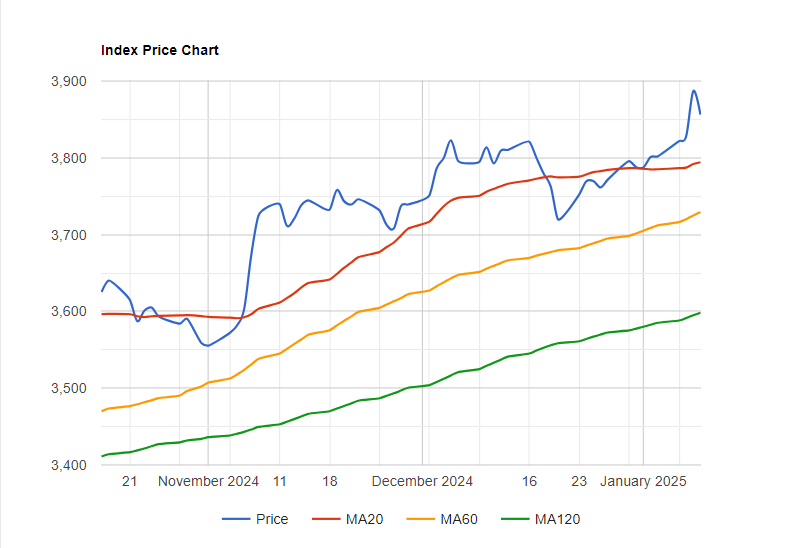
The Singapore stock market basically showed steady growth in 2024. The STI rose by nearly 17% throughout the year in 2024. I have checked the data and found that in October 2024, the total market capitalization of the Singapore stock market was $634.293 billion, and in November 2024, it reached $664.861 billion.
The data for December has not been counted yet, but it can be estimated that it has approached $700 billion.
This is a large - scale financial entity that cannot be ignored in the global market.
It is worth mentioning that in the third quarter of 2024, Singapore's GDP growth rate was as high as 8.19%. With the economy developing so rapidly, the Singapore stock market can still be a stable investment in 2025.
On the one hand, the Monetary Authority of Singapore has been actively taking actions to boost the stock market, committed to creating a good development environment for the stock market, and is expected to benefit from the reform plan that the Monetary Authority of Singapore (MAS) will release this year.
With national support and policy support, it's hard for the market not to rise.
On the other hand, as the expectation of the Fed's rate - cut has decreased, in order to prevent currency devaluation, countries like Malaysia, Thailand, and the Philippines may maintain their current currency interest rate levels, and may even raise interest rates slightly to prevent their currencies from depreciating rapidly.
However, Singapore is different. It even has some room for monetary policy relaxation, which will also attract a large amount of capital to enter.
By observing the Singapore stock market, we can find that the performance of growth stocks in the Singapore market has always been better than that of value stocks. But since the Fed entered the interest - rate - hiking cycle in early 2022, the situation has completely reversed. Value stocks have been rising steadily, while the market of growth stocks has declined rapidly.
After Singapore entered the interest - rate - hiking cycle following the US, growth stocks were under pressure on valuation due to the rise of the risk - free interest rate, and their market declined.
When the Fed started cutting interest rates in September 2024, both value stocks and growth stocks rebounded, jointly supporting the market of the Singapore stock market.
So, in 2025, with the slowdown of the rate - cut expectation, I think the market will probably return to the previous level. The position can be allocated with value stocks and growth stocks in a ratio of 7:3.
Okay, next we will continue to analyze the trends of the Asia - Pacific market, including the stock markets of South Korea, Japan, and Southeast Asian countries. See you next time.
Disclaimer: This is just my opinion based on what I’m seeing. Not financial advice—do your own research before investing.$$HSI
#$HSI