
Non-farm Payrolls Report: US Stocks Reach 20-Year High in Valuation, Analysts Forecast a Sharp Correction

Magical Investor
January 10, 2025
GoGPT Summarizes Articles
The US Department of Labor will release the non-farm payroll data for December at 9:30 am EST.
Against the backdrop of the yield of the 10-year US Treasury bond, which is known as the "anchor of global asset pricing", surging towards 5% at the beginning of the new year, the impact of tonight's data on the global market is undoubtedly self-evident...
Just before the release of the US non-farm payroll data, the US dollar strengthened,But then it dropped rapidly.The market generally believes that the non-farm payroll data may provide hints about the timing of the Federal Reserve's next interest rate cut.
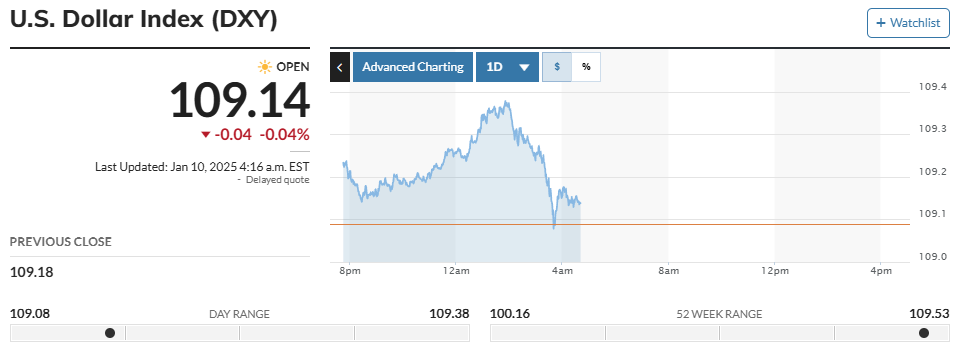
Potentially strong employment data may "prompt the market to discount the March rate cut and may push the first fully-priced rate cut to after June", so in terms of risk balance, there is a tendency for the US dollar to rise.
What is the market expectation for tonight's non-farm payrolls?
The market expects that non-farm payrolls may increase by 160,000 in December; the unemployment rate is expected to remain unchanged at 4.2%; and the wage growth may be 0.3% month-on-month.
If the data is lower than this expectation, it will trigger concerns about the US economic outlook and the Fed's rate-cutting pace. This may lead to panic selling, causing an overall decline in the US stock market.
In terms of institutional expectations, Goldman Sachs is significantly more pessimistic about tonight's non-farm payroll data compared to the market. The average growth rate of non-farm payrolls reflected by various labor market indicators tracked by Goldman Sachs may be 136,000.
Goldman Sachs itself predicts that non-farm payrolls will only increase by 125,000 in December-far below the median market expectation, and the unemployment rate may rise from 4.2% in November to 4.3%.
On the other hand, UBS is more optimistic about tonight's non-farm payrolls.
UBS economists expect that due to seasonal factors and the impact after the storms, non-farm payrolls will increase by 180,000 in December, higher than the market-consensus expectation of 160,000 and the two-month moving average of 132,000.
UBS predicts that the unemployment rate will remain at 4.2%, the average hourly wage will increase by 0.3%, and the working hours will remain stable.
Anyway, the answers will be revealed in a few hours. Investors need to invest cautiously and pay close attention to the fluctuations of the US stock market.
In addition, many people are concerned whether this non-farm payroll data will affect the rate-cutting rhythm. The answer is no.
Since the probability of the Federal Reserve cutting interest rates in January is only a meager 6.9% in the interest rate swap market, it can be basically determined tonight that-regardless of whether the non-farm payrolls data is good or bad, it is unlikely to affect the Federal Reserve's decision to pause interest rate cuts / stay on hold this month.
So there is no need to worry too much.
US Stocks at 20-Year High in Valuation, Likely to Experience a Correction?
Apart from today's non-farm payrolls, let's briefly talk about the current situation of the US stock market.
Some institutions have pointed out that the current valuation of US stocks has reached the highest level since 2002, which is exactly the same as the level when Alan Greenspan issued the "irrational exuberance" warning in 1996.
"Irrational exuberance" is a well-known concept mentioned by Greenspan on December 5, 1996.
At that time, Bill Clinton had just been re-elected as president, and the US stock market continued to rise. Greenspan warned investors that excessive optimism might lead to over-inflated asset values, and this kind of sentiment might be irrational.
He raised an important question: "How do we know when irrational exuberance has unduly escalated asset values, which then become subject to unexpected and prolonged contractions? And how do we factor that assessment into monetary policy decisions?"
This statement was interpreted by the market as Greenspan believing that the US stock market was overvalued and at risk of a bubble. Subsequently, the stock market declined.
The current valuation level of the US stock market has alerted some financial analysts and Federal Reserve officials. Fed Governor Cook said on Monday that at the current price level, the stock market and the corporate bond market are "prone to a significant decline".
Let's take a look at the valuations of various sectors.(The data is as of the end of 2024)
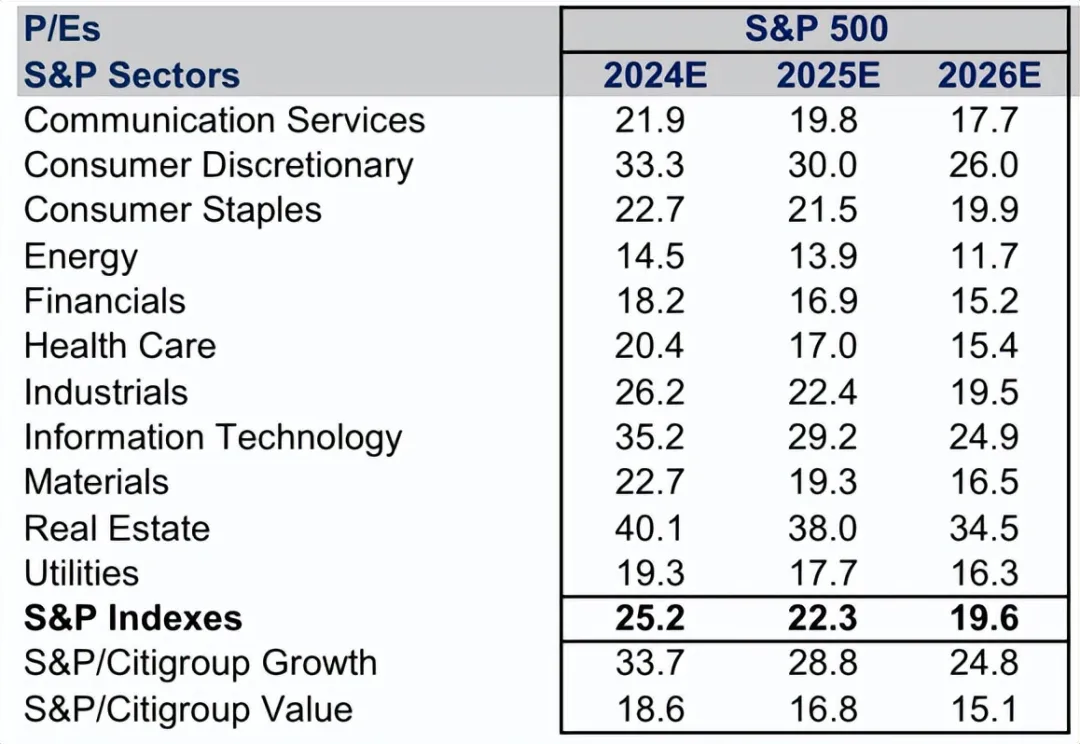
The price-to-earnings ratio (P/E) of the S&P 500 index is 25 (based on expected 2024 earnings), and the forward P/E ratio is 22.3 (based on expected 2025 earnings).
Note that the long-term average P/E ratio is approximately 16. Therefore, the S&P 500 index may be overvalued by 35%, and the valuation is similar to a bubble.
The information technology sector has the highest valuation, with a P/E ratio of 35, followed by the consumer discretionary sector with a P/E ratio of 33. Note that except for the energy sector, the P/E ratios of all sectors exceed 16.
So, by traditional standards, the entire market is very expensive.
Comparing with the current situation, the bubble is already very large.
Therefore, many analysts' basic prediction for 2025 is a US economic recession. Trump's immigration policies, potential tariffs, and energy shocks may also lead to an increase in inflation. Essentially, this is a stagflation environment similar to that in the 1970s.
In addition, if Nvidia's subsequent earnings fail to meet expectations and the AI bubble bursts, then technology giants such as Apple and Google will enter a dark era, and the US stock market will also start a significant correction, experiencing a recessionary bear market.
#$Nvidia Corp(NVDA)#$Apple Inc.(AAPL)