
Strong Non-Farm Payrolls Dampen US Rate-Cut Expectations: Is This Drop Just the Beginning?

Magical Investor
January 14, 2025
GoGPT Summarizes Articles
 The newly released US non-farm payroll data has shocked the market.
Not only did the number of new jobs added far exceed expectations, but the unemployment rate, which had been rising slightly for a while, also reversed its upward trend.
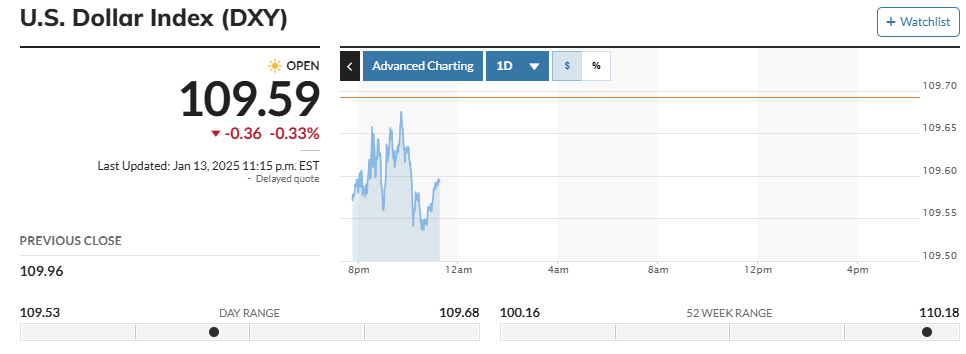
This has sent the US dollar index surging towards 110. (As of the time of writing, the US dollar index has broken through 110 just now.)
The market's expectation for the Federal Reserve to cut interest rates in 2025 has now been reduced to only one time.
The report released by the US Bureau of Labor Statistics last Friday showed that non-farm payrolls increased by 256,000 in December last year, far exceeding the expected 160,000, and the data for the previous two months was slightly revised downward.
The unemployment rate dropped to 4.1%, and average hourly earnings increased by 0.3% compared to November last year.
After the release of the non-farm payroll data, the US stock market plummeted on the same day.
The Nasdaq fell nearly 3%, and the S&P and Dow Jones indexes fell more than 1%.
For those who haven't had much exposure to interest rates, why did the stock market drop significantly despite such strong non-farm payroll data?
That's because you haven't understood the relationship between interest-rate cuts and asset prices yet.
Just remember one sentence: Interest rates are the gravitational force of financial assets. Raising interest rates means that interest rates are rising, and asset prices are falling. Lowering interest rates means that interest rates are falling, and asset prices are rising.
Not cutting interest rates means that interest rates remain at the current level. However, the market thought that there would be further interest-rate cuts this year and had already driven up prices in advance.
Now you're telling me that there won't be any more rate cuts. Shouldn't the part of the price that went up come back down?
Originally, the market expected two interest-rate cuts this year, but now there's only one left. So, it's no wonder that US stocks plunged.
But is this sharp drop just the beginning?
Goldman Sachs strategists pointed out earlier that US stocks are currently highly valued, which will greatly reduce the possibility of high returns in the coming year.
Goldman Sachs' analysis shows that a large part of the stock market's rise last year was due to the continuous increase in valuations.
Among the 493 constituent companies of the S&P 500 index (excluding the top seven technology stocks in the market), the increase in valuations accounted for nearly half of all returns.
"US stock valuations are at a 20-year high, and this is still the case even if we exclude the largest technology companies," Goldman Sachs said.
At the same time, the returns of US stocks have been highly concentrated in a small part of the market, making investors more likely to react strongly to negative news in these areas.
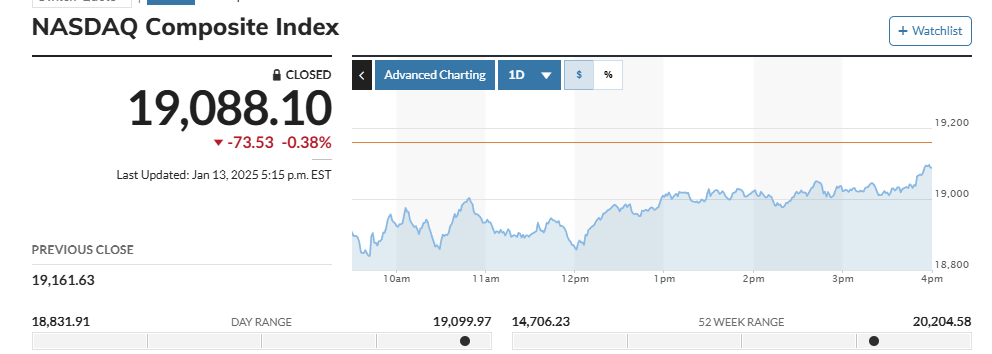
In 2024, several major giants accounted for 46% of the total return of the S&P 500 index. According to Goldman Sachs' analysis, the earnings growth of the "Magnificent Seven" technology stocks in the US is expected to reach about 33% in 2024, while the earnings growth of other constituent stocks in the S&P 500 index is expected to be only 3%.
Goldman Sachs pointed out that the over-concentration of the market exacerbates the vulnerability of US stocks when faced with disappointing performance growth.
I think there's some truth to this. One thing I'm very worried about right now is NVIDIA's earnings report this quarter. If it fails to meet expectations, it will be a disaster for US stocks and the AI industry.
From a technical perspective, the current chart of the Nasdaq index looks rather precarious. Once this downward channel opens, it might plummet straight towards 18,100 points, and then the situation will be hard to predict.
And Just as the earnings season arrives, I think US stocks urgently need some exciting earnings reports to reverse this downward trend.
But if the earnings reports of some key companies fail to meet expectations again, then we may need to be cautious for the time being.