
Japan's Interest Rate Hike? Early Warning of Financial Crisis? It Has Become a Global Focus

Magical Investor
January 23, 2025
GoGPT Summarizes Articles
It is reported that the Bank of Japan intends to further raise the policy interest rate at the monetary policy meeting to be held on January 23-24. It is expected to be raised from the current around 0.25% to around 0.5%.
The market generally believes that Trump's remarks are in line with expectations, so the Bank of Japan will implement an interest rate hike.
If there are no sudden changes in the market, the Bank of Japan will make a final decision at the meeting on the 24th.
Currently, the market's expectation of the Bank of Japan raising interest rates this week is extremely high. Some analyses even mention that the probability of an interest rate hike is as high as 98% or 99%.
In addition, according to the latest media survey, about three-quarters of economists hold the same view-that the Bank of Japan will raise interest rates on Friday. This proportion has also increased significantly compared to around 50% last month.
Japan's Interest Rate Hike and the Financial Crisis
You may ask, it's just an interest rate hike by one country. There are so many countries around the world, and many of them also raise interest rates. Why is it that when it comes to Japan, it seems so serious?
Yes, it is that serious. Let's first take a look at Japan's previous two interest rate hikes.
Japan's previous two interest rate hikes were indeed accompanied by global financial crises.
The first time was in August 2000. Friends who understand finance may know that in 2000, an epic stock market crash broke out in the United States, known as the bursting of the Internet bubble.
U.S. Internet stocks collapsed across the board, plummeting by more than 90%.
The Chinese stock market was also affected, with a slump of 50%. This incident occurred around the time of Japan's interest rate hike.
The second time Japan raised interest rates was from 2006-2007.
Subsequently, the U.S. subprime mortgage crisis broke out in 2007 and then evolved into a global financial tsunami in 2008.
The 2008 financial crisis was a once-in-a-century large-scale financial crisis in world history.
So the current concerns are not unfounded. Japan's previous two interest rate hikes were accompanied by financial crises. Now that Japan is raising interest rates again, some investors have started to worry.
And why is this so?
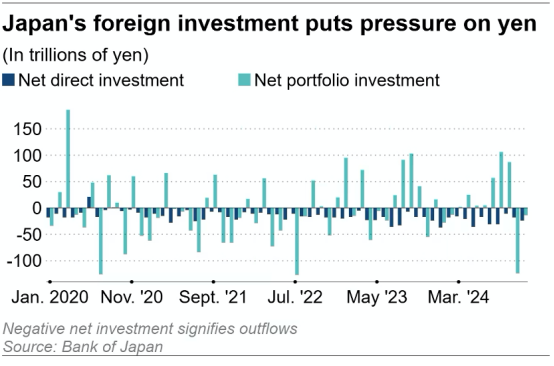
A survey by the trust institution Mitsubishi Asset Brains shows that in the first full trading week of 2025 starting on January 6, Japanese retail investors invested a record 948.9 billion yen in foreign stock investment funds and 21.2 billion yen in domestic stock funds.
In other words, 98% of Japanese retail funds were used to buy foreign stocks.
It's a simple truth. The market is worried that if Japan raises interest rates, Japanese retail funds are likely to flow back to the domestic market, and the global financial market will face a large-scale selling wave.
Undoubtedly, theoretically, this would make the yen appreciate.
But in reality, after the Bank of Japan raised interest rates in March and July last year, the interest rate level was only 0.25%; after the Federal Reserve cut interest rates three times last year, the policy interest rate was still in the range of 4.25-4.5%.
So even if the Bank of Japan raises interest rates this week, the interest rate gap between Japan and other major economies is still large. The situation has long suppressed the yen's position against other major currencies.
The data also reveals some clues. After the start of the previous two rounds of yen interest rate hike cycles, the yen not only did not appreciate but also depreciated to a certain extent, and the 10-year Japanese government bond yield did not show a significant increase.
However, we still need to be vigilant. Even if there might be elements of coincidence, who can say for sure? Whether this time will also "coincidentally" turn out the same way is still very much up in the air.