
Earnings Preview: Delivery and Performance Plunge—Is Boeing Facing Its 'Twilight'?

Shearing sheep
January 26, 2025
GoGPT Summarizes Articles
Boeing ($BA) is set to release its fourth-quarter earnings on January 28, with analysts forecasting an EPS of -$1.66 (-253.4% YoY).
On January 23, Boeing announced preliminary fourth-quarter results, which often signal a significant discrepancy between the company's actual performance and Wall Street's expectations.
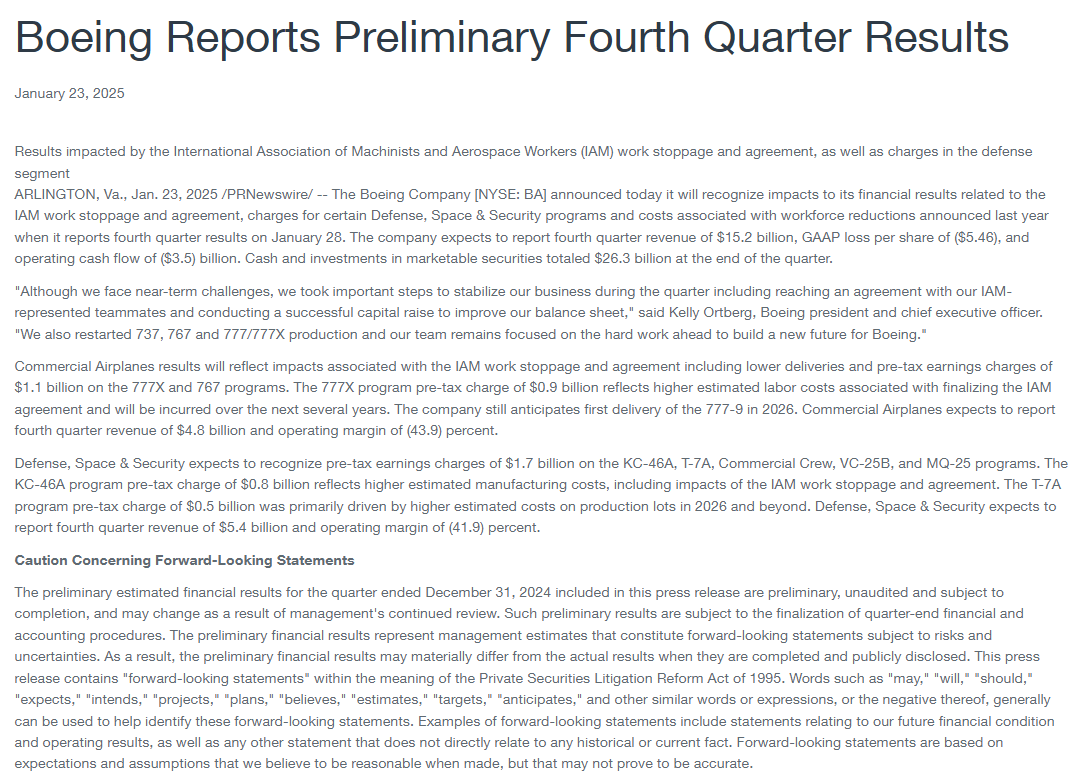
The preliminary results show that Boeing expects up to $3.5 billion in operational cash flow losses, primarily due to the impact of the International Association of Machinists (IAM) strike, layoffs, and defense business adjustments. The company anticipates a quarterly revenue of $15.2 billion, below Wall Street's estimate of $16.76 billion. Boeing also reported a GAAP loss per share of $5.46, much worse than analysts' predicted -$1.32.
Strike Impact and Financial Strain
Boeing noted that the IAM strike, which concluded in November with a new four-year contract, resulted in higher labor costs. Pre-tax costs for the 777X and 767 projects were estimated at $1.1 billion.
After the eight-week strike, Boeing increased IAM union worker salaries by 38% over four years, combined the previously approved $7,000 bonus with a $5,000 one-time payment, and offered workers the choice of depositing $12,000 into their 401(k) plans or receiving it as cash. Additionally, Boeing raised the matching rate for 401(k) contributions and reduced healthcare premiums.
Layoffs and Aircraft Deliveries
In early December, Boeing cut hundreds of jobs at its Washington and California facilities. Prior to this, the company had announced plans to reduce its workforce by 10%.
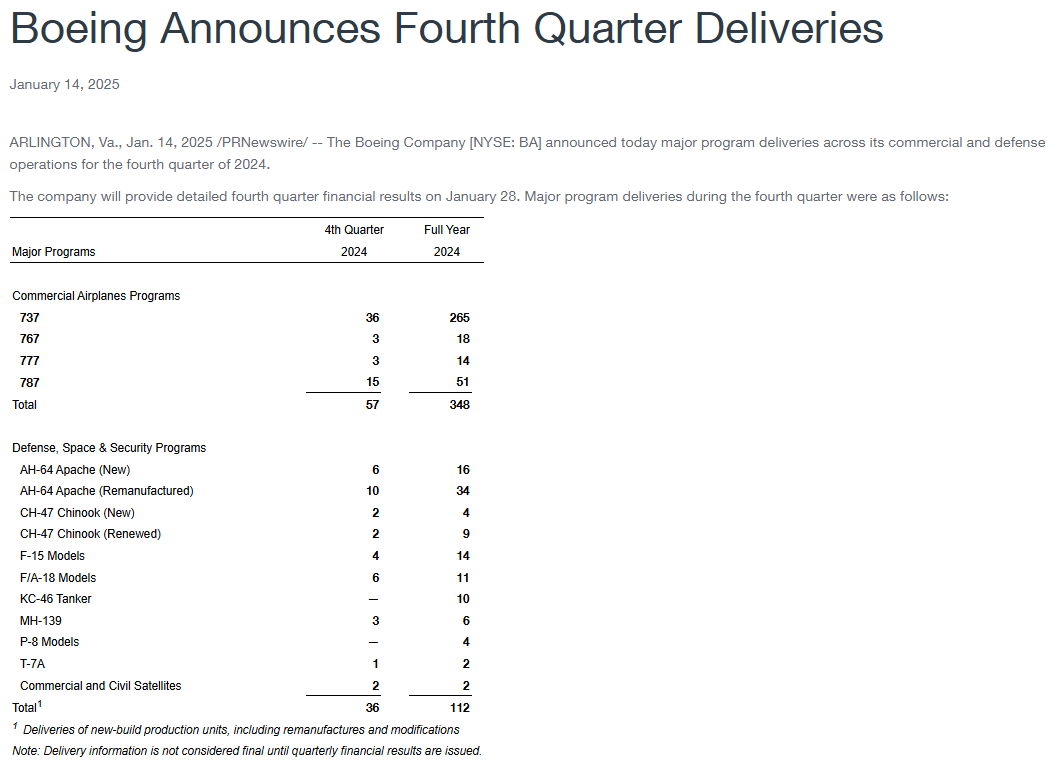
On January 14, Boeing released its delivery data for Q4 and the full year of 2024. In Q4, Boeing delivered 57 aircraft, including 36 737 MAX, 15 787 Dreamliners, 3 767s, and 3 777s. In total, Boeing delivered 348 commercial aircraft in 2024, a 34% decline from 528 in 2023. Of those, 737 deliveries amounted to 265, down 33% from 396 in 2023.
Due to the strike and layoffs, Boeing expects its commercial airplane division's revenue to be $4.8 billion, with an operating margin of -44%. The Defense, Space & Security division is expected to report $5.4 billion in revenue, with an operating margin of -42%.
Given these factors, Boeing is projected to face significant losses in 2024, and its operations and cash flow will be under considerable pressure.
Financial Status and Capital Measures
By the end of Q3 2024, Boeing had accumulated a loss of nearly $8 billion. Based on current fourth-quarter forecasts, Boeing's total loss for 2024 could reach $12 billion, comparable to its record loss in 2020.
Since 2018, Boeing has not been profitable. By the second quarter of 2024, the company's consolidated debt was $58 billion. As of the end of Q4 2024, Boeing held $26.3 billion in cash and marketable securities.
In November 2024, Boeing announced a $19 billion equity offering to bolster its cash reserves, driven by worsening cash flow and the risk of a downgrade in its credit ratings.
Additionally, Boeing is reportedly considering selling its prominent navigation division, Jeppesen. The division could fetch more than $6 billion, attracting interest from several aerospace suppliers and private equity firms. Boeing acquired Jeppesen for $1.5 billion in 2000.
Historical Context
Founded in 1916, Boeing is one of the world's largest aircraft manufacturers. The company experienced significant profits in the 2010s.
However, since 2019, a series of crashes revealed flaws in Boeing's production quality and safety standards, leading to financial losses. The global COVID-19 pandemic further exacerbated Boeing's operational pressures. In 2020, the company posted a record annual loss of nearly $12 billion.
In early 2024, a Boeing 737 MAX experienced a panel explosion mid-flight, prompting renewed federal scrutiny and slowing aircraft deliveries. In December, a Boeing 737-800 operated by Jeju Air crashed in South Korea, deepening the company's crisis.
Market Outlook
While the Q4 earnings report is expected to reflect a tough year, this doesn't necessarily mean Boeing will be stuck in a perpetual downward spiral.
Tony Bancroft, a portfolio manager at Gabelli Funds, believes Boeing "accelerated the losses and got those out of the way." He highlights that this was the CEO's first full quarter and that with factors like the strike and equity issuance, unfavorable Q4 results were somewhat inevitable.
"I think most of the bad news is behind Boeing," Bancroft says. "Going forward, you're going to see incremental improvements in production rates, and with the new administration and the new Department of Transportation, I think it's going to be a positive year for Boeing."
Conclusion
Despite facing numerous challenges in 2024, the market remains hopeful about Boeing's future.
As of January 25, multiple Wall Street firms updated Boeing's stock rating, with target prices ranging from $200 to $208. With Boeing's latest stock price at $176.06, this indicates a potential upside of at least 13.6%. Goldman Sachs analyst Noah Poponak maintains a Buy rating with a $200 target price. UBS analyst Gavin Parsons downgraded to a Hold rating but kept the target price at $208. Jefferies analyst Chloe Lemaire maintained a Buy rating with a $205 target price, while TD Cowen analyst Gautam Khanna also kept a Buy rating with a $200 target price.
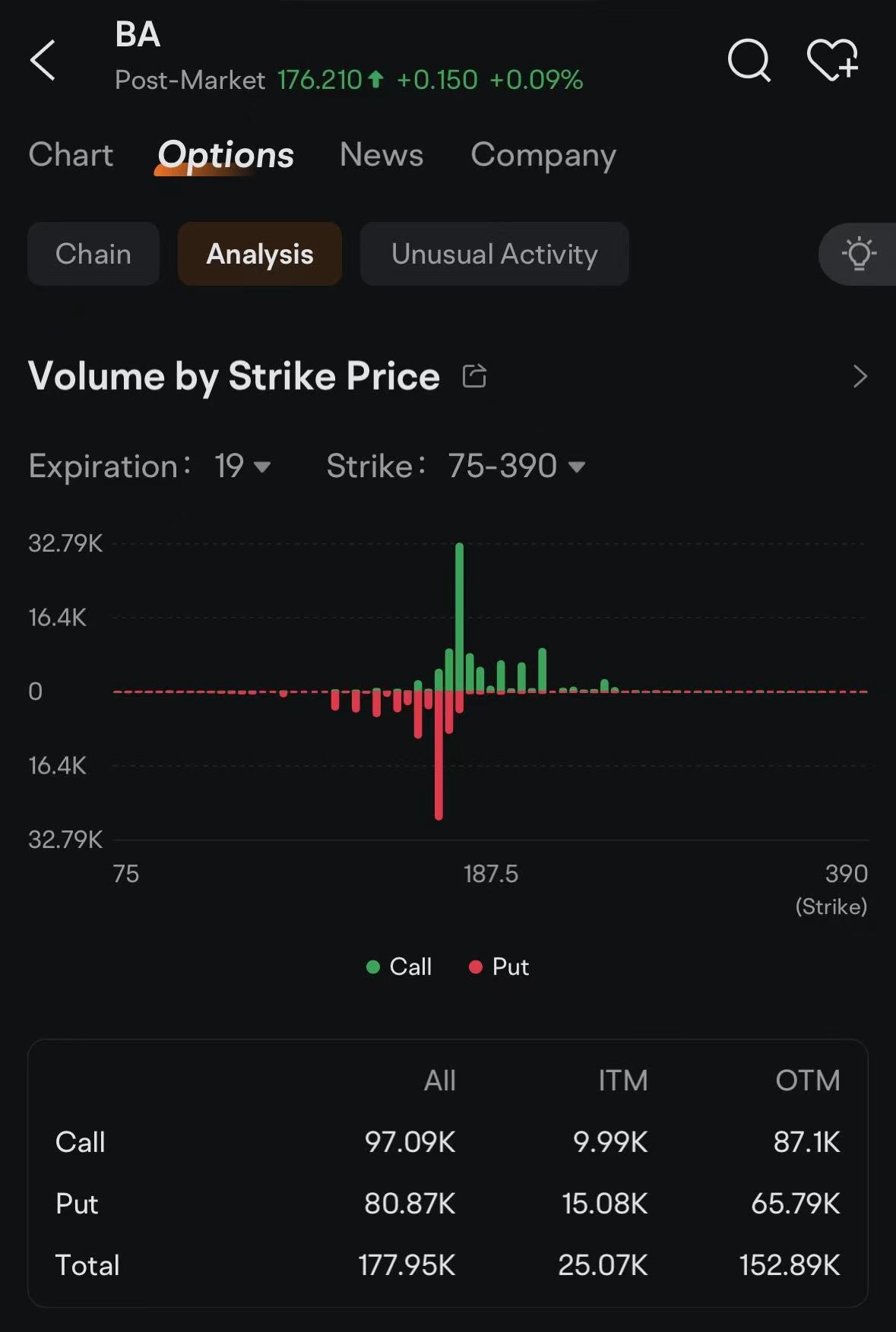
Regarding options, there have been 19 expirations to date, with a final date of January 15, 2027. Call options significantly outnumber put options, suggesting the market is more bullish than bearish on Boeing's future.
#🏦 earnings season begins! what to watch? 👀#boeing#earnings#$Boeing Company(BA)