
Earnings Preview: Is 2025 the Year of AMD’s Comeback?

Shearing sheep
January 27, 2025
GoGPT Summarizes Articles
AMD ($AMD) is set to release its Q4 2024 earnings on February 4th, and analysts are expecting earnings of $1.09 per share on revenue of $7.53 billion. But beyond the numbers, there’s a bigger story unfolding—one that could define AMD’s trajectory in 2025 and beyond.
A Rollercoaster Ride: AMD’s Recent Performance
If you’ve been following AMD, you know it’s been a wild ride. After a stellar 2023, where the stock delivered a jaw-dropping 128% return, 2024 was a different story. The stock ended the year down 18%, underperforming both the S&P 500 (up 24%) and the Nasdaq (up 30.8%). Looking back further, AMD’s returns have been all over the place: 57% in 2021, -55% in 2022, 128% in 2023, and -18% in 2024. If we’re looking for patterns, could 2025 be another positive year? Let’s break it down.
Q4 Expectations: Data Center Strength, But Challenges Remain
In Q3 2024, AMD posted revenue of $6.8 billion, up 18% year-over-year, driven largely by its Data Center segment, which saw a staggering 122% growth thanks to strong sales of Instinct GPUs and EPYC CPUs. However, the Gaming segment has been a weak spot, though there’s hope for a rebound in Q4 due to seasonal demand and the launch of the Ryzen 9000 X3D chips in November.
For Q4, AMD guided revenue of $7.5 billion, representing 22% year-over-year growth and 10% sequential growth. While this is solid, it fell short of Wall Street’s expectations, which has dampened investor enthusiasm. That said, the real focus should be on AMD’s guidance for the next quarter and beyond. Will they raise or lower expectations? That’s what could move the stock.
The AI Factor: AMD’s Secret Weapon
One of the biggest drivers of AMD’s growth is its positioning in the AI space. The MI300 series GPUs have been a game-changer, with sales exceeding $1 billion in less than two quarters. AMD expects Data Center GPU revenue to surpass $5 billion in 2024, and with major hyperscalers like Microsoft and Meta looking for alternatives to Nvidia’s expensive offerings, AMD is well-positioned to capitalize on this demand.
But it’s not just about hardware. AMD’s ROCm software stack for its GPUs is critical to challenging Nvidia’s dominance in AI. If AMD can improve its software ecosystem and make it easier for developers to adopt its GPUs, it could seriously disrupt Nvidia’s stronghold. And let’s not forget, customers want AMD to succeed—it gives them leverage against Nvidia and fosters a healthier competitive landscape.
The Rise of DeepSeek and Its Impact on AMD
Now, let’s talk about DeepSeek—a name that’s been making waves in the AI industry lately. DeepSeek is shaking things up with its innovative approaches to AI hardware and software, particularly in areas like inference and specialized AI workloads. While it’s still early days, DeepSeek’s rise could significantly impact the AI chip market, and AMD is right in the middle of this evolving landscape.
On one hand, DeepSeek’s emergence is a potential threat to Nvidia’s dominance. If DeepSeek can deliver competitive performance at lower costs, it could force Nvidia to rethink its pricing strategy or accelerate its innovation cycle. This could indirectly benefit AMD, which has been positioning itself as a cost-effective alternative to Nvidia’s expensive GPUs. On the other hand, DeepSeek could also challenge AMD directly, especially if it targets the same hyperscalers and enterprises that AMD is trying to win over.
Compared to Nvidia, AMD is more agile and open in its approach. Nvidia’s CUDA ecosystem, while powerful, is a double-edged sword—it’s deeply entrenched but also less flexible when it comes to integrating new technologies. AMD, with its ROCm software stack and open ecosystem, is better positioned to collaborate with emerging players like DeepSeek. This flexibility could allow AMD to adapt more quickly to changes in the AI landscape, creating a more collaborative and competitive environment.
DeepSeek V3: A Game Changer for AMD
The recent breakthroughs from DeepSeek’s V3 model are particularly noteworthy. This model represents a breakthrough in AI training efficiency, significantly reducing the cost of training state-of-the-art models. DeepSeek’s V3 benchmarks well against OpenAI’s GPT-4, yet it was trained for just $5.6 million—a fraction of the billions typically required for cutting-edge models. This is a game-changer for the AI industry, and it has major implications for AMD.
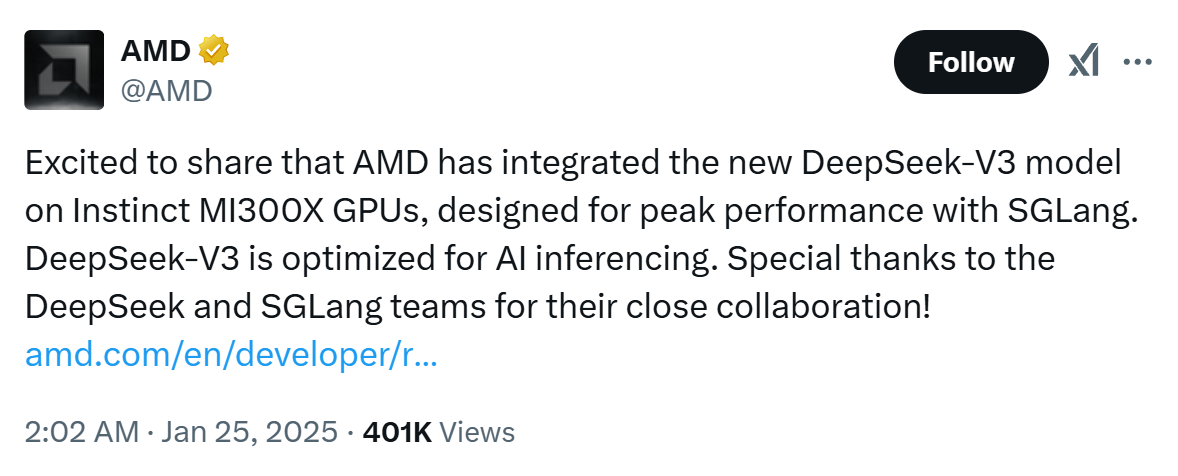
With DeepSeek’s architecture, AI labs no longer need the most expensive, cutting-edge GPUs to achieve competitive performance. This levels the playing field for AMD, whose MI300X GPU costs around $15,000 compared to Nvidia’s Blackwell chips at $70,000, becomes a much more attractive option. AMD’s GPUs already perform comparably to Nvidia’s H100 in key benchmarks, and with DeepSeek’s cost-efficient training methods, AMD’s value proposition becomes even stronger.
In essence, DeepSeek’s breakthroughs make AMD’s GPUs a more attractive option for AI developers and hyperscalers looking to optimize costs without sacrificing performance. This could help AMD capture a larger share of the AI market, especially as companies like Microsoft, Meta, and Google seek alternatives to Nvidia’s high-priced offerings.
Risks: Geopolitics, Recession, and Competition
Of course, no investment is without risks. Geopolitical tensions, particularly around Taiwan (where much of the semiconductor industry is concentrated), are a major concern. A recession could also hurt demand across AMD’s segments, though the company’s strong cash position ($1.3 billion in cash and equivalents) provides some cushion.
On the competitive front, Nvidia remains a formidable opponent, especially in AI. Intel is also trying to make a comeback with its Xeon CPUs, and Qualcomm’s Snapdragon chips could pose a threat in the PC market. AMD will need to execute flawlessly to maintain its momentum.
2025: A Turning Point for AMD?
Looking ahead, 2025 could be a pivotal year for AMD. The company’s Data Center segment is expected to continue its strong growth, driven by AI demand. The emergence of AI-capable PCs, powered by platforms like Microsoft’s Copilot+, could also drive an upgrade cycle, benefiting AMD’s Ryzen AI processors.
However, success isn’t guaranteed. AMD will need to navigate intense competition, improve its software ecosystem, and manage macroeconomic risks. If it can do that, 2025 could indeed be a year of strong returns for AMD shareholders.
Conclusion: A Cautious Buy
In my view, AMD is a cautious buy at these levels. The stock’s recent underperformance has created an attractive entry point, especially with the AI-driven growth story still intact. That said, investors should keep an eye on Q4 earnings and, more importantly, management’s guidance for 2025. If AMD can deliver on its promises and navigate the challenges ahead, 2025 could be a year of significant upside.
What do you all think? Is AMD a buy heading into 2025, or are you waiting for more clarity? #amd
Disclaimer: This is not financial advice. Always do your own research before making any investment decisions.
#🏦 earnings season begins! what to watch? 👀#amd#$Advanced Micro Devices(AMD)