
AMD Surpasses Q4 Revenue Estimates, Yet Datacenter Shortfall Pushes Stock Lower

Shearing sheep
February 5, 2025
GoGPT Summarizes Articles
On Tuesday, AMD dropped its Q4 earnings, and while they beat expectations in terms of revenue and adjusted earnings per share, the stock still took a hit in after-hours trading. What's going on here?
The reported Q4 revenue came in at $7.66 billion, a 24% increase from last year's $6.17 billion and a 12% increase from the previous quarter's $6.82 billion. However, net income fell by 28% year-on-year to $482 million, and dropped 37% from the previous quarter. On the other hand, adjusted net income for Q4 came in at $1.78 billion, up 42% from the same period last year, and up 18% from the previous quarter.
AMD exceeded Wall Street's expectations for Q4 revenue and adjusted earnings per share, while their full-year revenue also surpassed analysts' predictions, though adjusted earnings per share were slightly below expectations. Looking ahead, AMD's guidance for Q1 2025 revenue was above analysts' estimates.
But here's where the concern lies: the company's Datacenter division, which is critical to AMD's future growth, reported Q4 revenue that fell short of expectations. This underperformance in the Datacenter sector, especially amid growing demand for AI chips, sent AMD's stock tumbling after an initial post-earnings pop.
What Happened with Datacenter?
AMD's Datacenter business saw a solid 68% growth YoY, reaching $3.9 billion in Q4. While this growth is impressive, it fell short of analysts' expectations of $4.1 billion. The company is betting big on AI, and their Instinct GPUs are a key part of that strategy, but the market was expecting even more from this segment. With competitors like NVIDIA continuing to dominate the AI chip space, this miss raises concerns about AMD's ability to compete at the same level.
The Gaming and Client Sectors
AMD's Client business (PC chips) performed well, with a 58% YoY increase in revenue to $2.3 billion. This outpaced expectations, reflecting strong demand for Ryzen processors in both desktop and mobile devices. However, the Gaming sector took a significant hit, with Q4 revenue falling 59% YoY to $563 million. While this was still better than analysts expected, the drop raises questions about the sustainability of growth in AMD's gaming business.
Guidance and Future Outlook
Looking ahead, AMD's Q1 2025 revenue guidance of $6.8 billion to $7.4 billion surpassed analyst expectations, with the midpoint of $7.1 billion representing a 31% YoY increase. The company credited its record Datacenter revenue in Q4 to strong AI chip demand, driven by a surge in AMD Instinct GPU shipments and EPYC CPU sales.
During the earnings call, CEO Lisa Su highlighted how affordable AI models would accelerate AI adoption. AMD is optimistic about the overall AI cycle, forecasting significant growth for server CPUs in 2025. The company expects strong double-digit growth in revenue, earnings per share, and Datacenter business, with a particularly strong performance in the second half of 2025. Analysts have raised their 2025 revenue growth estimates for AMD to 25%. In Q4, AMD also began mass production of the MI325X, with plans to launch the MI400 in 2026.
AMD's continued investment in AI and Datacenter growth, along with its focus on adaptive computing, is fueling optimism. Lisa Su remains confident that AI models will drive further adoption, positioning AMD to compete more directly with NVIDIA in the AI chip space.
The Market Reaction
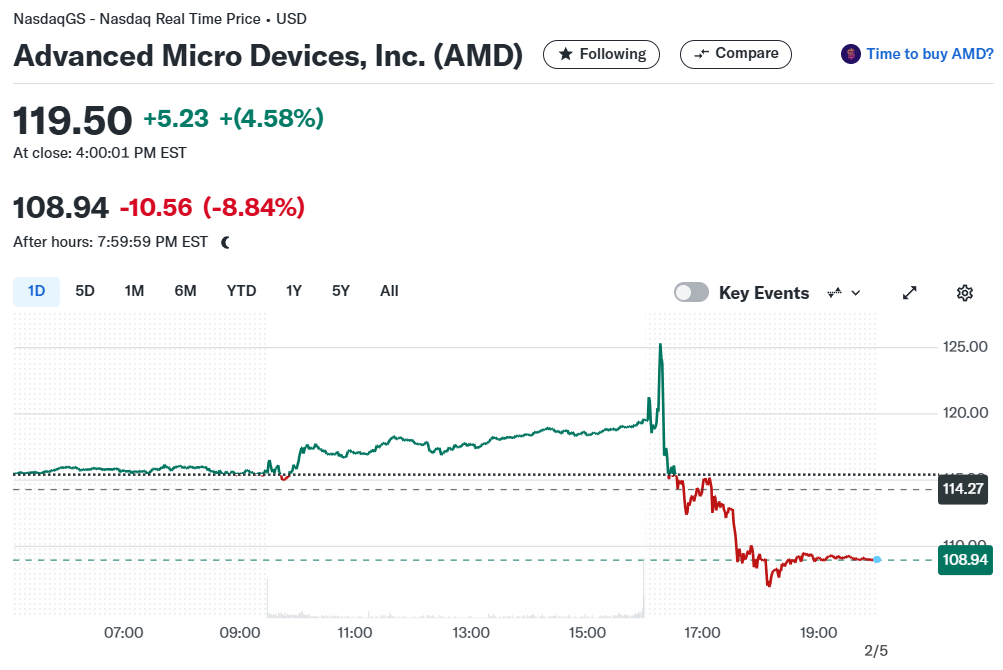
Despite the solid guidance and strong performance in certain sectors, the market's reaction was less than enthusiastic. AMD's stock initially rose by about 5% in after-hours trading but then reversed course, dropping by 8.84%. The underwhelming Datacenter results, combined with investor concerns about competition in the AI space, left many questioning AMD's ability to maintain its growth trajectory.
My Take
AMD's Q4 results show that the company is still in growth mode, especially in the Client and Datacenter sectors, but the Datacenter miss was a tough pill to swallow. The AI hype is real, and AMD has the potential to ride that wave, but they're facing intense competition, particularly from NVIDIA, which has positioned itself as the leader in AI chips. I think AMD's long-term growth prospects remain solid, especially with their strong portfolio and focus on adaptive computing. However, they'll need to execute well in 2025 to reassure investors that they can hold their own in the rapidly evolving AI chip market.
What are your thoughts on AMD's performance? $AMD
#The AI Chip War Intensifies: Can AMD Challenge Nvidia?#$Advanced Micro Devices(AMD)