
Alphabet Q42024 earning report - AI-driven growth

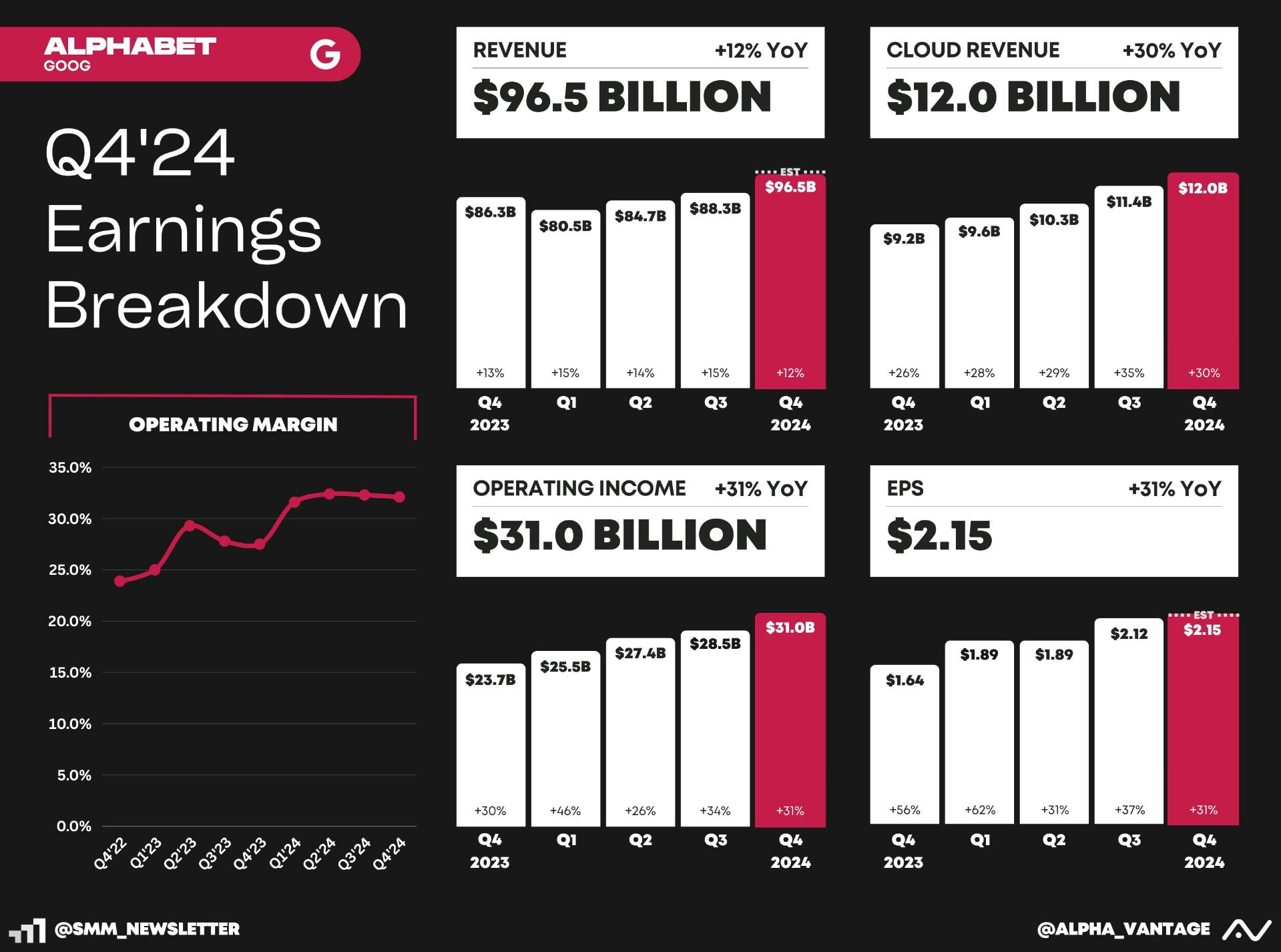
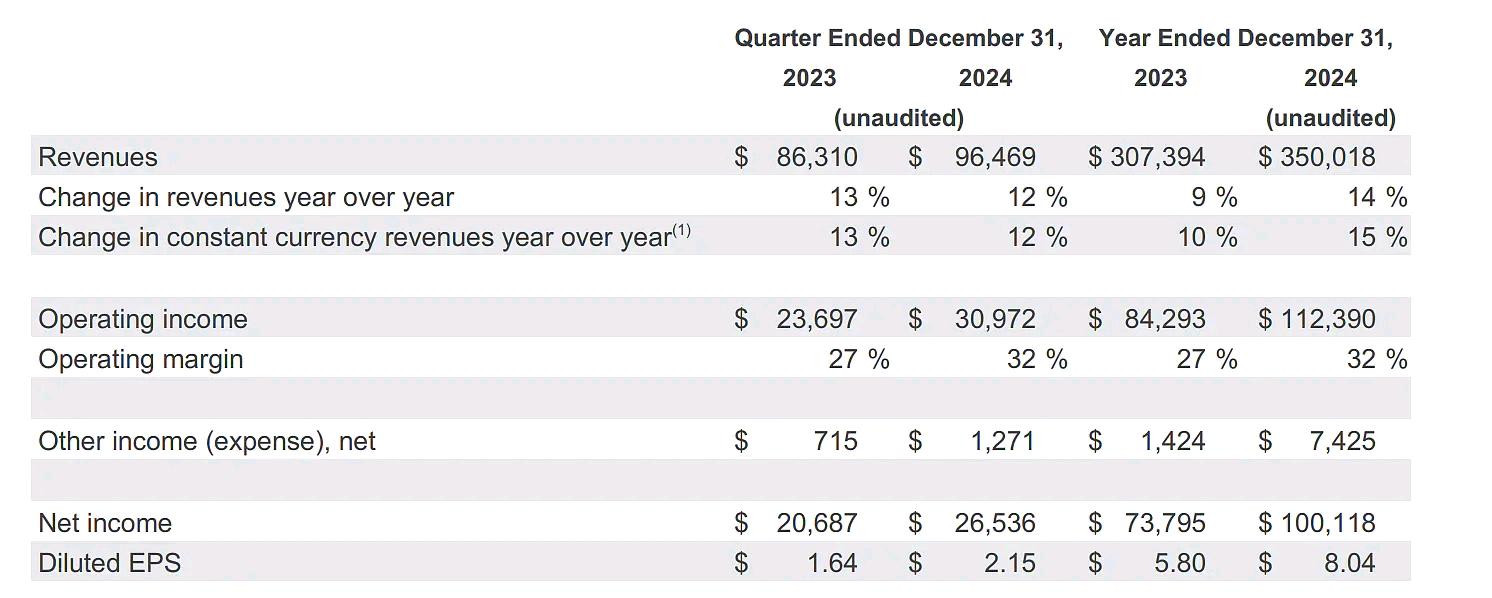
Google's parent company Alphabet has just released its Q4 and 2024 full-year financial report. Its performance was lower than expected, and its stock price plummeted by more than 8% after the market closed.
The gains in 2025 were directly wiped out, and the stock hit a record high of $207.05 before the close.
Let's talk about the overall data first
• In the fourth quarter of 2024, revenue increased by 12% year-on-year to $96.5 billion, and the business remained strong, but slightly lower than the expected $96.6 billion.
• Google Services revenue increased by 10% year-on-year to $84.1 billion, and Google Search and other products and YouTube advertising also declined slightly.
• Google Cloud revenue increased by 30% year-on-year, contributing $11.955 billion, mainly driven by the growth of Google Cloud Platform (GCP) core products, AI infrastructure and generative AI solutions. This figure is also lower than the market expectation of $12.19 billion, which is slightly weak.
The only bright spot is that earnings exceeded expectations, with net income increasing by 28% and earnings per share (EPS) of $2.15, higher than the expected $2.13.
CEO Sundar Pichai said: "Our results demonstrate the strong advantages of our differentiated full-stack AI innovation approach and the continued strength of our core business. We are confident in the opportunities ahead and plan to invest approximately $75 billion in capital expenditures in 2025 to accelerate development."
AI-driven Cloud Service
First, let's look at Google's cloud computing performance. Although Google Cloud's business grew by 30% year-on-year to nearly $12 billion, it was still lower than expected, and there were two big competitors, $AMZN and $MSFT , ahead.
Google is driven by the core products of Google Cloud Platform (GCP), involving AI infrastructure and generative AI solutions, which belongs to the AI-driven model of mainstream cloud computing vendors. YouTube and Google Cloud will end with an annualized revenue scale of $110 billion in 2024, and cloud computing and generative AI will gradually become their important sources of income.
However, Google's AI user layer is a clear shortcoming. A lot of technological advantages and distribution channels, but they have not been translated into widespread user acceptance. For example, the typical Deep Research recently released by OpenAI, Gemini 1.5 Pro integrated the Deep Research function in December last year, but it did not receive enough attention.
The company lags behind OpenAI in terms of product pace, faces the innovator’s dilemma, and continues to erode its core search advertising business. Even the latest model, Gemini 2.0, released, although widely praised by developers, is still overshadowed by DeepSeek.

As of the end of 2024, DeepSeek still ranks first in the App Store, ChatGPT ranks second, and Gemini ranks only 16th. CEO Sundar Pichai set a goal for 2025 to have 500 million people using Gemini by the end of the year. It is estimated that large-scale push users are indispensable. Recently, the US ranking has squeezed into the top three.
Advertising business is weak, competition and regulatory pressures coexist
Google's advertising revenue remains the main pillar of the company's financial performance. In the fourth quarter, Google Services revenue increased by 10% to $84.1 billion.
There is no doubt that Google has a strong market share in global search engines, YouTube ads and other services. But compared with market expectations, this growth rate is slightly weak, which is also the main reason for the stock price to plummet after the financial report was released.
At present, the global economy is unstable, and the expectations for the advertising market are inherently unstable. In addition, the competition is becoming more and more fierce, especially under the AI wave, Meta, Microsoft and other competitors are eyeing it, and the cross-border threshold is lowering.
In addition, the dollar remained strong in the fourth quarter, which also had a negative impact on Google's overseas revenue, further exacerbating the slowdown in revenue growth.
Currently, global regulators are stepping up their efforts to crack down on the technology industry, with the greatest pressure coming from the European Union. In September 2024, Google was convicted of abusing its monopoly power to attack competitors and was fined 2.4 billion euros; other antitrust cases in progress include illegal abuse of the Android mobile operating system (a fine of 4.125 billion euros) and Adsense advertising business (a fine of 1.49 billion euros).
In addition, the U.S. Department of Justice previously accused the company of having a monopoly in the advertising technology industry.
And just yesterday, Google was suspected of violating the Anti-Monopoly Law, and the State Administration for Market Regulation launched an investigation into Google in accordance with the law.
It is a headache to be deeply involved in a series of lawsuits and investigations at home and abroad.
AI Big Model open-source or closed-source
This is a question of left or right, leading or making money. A typical comparison is Meta and Microsoft.
As an open source advocate in the field of AI, Meta reiterated the importance of open source AI technology in its recently released financial report. It will continue to expand its investment in AI and AR/VR and promote the open source of its AI tools, especially in AI applications for advertising products and social networks. Although $META 's advertising revenue continues to grow, the profit model of open source AI is still relatively weak, and further breakthroughs are needed in product commercialization.
Microsoft, on the other hand, adopts a more closed strategy, especially in cooperation with OpenAI. Through the cooperation between the Azure cloud platform and OpenAI, Microsoft deeply integrates generative AI technology with enterprise-level applications, and quickly forms a unique competitive advantage. According to the 2024 financial report, Microsoft's Azure cloud business and generative AI services have grown significantly, especially in the penetration of the enterprise market, which has driven the growth of its cloud computing revenue. Microsoft's AI strategy is highly closed source, ensuring the exclusivity and profitability of its products in the enterprise market.
In contrast, although Google has launched open source tools such as TensorFlow, it still prefers a closed strategy in the promotion of AI products. Gemini is an example. Google hopes to promote its AI technology by deeply integrating it into search engines and cloud computing platforms, but its popularity on the consumer side is still limited. Especially in terms of search engines, it is not as popular as Perplexity.
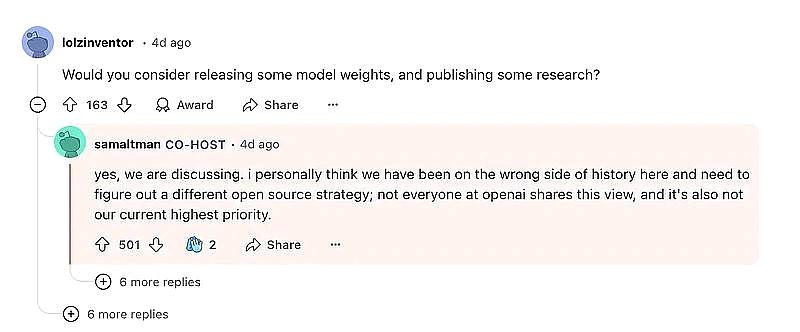
The recent explosion of DeepSeek is said to be a victory for open source. OpenAI CEO Sam Altman also expressed a similar view recently, "We have always been on the wrong side of history when it comes to open source."
2025 Outlook
Looking ahead to 2025, Google expects full-year capital expenditures of approximately $75 billion.
On Monday, Google confirmed that it had launched a voluntary resignation program for U.S. employees, including departments responsible for key products such as Android, Chrome, Google Photos, and hardware product lines such as Pixel, Fitbit and Nest. It was specifically pointed out that this offer does not apply to other departments such as artificial intelligence or search, a typical wave of preparations for All in AI.
According to a company statement, the program allows eligible employees to voluntarily resign and receive severance pay, with up to 25,000 employees. It is not ruled out that there will be potential major corporate restructuring or even divestitures. On the one hand, Google is also involved in an antitrust lawsuit, and Trump's comprehensive tariffs have taken effect, facing the risk of rising hardware costs.
A Google spokesperson said, "There is so much important work ahead, and we hope that everyone will be fully committed to our mission and focus on building excellent products quickly and efficiently."
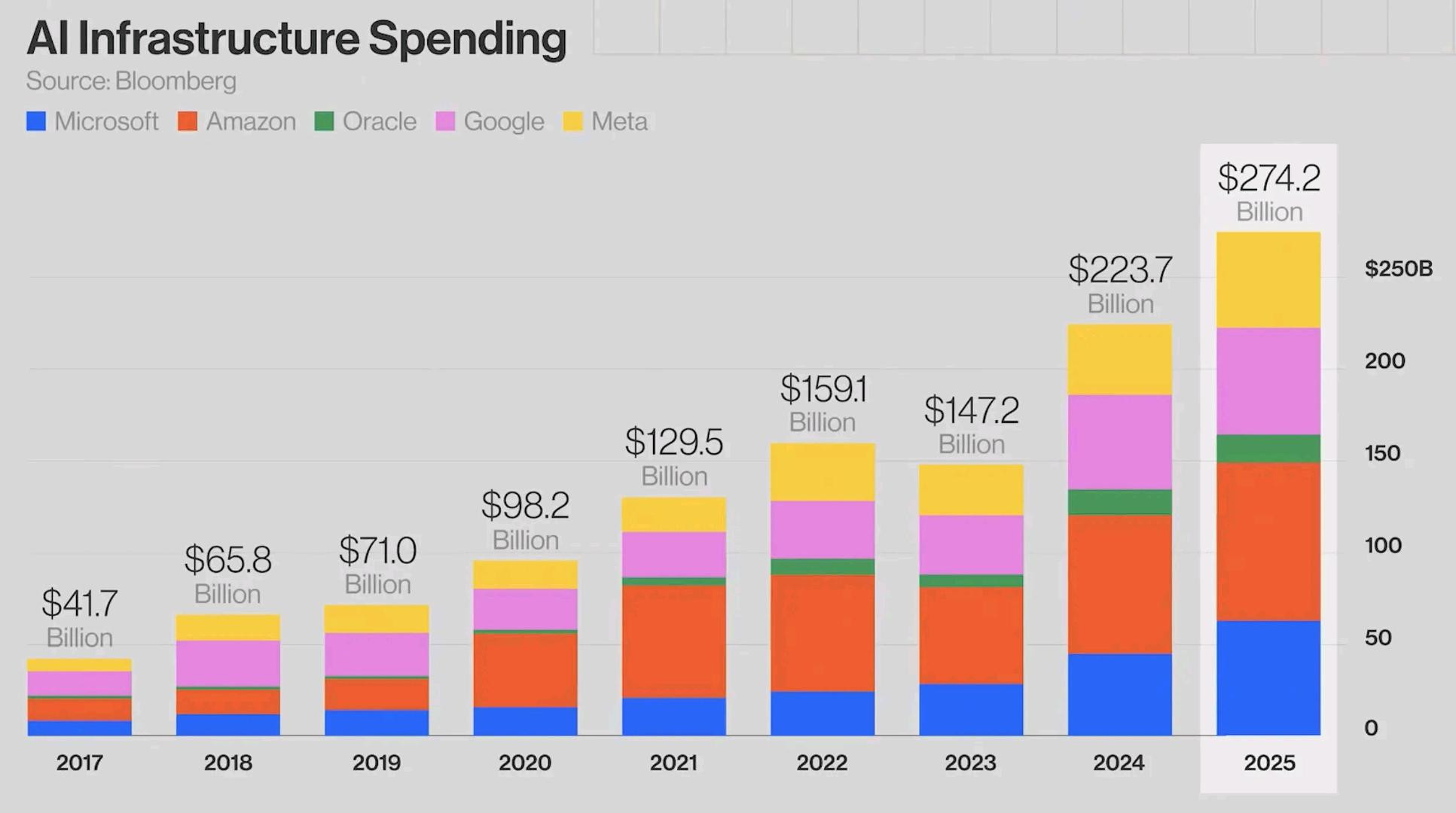
According to Bloomberg, $MSFT , $GOOGL , $META and other companies will invest $274.2 billion in AI infrastructure in 2025.
Everyone sees that AI big models are a good thing, and they are the driving force that determines the position of these technology giants in the next few years or even decades. But in the short term, how to resolve contradiction between technological innovation and market acceptance, and balance capital expenditure and profit, is a common problem for these giants.