
AI is Transforming Healthcare: One of the Most Promising Investment Areas in the Next Decade

Magical Investor
February 7, 2025
GoGPT Summarizes Articles
Cathie Wood, known as the "female Warren Buffett," has once again endorsed AI + healthcare.
Recently, ARK Invest released "Big Ideas 2025," a 148-page report stating that AI, robotics, energy storage, public blockchains, and multi-omics sequencing will drive exponential growth in the global economy.
ARK Invest, founded by Cathie Wood, is a well-known institution focused on investing in disruptive technologies, with an assets under management of $30.2 billion. Its annual "Big Ideas" report has become an important document for global investors to understand cutting-edge technologies and market trends.
The report points out that using artificial intelligence to "manipulate" data will revolutionize diagnosis, drug discovery, and treatment. By 2030, the performance of the entire industry will improve by several orders of magnitude.
So, how does AI integrate with the healthcare field? And what are the investment opportunities? Let's briefly discuss in this article.
AI is Leading a Revolution in the Global Healthcare Industry

Since the outbreak of the COVID-19 pandemic, the global healthcare industry has experienced unprecedented changes and accelerated development. At the core of this transformation, artificial intelligence is emerging as a key technology reshaping the global healthcare landscape.
AI not only shows great potential in early disease detection, drug research and development, genomics, clinical trial optimization, and patient management, but is also rapidly evolving from an emerging technology into an essential core resource in the healthcare industry.
According to a 2023 report by PwC, the global healthcare AI market was valued at $11 billion in 2023 and is expected to grow to $188 billion by 2030, with a compound annual growth rate (CAGR) of over 40%.
And according to data from Market.us, the market size of generative AI in the healthcare field is expected to reach $17.2 billion in 2032, with a CAGR as high as 37%.
This means that in the next decade, AI will completely transform the innovation path and investment logic of the healthcare industry.
Core Application Scenarios and Potential of Healthcare AI

Let's take a look at the specific applications of AI in the healthcare field. The following information is obtained from research.
Early Disease Detection: AI Facilitates Precise Screening and Personalized Diagnosis
AI technology, with its powerful capabilities in medical imaging, genomic analysis, and pathological data processing, has significantly improved the accuracy and efficiency of early disease detection.
Larry Ellison, co-founder of Oracle, mentioned in a speech at the White House that AI plays an indispensable role in early cancer detection and vaccine development.
It can help detect tiny tumor fragments, accelerate the development of mRNA vaccines, and thus promote the implementation of customized cancer treatment plans.
Drug Research and Development and Discovery: AI Drives the Next Generation of Innovative Drugs
Drug research and development is characterized by long cycles, high costs, and significant risks. AI technology is disrupting this model.
Generative AI is accelerating the new drug development process, reducing research and development costs, and increasing the speed of drug market entry.
Research by ARK Invest shows that AI can increase the return on investment in drug research and development to 30%-47%.
Multi-omics Sequencing: AI Ushers in a New Era of Precision Medicine
Multi-omics sequencing (Multiomic Sequencing) encompasses the integrated analysis of multi-level biological information such as genomics, transcriptomics, and proteomics.
Combining with AI technology can enable a deeper exploration of disease mechanisms and the formulation of individualized treatment plans.
Automated Healthcare and Intelligent Robots
The integration of AI and robotics is changing the traditional healthcare service model, with extensive applications in areas such as surgical robots, automated diagnosis, and pathological database management.
Christina Zorn, the chief administrative officer of the Mayo Clinic, emphasized at the J.P. Morgan Healthcare Conference that AI and robotics will become important components of future healthcare teams, helping to address issues such as healthcare workforce shortages and efficiency bottlenecks.
many issues need to be addressed in the transformation from technology to clinical practice.
In the future of the healthcare AI field, there will surely be a number of companies emerging.
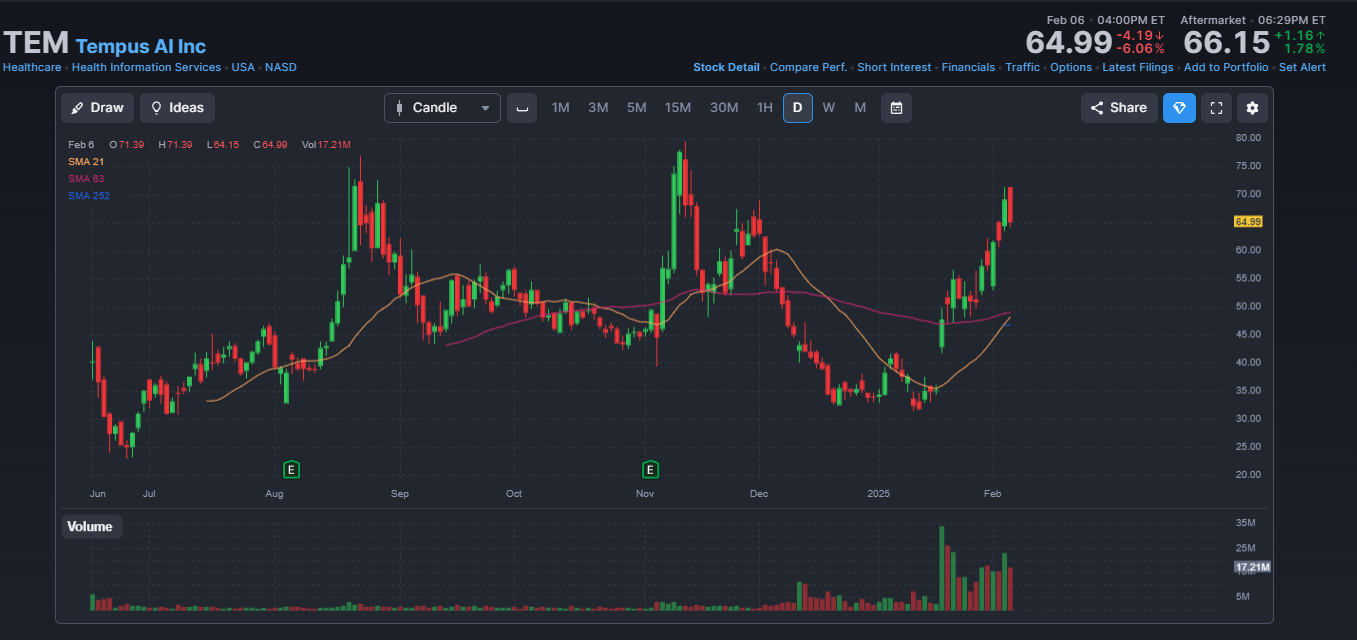
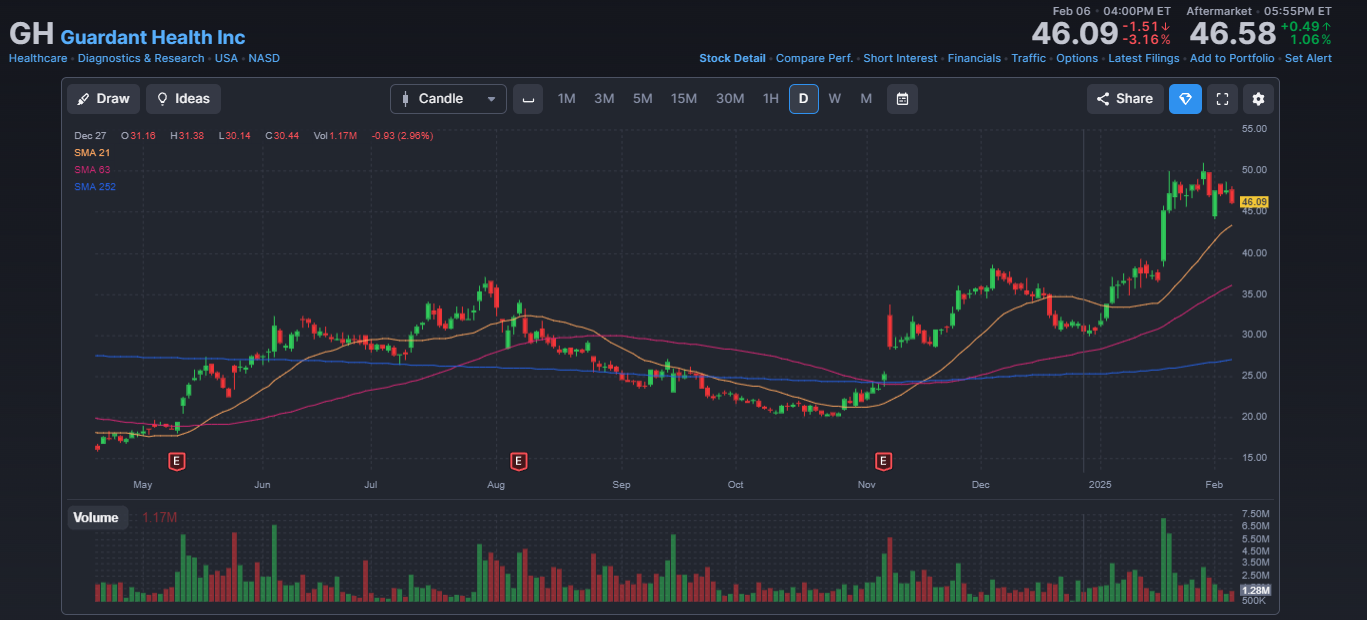 For example, GH, EXAS which develops AI-driven cancer screening technology, as well as BFLY, and TEM. These are all good investment options.
Currently, the number of investors in healthcare AI stocks is relatively small.
#$Guardant Health Inc. Common Stock(GH)#$Butterfly Network Inc.(BFLY)#$Tempus AI Inc. Class A Common Stock(TEM)