
The Great Inflation Expectation Divide: What's Behind the Chaos?

Shearing sheep
February 11, 2025
GoGPT Summarizes Articles
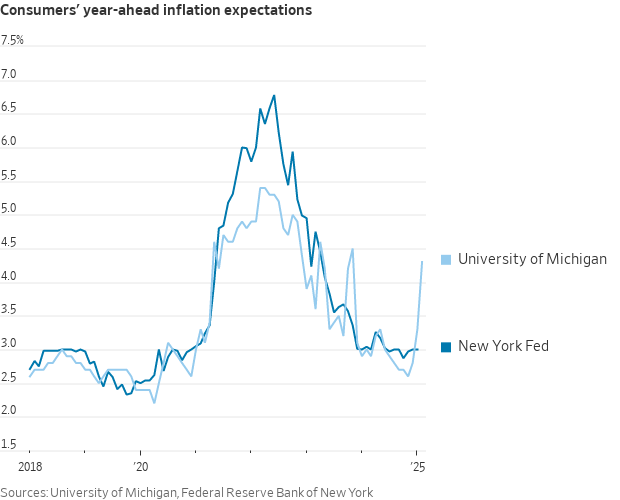
This week, as Fed Chair Powell is set to deliver his semiannual testimony and the January CPI data is about to drop, the focus on U.S. inflation is seriously heating up.
What's causing all the fuss? It's mostly due to a strange divergence in two major inflation expectation surveys—the University of Michigan's Consumer Confidence Index and the New York Federal Reserve's survey. Over the last couple of trading days, these two reports have been heading in completely different directions, and that's something we don't see often.
Let's break it down:
1. University of Michigan's Survey – Last Friday, this one revealed consumer confidence index not only hit a seven-month low, but one-year inflation expectations skyrocketed to 4.3%, up from 3.3% in December. That's a huge jump, and it caught a lot of traders off guard. Bond markets immediately reacted, with some even pricing in the possibility that the Fed might only cut rates once in 2025.
2. New York Fed's Survey – But then, on Monday, the New York Fed came out with their survey, and it told a completely different story. While their five-year inflation expectations rose to 3% (the highest since May 2024), their one- and three-year expectations held steady at 3%. So, on one hand, Michigan is screaming, "Inflation is coming!" and on the other, the New York Fed is like, "Eh, it's fine."
As you might expect, this divergence has sparked debate over which survey is more reliable.
Why the Divergence?
Here's where it gets interesting. The University of Michigan's survey revealed a massive partisan split. Democrats are predicting one-year inflation at a runaway 5.1%, while Republicans are expecting it to drop to 0.0%. Yes, you read that right—zero. This stark divide suggests that political bias is heavily influencing these expectations. Democrats seem convinced that Trump's policies will lead to chaos and soaring inflation, while Republicans are almost blindly optimistic that he'll fix everything.
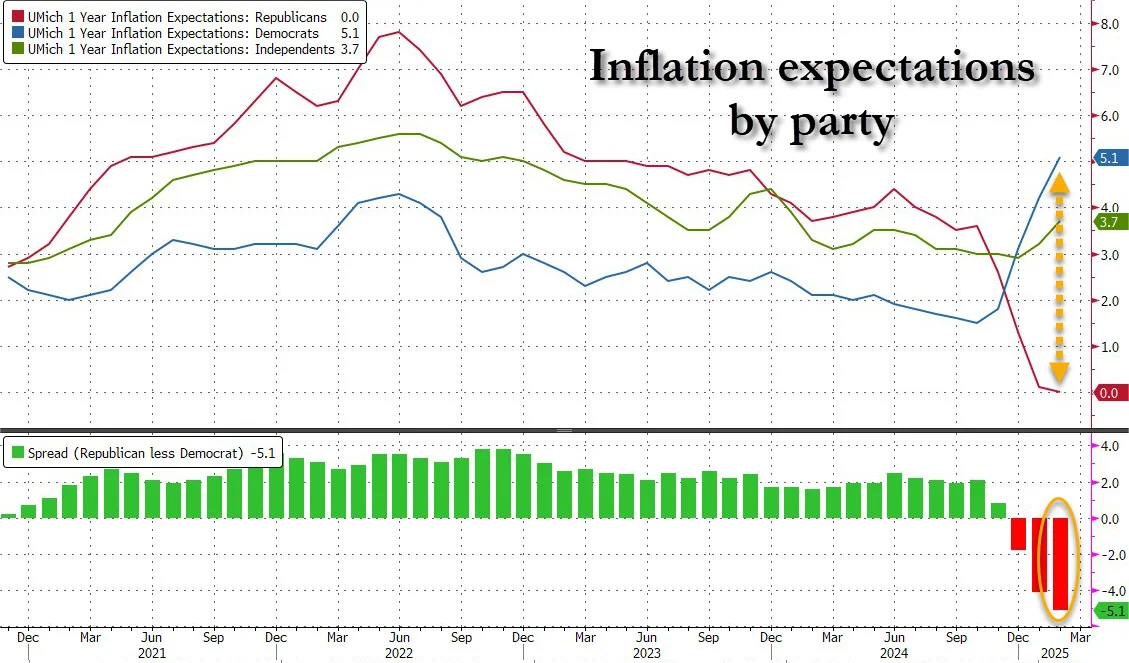
Now, I'm not dismissing the Michigan survey, but when you see numbers like that, it's tough not to take them with a grain of salt. On the flip side, the New York Fed's survey, while more "official," isn't without its own issues. Their data shows that respondents expect price increases across the board—gas, food, medical costs, rent, you name it. And the gap between the 25th and 75th percentile expectations is the widest it's been since mid-2023. That's not exactly reassuring.
What does this all mean for the market?
Despite the mixed signals, the bond market seems to be leaning toward the "inflation is coming" narrative. On Monday, after Trump floated the idea of new tariffs, bond investors started betting that the Fed will face renewed inflationary pressures. In simple terms, inflation expectations are higher for the short term compared to the long term, which is pretty unusual. The five-year breakeven inflation rate hit 2.64%, which is 27 basis points higher than the 30-year rate—the largest gap since 2023. Historically, long-term inflation expectations are usually higher than short-term ones, but right now, the market is pricing in more near-term risk.
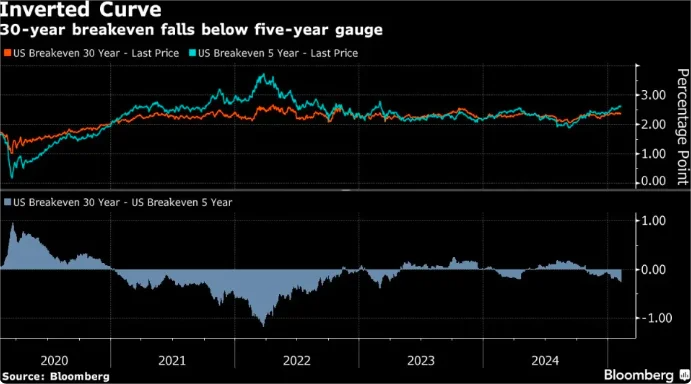
This makes sense when you consider Trump's tariff threats. Tariffs tend to have an immediate impact on prices, but their long-term effects are less clear. Deutsche Bank's interest rate strategist, Stephen, pointed out that the breakeven rate fluctuations suggest tariffs will cause short-term price spikes without undermining long-term inflation expectations. Still, the risk of stagflation—a combo of high inflation and stagnant growth—is looming.
Now, the market is nervous. The divergence in inflation expectations, the partisan split in the Michigan survey, and the bond market's reaction all point to a lot of uncertainty. Trump's tariff threats are adding fuel to the fire, and while the New York Fed's data is more stable, it's not exactly calming anyone down.
If tariffs do go into effect, we could see a short-term inflationary spike, but the bigger concern is the potential for stagflation. Apollo Global Management's chief economist, Torsten Sløk, warned that a full-blown trade war could deliver a "stagflation shock" to the U.S. economy. And EY's Greg Daco estimates that tariffs could shrink GDP by 1.5 to 2.1 percentage points in 2025 and 2026, while pushing inflation up by 0.7 percentage points.
So, what does this all mean for us as investors?
Stay vigilant. The market is clearly pricing in some near-term risks, but the long-term picture is still murky. Keep an eye on how the Fed reacts to these inflation expectations, and watch for any concrete moves on tariffs. If Trump follows through, we could be in for a bumpy ride. #inflation
#inflation